Experiencer, Helper, or Observer: Online Fraud Intervention for Older Adults Through Role-based Simulation
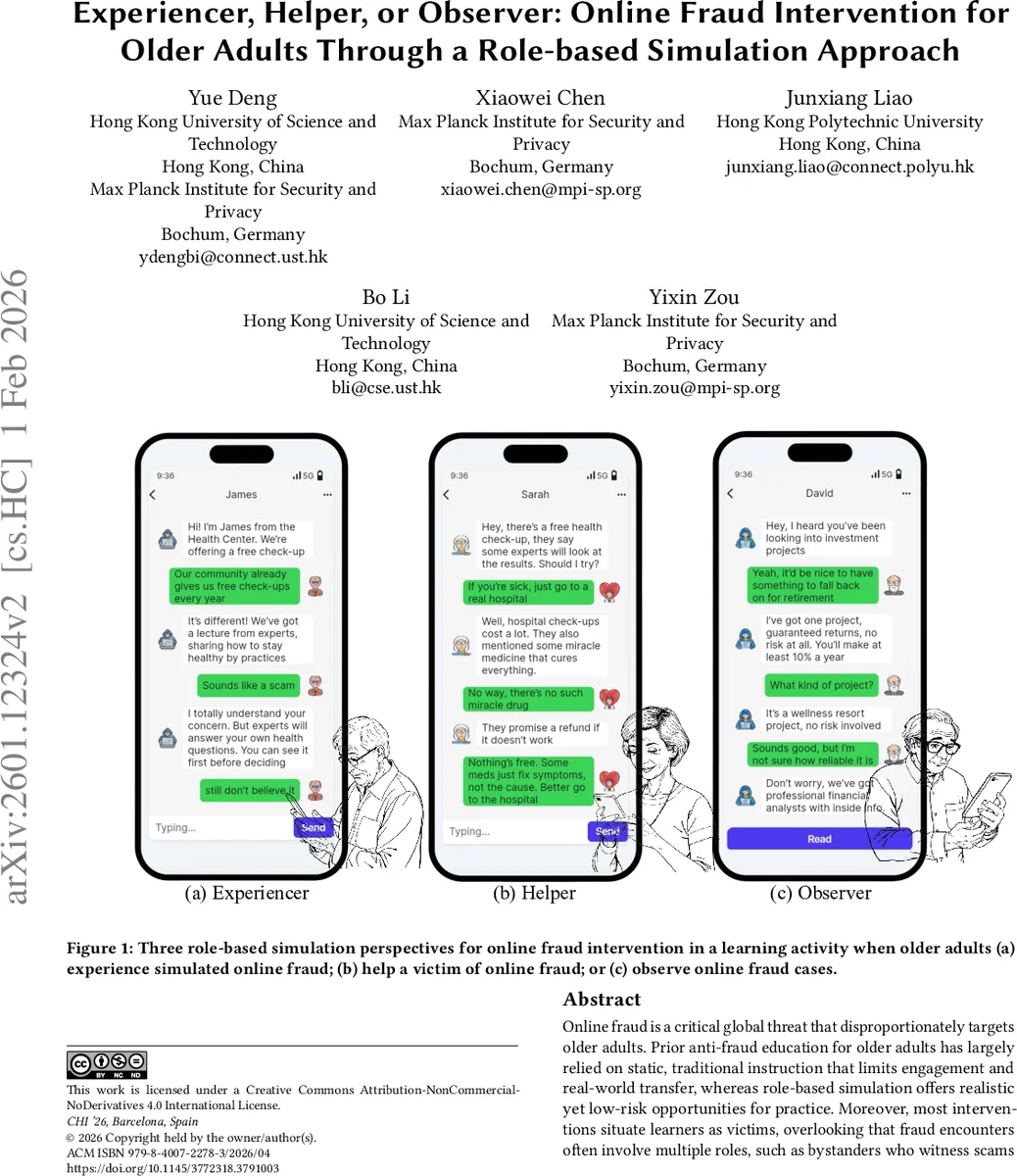
Online fraud is a critical global threat that disproportionately targets older adults. Prior anti-fraud education for older adults has largely relied on static, traditional instruction that limits engagement and real-world transfer, whereas role-based simulation offers realistic yet low-risk opportunities for practice. Moreover, most interventions situate learners as victims, overlooking that fraud encounters often involve multiple roles, such as bystanders who witness scams and helpers who support victims. To address this gap, we developed ROLESafe, an anti-fraud educational intervention in which older adults learn through different learning roles, including Experiencer (experiencing fraud), Helper (assisting a victim), and Observer (witnessing fraud). In a between-subjects study with 144 older adults in China, we found that the Experiencer and Helper roles significantly improved participants’ ability to identify online fraud. These findings highlight the promise of role-based, multi-perspective simulations for enhancing fraud awareness among older adults and provide design implications for future anti-fraud education.
💡 Research Summary
The paper addresses the growing problem of online fraud targeting older adults, noting that traditional anti‑fraud education (lectures, pamphlets, static media) offers limited engagement and poor transfer to real‑world situations. To overcome these shortcomings, the authors designed ROLESafe, a role‑based simulation platform that places participants in one of three perspectives: Experiencer (directly interacting with a simulated scammer), Helper (convincing a simulated victim not to fall for the scam), and Observer (watching a pre‑generated scam conversation). The simulation uses a large language model (LLM) to generate realistic scam dialogues, ensuring ecological validity while keeping the experience low‑risk.
A between‑subjects experiment recruited 144 Chinese seniors (aged 60‑75) and randomly assigned them to the three role conditions or a control group that received static educational material. Participants completed a pre‑test measuring their ability to identify fraud cues (e.g., urgency, authority appeal, too‑good‑to‑be‑true offers), engaged with the assigned simulation for about 20 minutes, and then completed a post‑test. A follow‑up test was administered two weeks later. Additional measures captured usability, satisfaction, and qualitative feedback through semi‑structured interviews.
Statistical analysis (ANOVA with Tukey post‑hoc tests) revealed that both the Experiencer and Helper groups significantly outperformed the control group on post‑test fraud‑cue identification (p < .01, medium effect sizes). Moreover, the Helper condition yielded higher scores than the Observer condition (p < .05), suggesting that the “learning‑by‑teaching” dynamic inherent in the Helper role deepens understanding more than passive observation. All simulation groups reported higher engagement and satisfaction than the control condition. However, the two‑week follow‑up showed no significant differences among groups, indicating that the gains were short‑lived without reinforcement.
Qualitative interviews highlighted several themes. Participants praised the realism and immersion of the role‑play, especially noting that helping a victim forced them to articulate why a message was suspicious, thereby solidifying their knowledge. Some users found the interface initially cumbersome, and a few reported that the LLM‑generated dialogue occasionally sounded unnatural, pointing to areas for UI and AI refinement.
The authors situate their contributions within three learning theories: Experiential Learning (concrete experience via Experiencer), Learning by Teaching (Helper), and Social Learning (Observer). By empirically comparing these perspectives, the study demonstrates that multi‑role simulations can be more effective than single‑role or static approaches for older adults. The paper also contributes a scalable, low‑cost method for generating up‑to‑date scam scenarios using LLMs, which can be adapted across cultures and languages.
Limitations include the homogenous Chinese sample, short follow‑up period, and potential usability barriers for less tech‑savvy seniors. Future work is suggested to test the approach in diverse cultural contexts, incorporate gamification or spaced‑repetition reminders to sustain learning, and explore longer‑term outcomes such as actual reduction in fraud victimization.
In conclusion, ROLESafe shows that role‑based, multi‑perspective simulation is a promising avenue for enhancing fraud awareness among older adults, with the Helper role offering the strongest immediate learning gains. The study advances HCI and security research by providing both theoretical insight and a practical, adaptable educational tool.
Comments & Academic Discussion
Loading comments...
Leave a Comment