Constructing bounded orbits of special types on homogeneous spaces
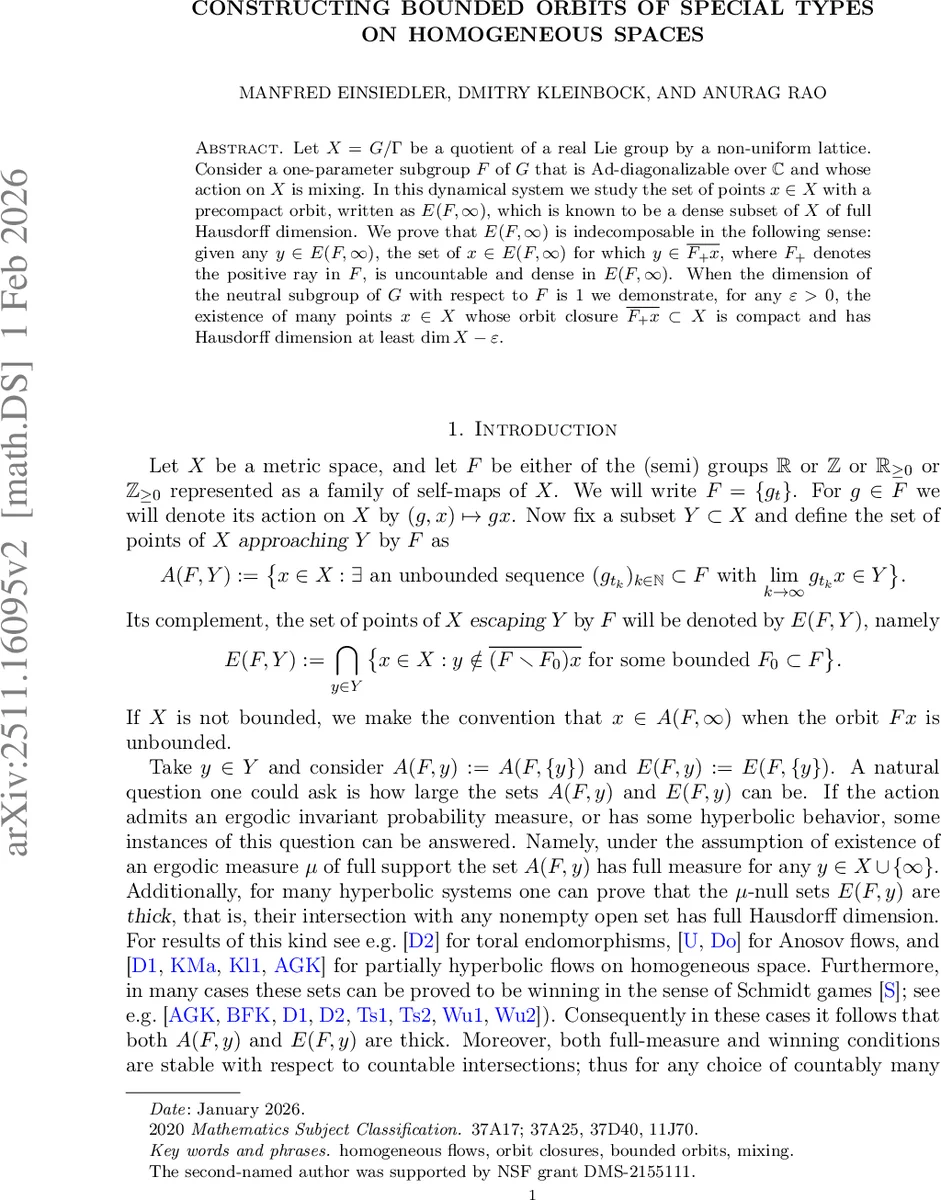
Let $X = G/Γ$ be a quotient of a real Lie group by a non-uniform lattice. Consider a one-parameter subgroup $F$ of $G$ that is $\operatorname{Ad}$-diagonalizable over $\mathbb{C}$ and whose action on $(X,m_X)$ is mixing. In this dynamical system we study the set of points $x \in X$ with a precompact orbit, written as $E(F,\infty)$, which is known to be a dense subset of $X$ of full Hausdorff dimension. We prove that $E(F,\infty)$ is indecomposable in the following sense: given any $y \in E(F,\infty)$, the set of $x \in E(F,\infty)$ for which $y \in \overline{F_+x}$, where $F_+$ denotes the positive ray in $F$, is uncountable and dense in $E(F,\infty)$. When the dimension of the neutral subgroup of $G$ with respect to $F$ is $1$ we demonstrate, for any $\varepsilon>0$, the existence of many points $x \in X$ whose orbit closure $\overline{F_+x} \subset X$ is compact and has Hausdorff dimension at least $\dim X - \varepsilon$.
💡 Research Summary
The paper investigates the dynamics of a one‑parameter subgroup F = {gₜ = exp(t a₀)} acting on a homogeneous space X = G/Γ, where G is a real Lie group and Γ a non‑uniform lattice. The subgroup is assumed to be Ad‑diagonalizable over ℂ and to act mixingly with respect to the G‑invariant probability measure m_X. The central object of study is the set
E(F,∞) = { x ∈ X : the F‑orbit of x is pre‑compact },
which is known to be dense and to have full Hausdorff dimension.
The authors introduce a new structural property: indecomposability. For any fixed y ∈ E(F,∞), the set of points x ∈ E(F,∞) whose forward orbit F₊ has y in its closure is uncountable and dense in E(F,∞). This goes beyond the usual “thick” or “winning” properties obtained via Schmidt games, showing a strong internal connectivity of E(F,∞).
The Lie algebra 𝔤 is split according to the real parts of the eigenvalues of ad a₀ into expanding (𝔥), neutral (𝔫), and contracting (𝔥₋) subspaces, giving rise to connected subgroups H, Z, H₋. The expanding subgroup H is nilpotent, unimodular, and simply connected; the neutral subgroup Z is the centralizer of a₀. The conjugation map Φₜ(g) = gₜ g gₜ⁻¹ acts by expanding H, contracting H₋, and preserving Z. Lemma 2.4 quantifies these dynamics: as t → −∞, Φₜ shrinks H to the identity; as t → +∞, Φₜ shrinks H₋; while Z remains uniformly bounded under Φₜ.
A key ingredient is the equidistribution of gₜ‑translates of H‑orbits, a consequence of mixing (Proposition 3.1). For any bounded measurable set V ⊂ H, any compact set Q ⊂ X with smooth boundary, and any compact L ⊂ X, there exists t₀ such that for all t > t₀ and all x ∈ L, a proportion of points in V are sent by gₜ into Q close to the product m_H(V)·m_X(Q). This uniform distribution allows the construction of “tree‑like” subsets of H with prescribed visiting properties.
The main quantitative result (Theorem 1.3) states that for any non‑empty open U ⊂ X and any y ∈ E(F,∞),
dim (U ∩ A(F₊, y) ∩ E(F₊, ∞)) ≥ dim X − dim Z + 1,
where A(F₊, y) denotes points whose forward F‑orbit accumulates at y. The proof proceeds by selecting a base point x₀ ∈ U, constructing a local diffeomorphism φ from a product of small balls in Z, H₋, H onto U, and then applying Theorem 2.5 (a technical statement about thick subsets of H) to obtain a set S ⊂ H of full dimension such that each h ∈ S produces a point hx₀ with the desired properties. Using the contraction/expansion estimates for Φₜ and the dimension estimate Lemma 2.6 (a Marstrand‑type projection theorem), the authors lift the dimension from H to the whole space, yielding the claimed lower bound.
When the neutral subgroup has dimension 1 (i.e., dim Z = 1), the bound becomes dim X, and the authors obtain stronger statements. Theorem 1.4 shows that for any compact F‑invariant subset B ⊂ E(F,∞), there exists a thick set of points x with B ⊂ F₊ x. Consequently, Corollary 1.5 guarantees, for any ε > 0, a thick set of points whose forward orbit closure is compact and has Hausdorff dimension at least dim X − ε. This generalizes earlier results for SL(2,ℝ)/SL(2,ℤ) and provides new examples in higher‑rank settings such as SL(2,ℝ)⋉ℝ² with the lattice SL(2,ℤ)⋉ℤ².
The paper’s methodology blends several sophisticated tools: Lie‑theoretic decomposition, quantitative mixing, equidistribution of expanding horospherical subgroups, and fine dimension theory (Marstrand projections). By doing so, it not only extends known “thick” and “winning” results but also reveals a deeper indecomposable structure of the set of bounded orbits. The results have immediate implications for Diophantine approximation (e.g., constructing numbers that are badly approximable yet not improvable with respect to certain norms) and for the study of orbit closures in homogeneous dynamics. Future directions suggested include handling neutral subgroups of higher dimension, exploring non‑mixing flows, and investigating analogous indecomposability phenomena in other dynamical contexts.
Comments & Academic Discussion
Loading comments...
Leave a Comment