Lecture notes on the symplectic geometry of graded manifolds and higher Lie groupoids
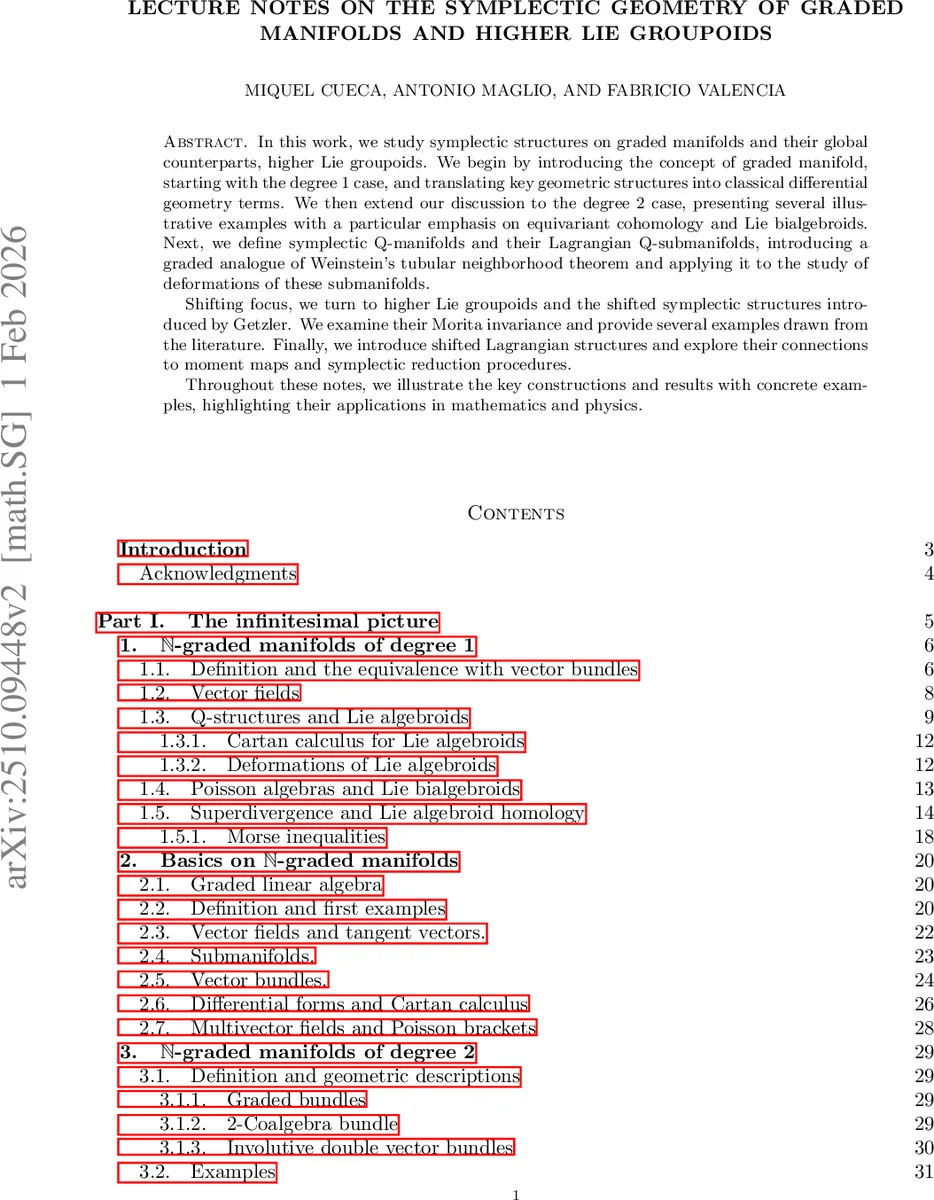
In this work, we study symplectic structures on graded manifolds and their global counterparts, higher Lie groupoids. We begin by introducing the concept of graded manifold, starting with the degree 1 case, and translating key geometric structures into classical differential geometry terms. We then extend our discussion to the degree 2 case, presenting several illustrative examples with a particular emphasis on equivariant cohomology and Lie bialgebroids. Next, we define symplectic Q-manifolds and their Lagrangian Q-submanifolds, introducing a graded analogue of Weinstein’s tubular neighborhood theorem and applying it to the study of deformations of these submanifolds. Shifting focus, we turn to higher Lie groupoids and the shifted symplectic structures introduced by Getzler. We examine their Morita invariance and provide several examples drawn from the literature. Finally, we introduce shifted Lagrangian structures and explore their connections to moment maps and symplectic reduction procedures. Throughout these notes, we illustrate the key constructions and results with concrete examples, highlighting their applications in mathematics and physics. These lecture notes are based on two mini-courses delivered by the first author at Geometry in Algebra and Algebra in Geometry VII (2023) in Belo Horizonte, Brazil, and at the INdAM Intensive Period: Poisson Geometry and Mathematical Physics (2024) in Napoli, Italy.
💡 Research Summary
This paper presents comprehensive lecture notes on the symplectic geometry of graded manifolds and higher Lie groupoids, serving as an accessible introduction to these advanced topics. The work is divided into two main parts, reflecting the dual perspectives of “infinitesimal” and “global” pictures prevalent in the field.
Part I, “The infinitesimal picture,” focuses on the theory of N-graded manifolds. It begins by establishing a fundamental equivalence: the category of degree 1 graded manifolds is equivalent to the category of vector bundles. This bridge allows the translation of geometric structures on graded manifolds into classical differential geometry terms. Key structures such as Lie algebroids and Lie bialgebroids are shown to correspond naturally to Q-structures (homological vector fields) on degree 1 and 2 graded manifolds, respectively. The core of this part is the study of symplectic Q-manifolds—graded manifolds equipped with a homological vector field Q compatible with a symplectic structure. The authors demonstrate that symplectic Q-manifolds of degree 1 correspond to Poisson manifolds, while those of degree 2 correspond to Courant algebroids, providing crucial links to established theories. Further topics include Lagrangian Q-submanifolds, a graded analogue of Weinstein’s tubular neighborhood theorem for studying their deformations, and an introduction to the AKSZ construction for topological field theories.
Part II, “The global picture,” shifts to the framework of higher Lie groupoids, which are simplicial manifolds satisfying Kan conditions. The central object here is the concept of an m-shifted symplectic structure on a Lie n-groupoid, pioneered by Getzler. The authors show that this notion is invariant under Morita equivalence, a key property for a robust geometric theory. They provide a wealth of examples, including ordinary symplectic structures on manifolds (0-shifted on Lie 0-groupoids), symplectic groupoids (1-shifted on Lie 1-groupoids), and double symplectic groupoids (2-shifted on Lie 2-groupoids). The integration of Poisson manifolds into symplectic groupoids is revisited in this language. The final chapter introduces shifted Lagrangian structures, which are used to define a “symplectic category” for higher structures. This framework elegantly encapsulates various moment map theories (standard Hamiltonian and quasi-Hamiltonian) and their associated symplectic reduction procedures. The notes conclude by sketching how classical topological field theories, like Chern-Simons theory, can be viewed as functors into this enhanced symplectic category.
Throughout the notes, the authors emphasize concrete examples and applications, particularly from Poisson geometry and mathematical physics, making abstract concepts more tangible. The exposition aims to clarify the relationships between different frameworks (Q-manifolds, higher Lie groupoids, and n-stacks) used to study higher structures, positioning symplectic geometry as a unifying thread. The work is pedagogical in nature, synthesizing results from the literature without presenting original theorems, and is based on mini-courses delivered by the first author.
Comments & Academic Discussion
Loading comments...
Leave a Comment