Analytic Scalar Field Theory
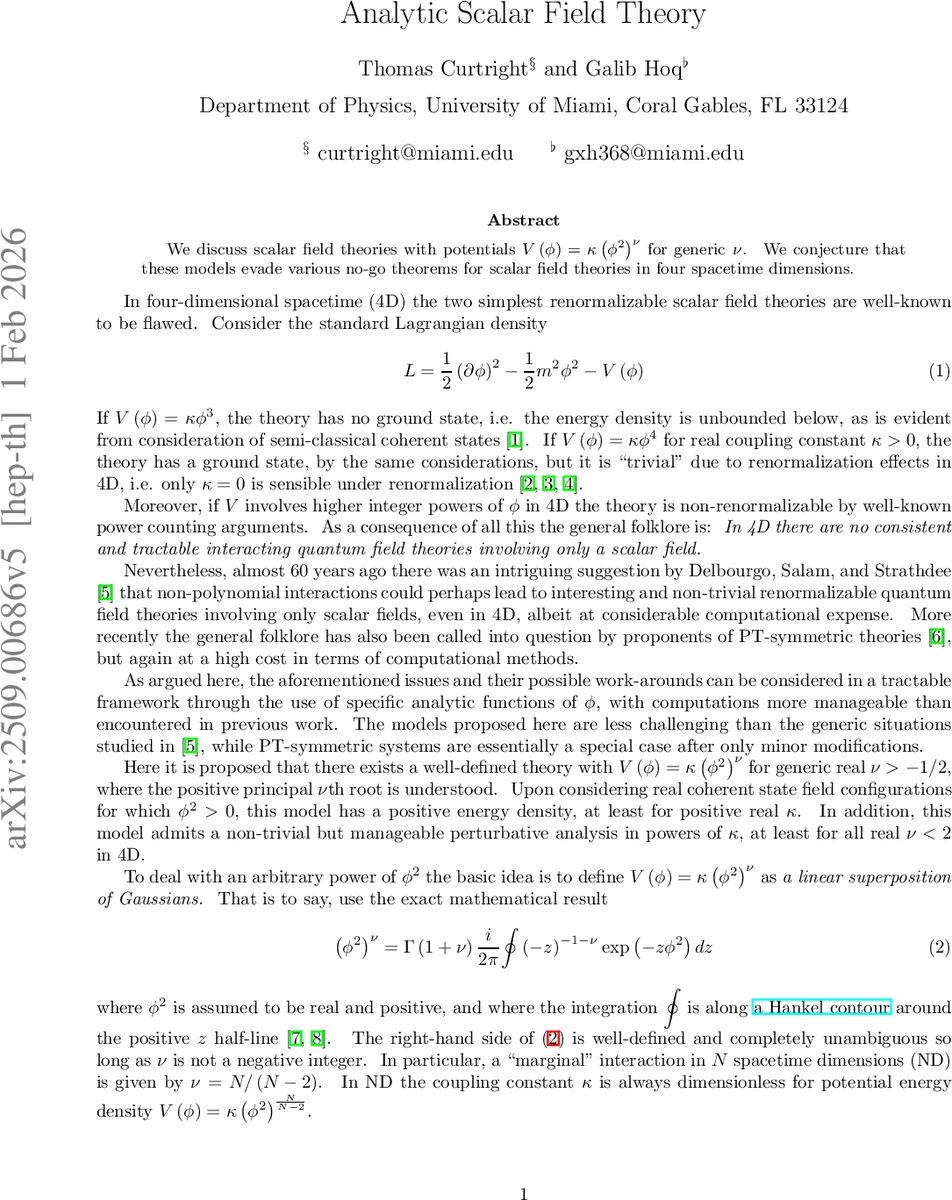
We discuss scalar field theories with potentials V(ϕ)=\k{appa}(ϕ^2)^{ν} for generic ν. We conjecture that these models evade various no-go theorems for scalar fields in four spacetime dimensions.
💡 Research Summary
The paper revisits the long‑standing belief that interacting scalar quantum field theories in four dimensions are either trivial or non‑renormalizable. Starting from the standard Lagrangian with polynomial interactions (φ³, φ⁴, etc.), the authors point out the well‑known problems: an unbounded energy spectrum for a cubic term, triviality of the quartic coupling, and the failure of power‑counting for higher powers. Inspired by early work of Delbourgo, Salam and Strathdee, they propose a non‑polynomial potential of the form
V(φ)=κ (φ²)^ν, with real ν > −½.
The key technical step is to represent the fractional power (φ²)^ν as a linear superposition of Gaussian exponentials using a Hankel‑contour integral (Eq. 2). This representation is mathematically well‑defined for all non‑negative‑integer ν and for φ² > 0, thereby removing ambiguities associated with branch cuts.
At leading order in the coupling κ, the vacuum expectation value (VEV) of the potential reduces to the free‑field Gaussian moment ⟨φ²⟩^ν multiplied by a coefficient that is an exact combination of Gamma functions:
⟨V(φ)⟩ = 2 ν √π Γ(ν+½) κ ⟨φ²⟩^ν.
Thus quantum corrections at O(κ) amount simply to a redefinition of the coupling, κ_eff = (2 ν Γ(ν+½)/√π) κ, with the full ν‑dependence explicit. The authors verify that this result holds even for some negative powers of φ², provided ν > −½ so that the coefficient remains finite and positive.
The O(κ) correction to the propagator is a mass shift:
Δ(k) = i/(k²−m²−2 ν κ_eff ⟨φ²⟩^{ν−1}),
with momentum‑dependent corrections only appearing at O(κ²). The paper outlines how higher‑order terms can be systematically generated by repeatedly applying the Gaussian superposition (2) and using Stratonovich‑Hubbard transformations or Wick combinatorics. At O(κ²) the VEV of two separated operators yields a hypergeometric function ₂F₁, which satisfies cluster decomposition and reduces to elementary functions for special ν (e.g., ν=3/2).
The authors also explore mixed potentials V(φ)=κ₁(φ²)^{ν₁}+κ₂(φ²)^{ν₂} with 0<ν₁<½. Each term acquires its own effective coupling κ_i^eff, given by distinct Gamma‑function combinations, and the combined VEV is simply the sum of the two contributions. Plots of κ_i^eff/κ_i versus ν_i illustrate the non‑trivial dependence.
Dimensional analysis shows that the mass dimension of κ is
Comments & Academic Discussion
Loading comments...
Leave a Comment