Computational Complexity of Model-Checking Quantum Pushdown Systems
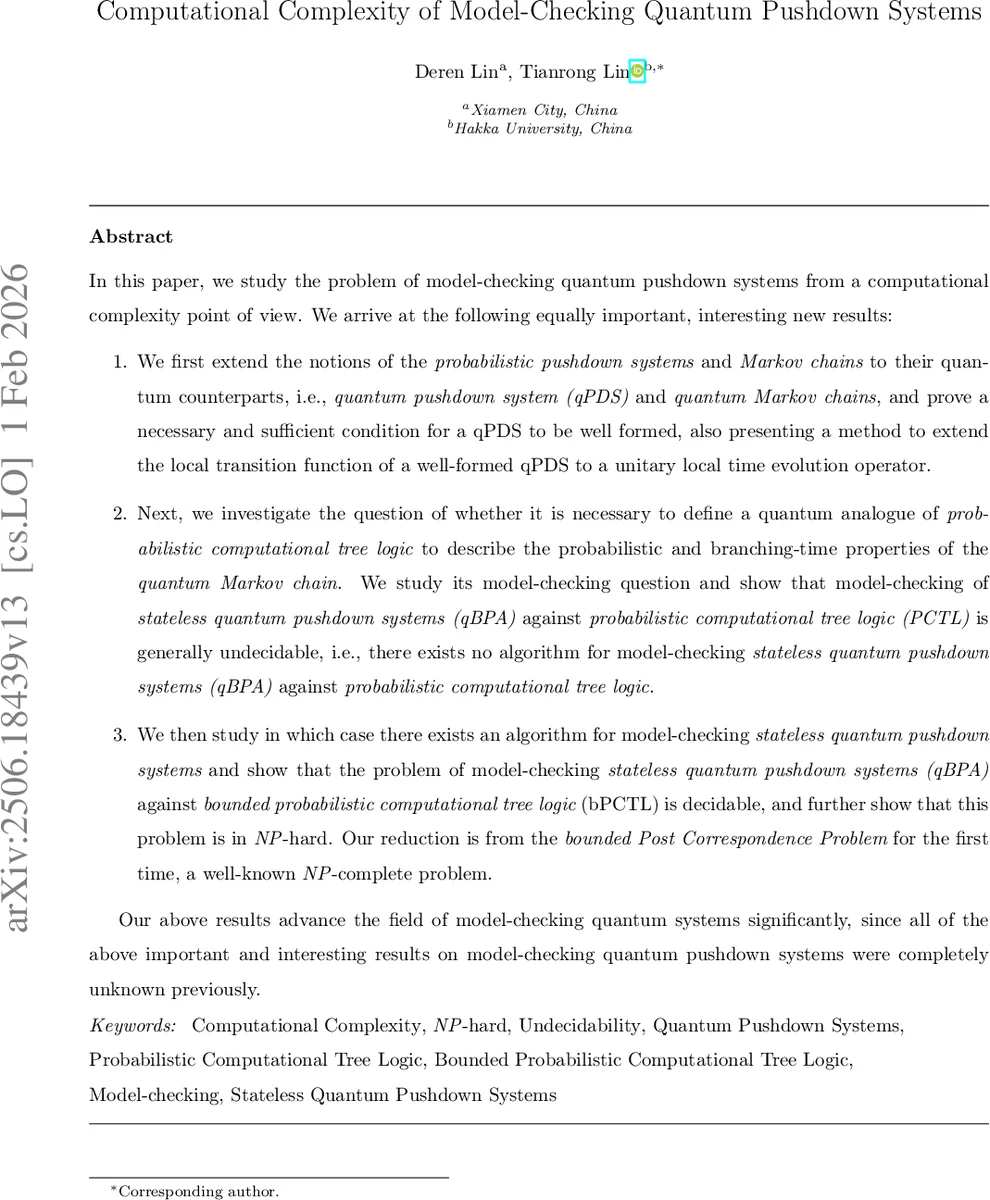
In this paper, we study the problem of model-checking quantum pushdown systems from a computational complexity point of view. We arrive at the following equally important, interesting new results: We first extend the notions of the {\it probabilistic pushdown systems} and {\it Markov chains} to their quantum counterparts, i.e., {\em quantum pushdown system (qPDS)} and {\em quantum Markov chains}, and prove a necessary and sufficient condition for a qPDS to be well formed, also presenting a method to extend the local transition function of a well-formed qPDS to a unitary local time evolution operator. Next, we investigate the question of whether it is necessary to define a quantum analogue of {\it probabilistic computational tree logic} to describe the probabilistic and branching-time properties of the {\it quantum Markov chain}. We study its model-checking question and show that model-checking of {\it stateless quantum pushdown systems (qBPA)} against {\it probabilistic computational tree logic (PCTL)} is generally undecidable, i.e., there exists no algorithm for model-checking {\it stateless quantum pushdown systems (qBPA)} against {\it probabilistic computational tree logic}. We then study in which case there exists an algorithm for model-checking {\it stateless quantum pushdown systems} and show that the problem of model-checking {\it stateless quantum pushdown systems (qBPA)} against {\it bounded probabilistic computational tree logic} (bPCTL) is decidable, and further show that this problem is in $\mathit{NP}$-hard. Our reduction is from the {\it bounded Post Correspondence Problem} for the first time, a well-known $\mathit{NP}$-complete problem.
💡 Research Summary
The paper investigates the computational complexity of model‑checking problems for quantum pushdown systems (qPDS) and the associated quantum Markov chains. It begins by extending the classical notions of probabilistic pushdown systems and Markov chains to the quantum domain. A quantum pushdown system is defined as an infinite‑state system equipped with a stack, where each transition is described by complex amplitudes. The authors introduce a “well‑formed” criterion: a qPDS is well‑formed if and only if its local transition function satisfies the condition of Theorem 4.2, which essentially requires that the local transition matrix be a partial isometry that can be extended to a unitary operator. Theorem 4.5 then gives a constructive method for extending a well‑formed local transition function to a full unitary evolution operator, ensuring compliance with the fundamental quantum mechanical requirement of norm preservation.
Having established a rigorous quantum model, the authors turn to specification languages. Rather than invent a new quantum analogue of probabilistic computational tree logic (PCTL), they argue that ordinary PCTL (and its extension PCTL*) is sufficient for expressing properties of quantum Markov chains, because measurement outcomes are ultimately probabilistic. Using this logic, they prove that the model‑checking problem for stateless quantum pushdown systems (qBPA) against PCTL is undecidable (Theorem 2). This result mirrors known undecidability results for classical probabilistic pushdown systems but is reinforced by the additional non‑determinism introduced by quantum superposition and entanglement. Consequently, model‑checking qBPA against the more expressive PCTL* is also undecidable, and the same holds for the full class of qPDS.
To obtain decidability, the paper introduces bounded probabilistic computational tree logic (bPCTL), which replaces the unrestricted “until” operator with a bounded version (U≤k). This restriction limits the depth of the search space, allowing the verification problem to be reduced to a finite exploration. The authors prove that model‑checking qBPA against bPCTL is decidable, and they further establish NP‑hardness (Theorem 5). The hardness reduction is novel: it is the first use of the bounded Post Correspondence Problem (bounded PCP) – a known NP‑complete problem – to show NP‑hardness of a quantum verification task. By demonstrating a polynomial‑time reduction from bounded PCP to the qBPA‑bPCTL model‑checking problem, they show that any algorithm solving the latter would also solve bounded PCP, implying NP‑hardness.
Because qBPA is a subclass of qPDS, the same decidability and hardness results extend to the full class of quantum pushdown systems. The paper also includes appendices that detail how to modify an ill‑formed qBPA (denoted Ω or Δ) into a well‑formed one, providing concrete algorithms for correcting local transition functions.
In summary, the work makes three major contributions: (1) a formal definition of quantum pushdown systems together with a necessary and sufficient well‑formedness condition and a method to obtain unitary evolution; (2) a proof that model‑checking qBPA (and thus qPDS) against standard PCTL is undecidable; (3) a positive result showing that when the specification logic is restricted to bounded‑until (bPCTL), model‑checking becomes decidable but remains computationally hard (NP‑hard). These findings advance the theory of verification for quantum infinite‑state systems and highlight the delicate balance between expressive power of the specification language and tractability of verification.
Comments & Academic Discussion
Loading comments...
Leave a Comment