Classical mechanics as the high-entropy limit of quantum mechanics
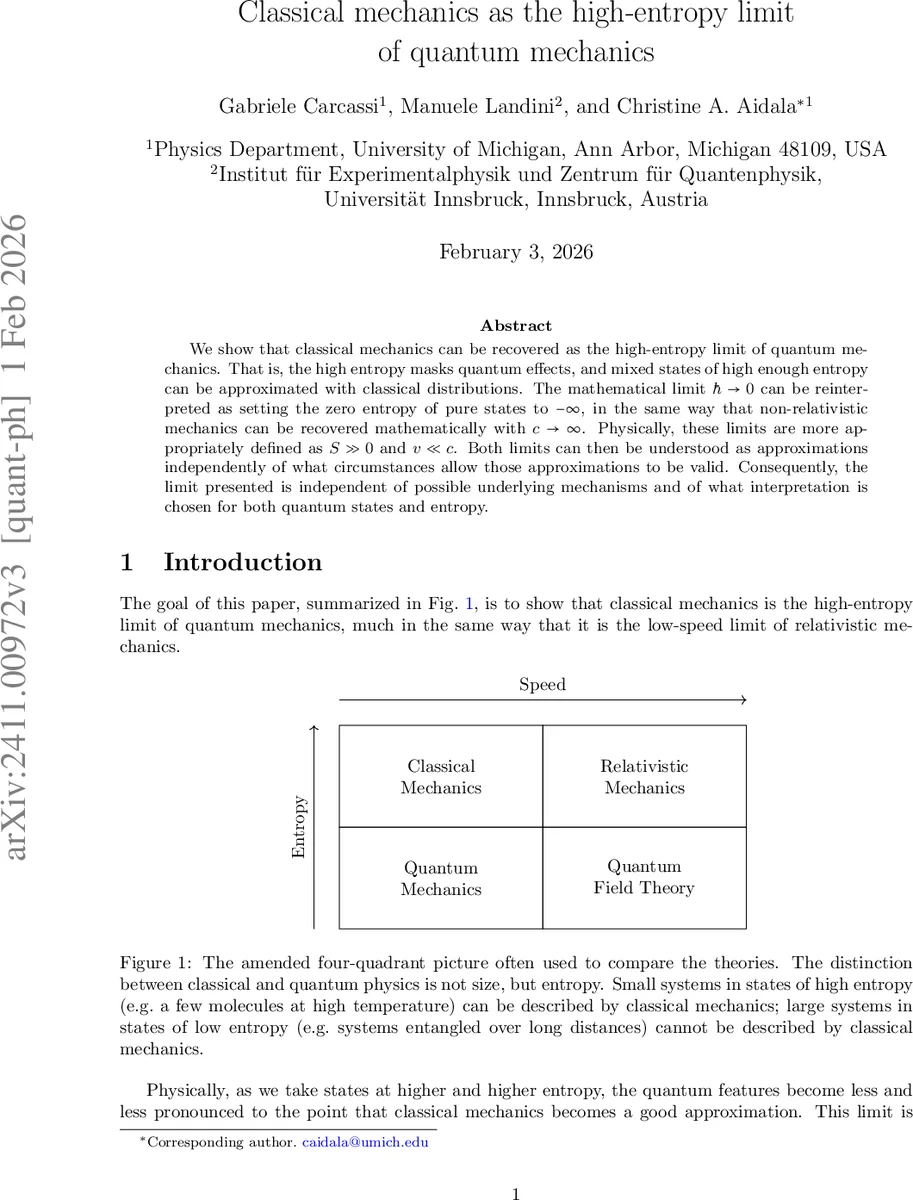
We show that classical mechanics can be recovered as the high-entropy limit of quantum mechanics. That is, the high entropy masks quantum effects, and mixed states of high enough entropy can be approximated with classical distributions. The mathematical limit $\hbar \to 0$ can be reinterpreted as setting the zero entropy of pure states to $-\infty$, in the same way that non-relativistic mechanics can be recovered mathematically with $c \to \infty$. Physically, these limits are more appropriately defined as $S \gg 0$ and $v \ll c$. Both limits can then be understood as approximations independently of what circumstances allow those approximations to be valid. Consequently, the limit presented is independent of possible underlying mechanisms and of what interpretation is chosen for both quantum states and entropy.
💡 Research Summary
The paper puts forward a novel perspective that classical mechanics emerges naturally as the high‑entropy limit of quantum mechanics. Rather than distinguishing the two theories by size or energy scale, the authors argue that the decisive parameter is entropy: when the entropy of a quantum system is sufficiently large, quantum signatures such as coherence and entanglement become effectively invisible, and the system can be described by a classical probability distribution.
The authors begin by establishing a quantitative link between entropy and uncertainty for a single degree of freedom. Gaussian states maximize entropy at fixed uncertainty (or equivalently minimize uncertainty at fixed entropy). They write the classical entropy as (S_C(\Sigma)=\ln\Sigma+1) and the quantum von‑Neumann entropy as a more complicated function of (\Sigma) and (\hbar). Plotting both functions shows that for (\Sigma\gg\hbar) the two curves practically coincide, while for (\Sigma) of order (\hbar) the quantum entropy drops sharply to zero at the Heisenberg bound. This demonstrates that once the phase‑space volume associated with the state is many times larger than (\hbar), the quantum corrections to the uncertainty relation become negligible.
Next, the paper introduces the notion of “entropic aliasing.” Using the two‑slit experiment, the authors show that randomizing the relative phase between the two paths yields the same mixed state as randomizing the path itself: the maximally mixed state (\rho=I/n). In the Bloch sphere picture, states of equal entropy lie on concentric spheres; as entropy grows these spheres shrink toward the centre, making distinct quantum states increasingly indistinguishable. The trace distance between any two states contracts under completely positive trace‑preserving (CPTP) maps that increase entropy, and observables that do not commute for pure states become effectively commuting near the maximally mixed state. Thus, high entropy “aliases” quantum features into classical statistical uncertainty.
Mathematically, the familiar limit (\hbar\to0) is re‑interpreted as sending the entropy of a pure state to (-\infty). In physical terms this corresponds to the condition (S\gg0), exactly analogous to the low‑velocity condition (v\ll c) that underlies the non‑relativistic limit. The authors stress that these limits are not about taking constants to infinity or zero, but about comparing the actual values of physical quantities with the extreme bounds.
The paper then revisits two classic examples. First, the failure of classical statistical mechanics to predict black‑body radiation is recast: the Rayleigh‑Jeans law emerges from the Planck law when the temperature is high (inverse temperature (\beta\to0)) or, equivalently, when the entropy is large. Second, the Wigner function for a thermal state is examined. By expanding the transformed Hamiltonian (\tilde H) in powers of (\beta) rather than (\hbar), the authors show that the first‑order quantum correction vanishes, confirming that the classical distribution is accurate to first order in the high‑entropy (low‑(\beta)) regime. Higher‑order corrections appear only at second order, reinforcing the claim that entropy, not (\hbar), governs the emergence of classical behavior.
The discussion also connects the high‑entropy viewpoint to experimental realities. Decoherence, which inevitably raises entropy, destroys quantum coherence; high temperature, high pressure, or high phase‑space density conditions that increase entropy suppress phenomena such as superconductivity, the quantum Hall effect, or Bose‑Einstein condensation. Conversely, low‑entropy conditions (low temperature, low pressure) are required to observe these quantum effects.
In conclusion, the authors propose that classical mechanics should be understood not as the (\hbar\to0) limit of quantum mechanics but as the regime where the system’s entropy is much larger than the minimal quantum entropy. This reinterpretation is independent of any particular quantum interpretation or underlying mechanism and aligns the classical limit with the well‑established non‑relativistic limit. By framing the quantum‑to‑classical transition in terms of entropy, the paper offers a unifying, physically transparent picture that bridges statistical mechanics, quantum decoherence, and the traditional mathematical limits of (\hbar) and (c).
Comments & Academic Discussion
Loading comments...
Leave a Comment