A new model for two-layer liquid-gas stratified flows in pipes with general cross sections
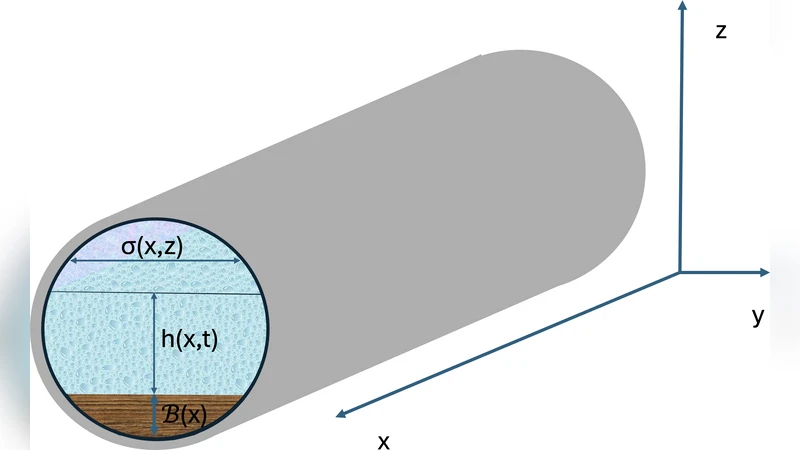
In this work, we derive a new model for immiscible two-layer gas-liquid stratified flows in pipes with general cross sections. The bottom layer is occupied by an incompressible fluid in liquid phase with hydrodynamics based on a hydrostatic pressure, following a shallow water approximation. The top layer is occupied by a compressible gas, following an ideal gas law leading to conservation of mass, momentum and energy. The two subsystems are linked through non-conservative products, representing momentum and energy exchanges between layers. The hyperbolic properties of the resulting model are analyzed, including the derivation of entropy inequalities, and the approximations of eigenvalues of the corresponding coefficient matrix. Numerical tests are included to demonstrate the merits of the model and the numerical approximations, including well-balancedness, Riemann problems, and perturbations and convergence toward steady states at rest. Besides simulations of water and air where the density difference between layers is significant, a case where such difference is not so pronounced (like gas and liquid hydrogen) is also shown.
💡 Research Summary
The paper introduces a novel one‑dimensional model for immiscible two‑layer gas‑liquid stratified flow in pipes with arbitrary cross‑section shapes. The lower layer, representing an incompressible liquid, is described by a shallow‑water approximation that assumes hydrostatic pressure distribution in the vertical direction. This yields mass and momentum balance equations expressed in terms of the cross‑sectional area and the depth‑averaged velocity, while gravity‑induced pressure gradients are retained exactly. The upper layer, occupied by a compressible gas, follows the ideal‑gas law and obeys the full set of conservation equations for mass, momentum, and energy. Interaction between the layers is modeled through non‑conservative product terms that account for interfacial shear, pressure transmission, and heat exchange.
A rigorous mathematical analysis demonstrates that the coupled system is hyperbolic: the Jacobian matrix possesses a complete set of real eigenvalues, which are approximated analytically in terms of geometric parameters, layer velocities, densities and pressures. These approximations provide explicit wave‑speed estimates for acoustic, surface and shear modes, facilitating stability assessments in engineering design. Entropy inequalities are derived, proving that the model respects the second law of thermodynamics and quantifying the entropy production associated with the non‑conservative coupling.
The authors validate the formulation with a series of numerical tests. A well‑balanced scheme is constructed to preserve stationary hydrostatic equilibria, and its capability is verified by perturbing a resting state and observing the correct recovery. Riemann problems illustrate the model’s ability to capture shock and rarefaction waves across the interface. Convergence studies confirm second‑order accuracy toward steady solutions. Two physical configurations are examined: a water‑air system with a large density contrast and a gas‑liquid hydrogen system where the contrast is modest. In both cases the model accurately predicts pressure, velocity and temperature fields, and demonstrates robust convergence even when the density difference is small.
Overall, the work delivers a comprehensive, thermodynamically consistent framework for stratified pipe flows with general cross sections, extending beyond traditional two‑fluid models that are limited to circular pipes or assume negligible compressibility. The analytical eigenvalue estimates and entropy analysis provide valuable tools for designers, while the numerical experiments showcase the model’s practical applicability to a wide range of industrial scenarios, from conventional water‑air pipelines to cryogenic hydrogen transport. Future extensions may incorporate viscous shear, turbulent mixing, and three‑dimensional effects to further enhance predictive capability.
Comments & Academic Discussion
Loading comments...
Leave a Comment