LMTE: Putting the "Reasoning" into WAN Traffic Engineering with Language Models
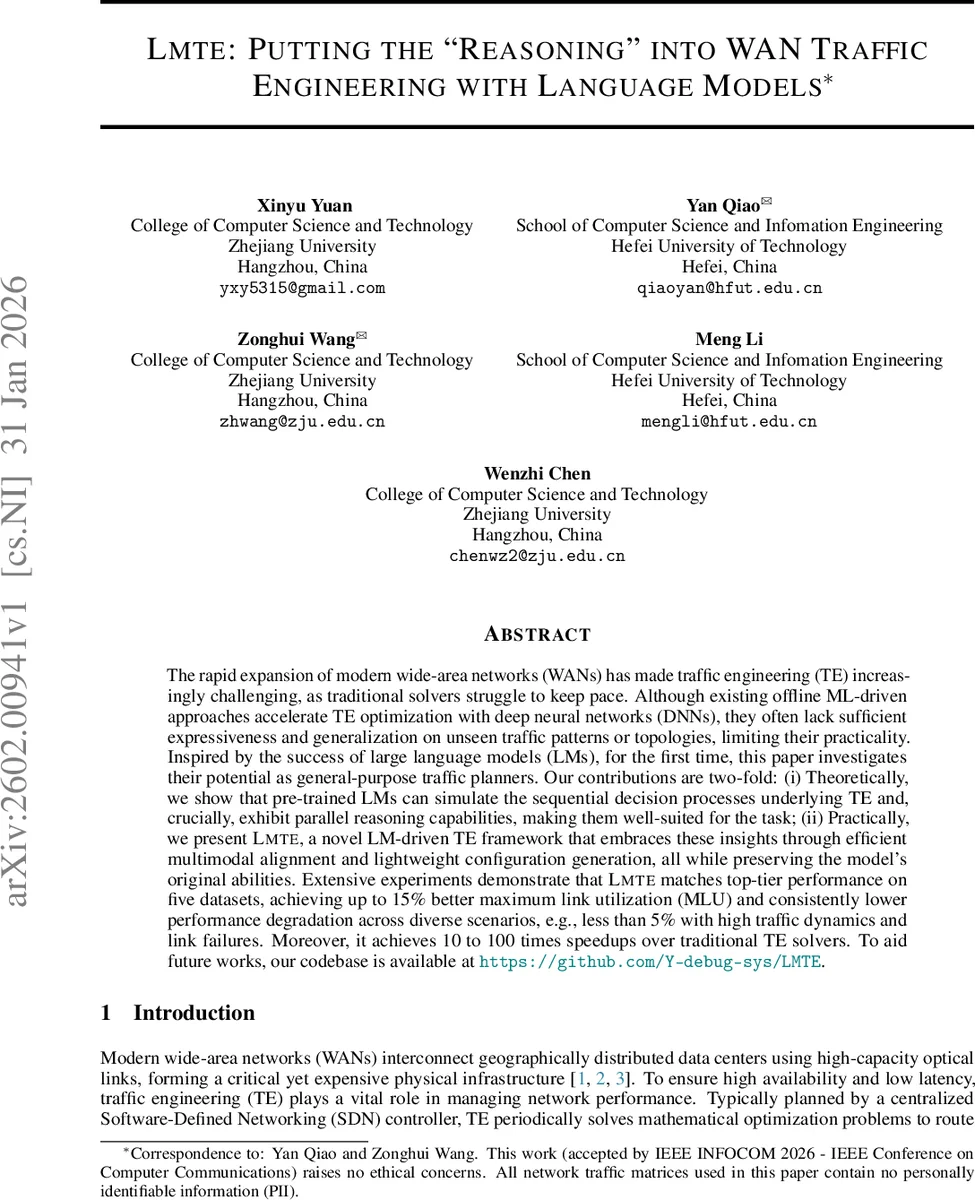
The rapid expansion of modern wide-area networks (WANs) has made traffic engineering (TE) increasingly challenging, as traditional solvers struggle to keep pace. Although existing offline ML-driven approaches accelerate TE optimization with deep neural networks (DNNs), they often lack sufficient expressiveness and generalization on unseen traffic patterns or topologies, limiting their practicality. Inspired by the success of large language models (LMs), for the first time, this paper investigates their potential as general-purpose traffic planners. Our contributions are two-fold: (i) Theoretically, we show that pre-trained LMs can simulate the sequential decision processes underlying TE and, crucially, exhibit parallel reasoning capabilities, making them well-suited for the task; (ii) Practically, we present LMTE, a novel LM-driven TE framework that embraces these insights through efficient multimodal alignment and lightweight configuration generation, all while preserving the model’s original abilities. Extensive experiments demonstrate that fold matches top-tier performance on five datasets, achieving up to 15% better maximum link utilization (MLU) and consistently lower performance degradation across diverse scenarios, e.g., less than 5% with high traffic dynamics and link failures. Moreover, it achieves 10 to 100 times speedups over traditional TE solvers. To aid future works, our codebase is available at https://github.com/Y-debug-sys/LMTE.
💡 Research Summary
The paper introduces LMTE, the first traffic‑engineering (TE) framework that leverages large pre‑trained language models (LMs) as general‑purpose planners for wide‑area networks (WANs). Recognizing that TE can be expressed as a sequential decision process, the authors model the problem as a deterministic automaton whose states are routing configurations (split ratios) and whose inputs are origin‑destination (OD) pairs together with traffic demands. They prove that a transformer‑based LM can approximate the automaton’s transition function with only logarithmic depth, effectively compressing many iterative optimization steps into a few parallel reasoning steps. This theoretical insight explains why LMs, despite being trained on natural language, can generalize to unseen traffic patterns and topologies when provided with appropriate multimodal inputs.
Practically, LMTE aligns topology graphs and traffic matrices to textual representations via cross‑attention between multimodal encoders and the frozen LM backbone. A lightweight domain‑aware prompt template guides the LM to interpret TE tasks, while a shared head network predicts per‑router split ratios. Only about 1 % of the LM’s parameters are fine‑tuned, making adaptation far cheaper than full fine‑tuning or LoRA‑style methods. The system offloads most computation to the cloud, keeping the on‑device footprint minimal.
Extensive experiments on five datasets—including three real WANs (e.g., GÉANT, Abilene) and two large synthetic topologies—show that LMTE consistently outperforms state‑of‑the‑art TE solvers. It achieves up to 15 % lower maximum link utilization (MLU) and an average 10 % improvement over the best baselines. Under challenging conditions such as link failures, abrupt traffic bursts, and distributional drift, LMTE’s performance degrades by less than 5 %, whereas competing methods suffer larger losses. Moreover, LMTE delivers 10–100× speed‑ups compared with traditional linear‑programming solvers, while requiring only a fraction of the trainable parameters.
In summary, the work demonstrates that the reasoning capabilities of large language models can be harnessed for complex network optimization tasks, offering superior generalization, efficiency, and scalability. The authors release their code and data publicly, paving the way for future research at the intersection of LMs and network engineering.
Comments & Academic Discussion
Loading comments...
Leave a Comment