Edge-Native Generative De-identification: Inversion-Free Flow for Privacy-Preserving Federated Skin Image Analysis
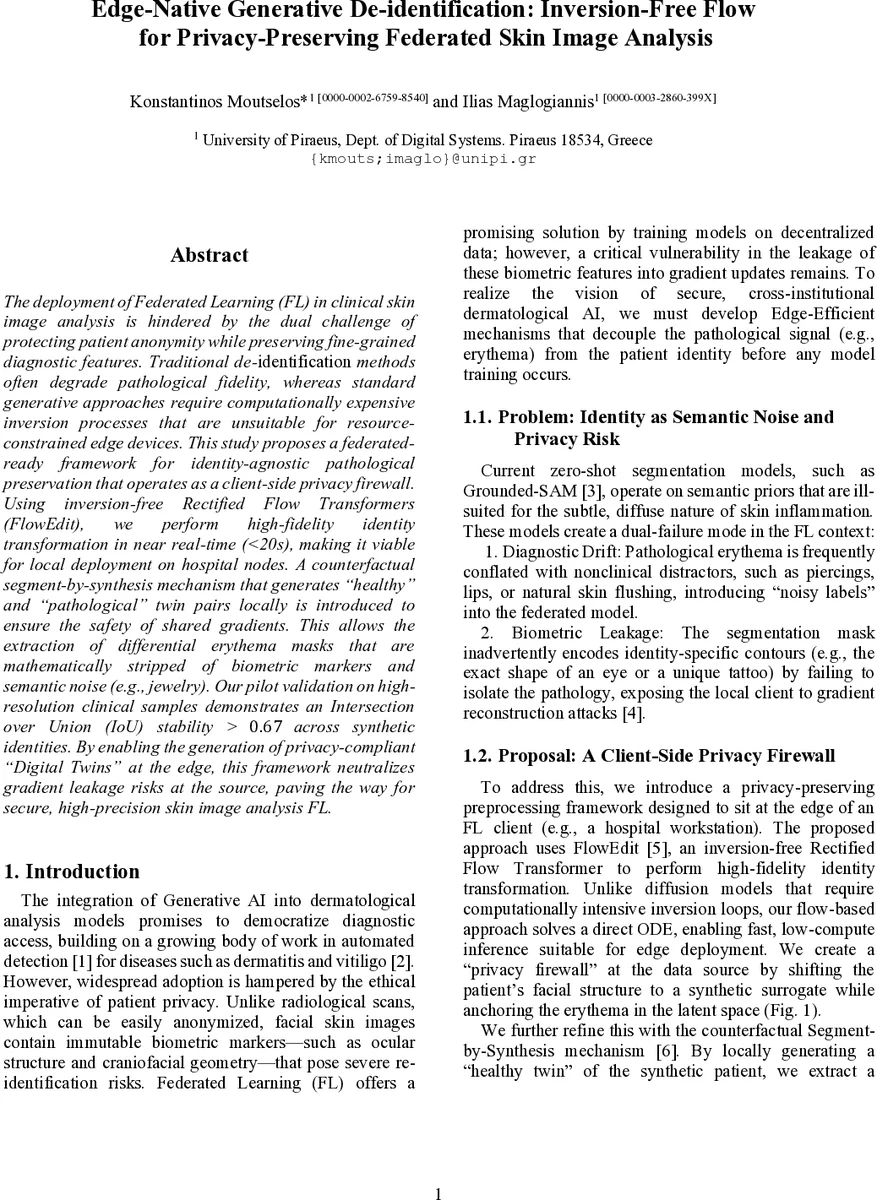
The deployment of Federated Learning (FL) for clinical dermatology is hindered by the competing requirements of protecting patient privacy and preserving diagnostic features. Traditional de-identification methods often degrade pathological fidelity, while standard generative editing techniques rely on computationally intensive inversion processes unsuitable for resource-constrained edge devices. We propose a framework for identity-agnostic pathology preservation that serves as a client-side privacy-preserving utility. By leveraging inversion-free Rectified Flow Transformers (FlowEdit), the system performs high-fidelity identity transformation in near real-time (less than 20s), facilitating local deployment on clinical nodes. We introduce a “Segment-by-Synthesis” mechanism that generates counterfactual healthy and pathological twin pairs locally. This enables the extraction of differential erythema masks that are decoupled from biometric markers and semantic artifacts (e.g. jewelry). Pilot validation on high-resolution clinical samples demonstrates an Intersection over Union (IoU) stability greater than 0.67 across synthetic identities. By generating privacy-compliant synthetic surrogates at the edge, this framework mitigates the risk of gradient leakage at the source, providing a secure pathway for high-precision skin image analysis in federated environments.
💡 Research Summary
The paper tackles a critical bottleneck in federated learning (FL) for dermatological imaging: how to protect patient identity while preserving the fine‑grained pathological cues needed for accurate diagnosis. Traditional de‑identification (blurring, pixelation) destroys subtle erythema textures, and GAN‑based face swapping introduces smoothing artifacts that compromise clinical utility. Moreover, diffusion‑based generative methods require costly iterative inversion steps, making them unsuitable for the low‑power edge devices typically deployed in hospitals.
To address these challenges, the authors propose an edge‑native, inversion‑free generative de‑identification framework built around two novel components:
-
Rectified Flow Transformer (FlowEdit) – an inversion‑free model that directly solves an ordinary differential equation (ODE) to map a source image distribution (the patient) to a target distribution (a synthetic surrogate identity). By blending three velocity fields—unconditional (natural drift), source‑conditioned, and target‑conditioned—weighted by guidance scales (γ_source, γ_target), FlowEdit can change global facial geometry (e.g., gender, ethnicity) while keeping the source‑guidance high enough to anchor pathological textures such as erythema. Because the ODE is solved in a single pass, inference on a 1024 × 768 image takes under 20 seconds on an NVIDIA L4 GPU, a speed compatible with real‑time clinical workflows.
-
Counterfactual Segment‑by‑Synthesis – a synthesis‑based labeling strategy that generates a “healthy twin” of the synthetic patient using the same latent seed and lighting conditions, but with a prompt describing healthy skin. The pathological twin (synthetic identity + erythema) and the healthy twin differ only in the disease signal. By computing a pixel‑wise difference in the CIELAB α* channel, the method isolates the redness component while canceling out identity‑related noise (eye shape, tattoos, jewelry). A dynamic threshold θ* is then optimized to maximize Intersection‑over‑Union (IoU) against the ground‑truth pathology mask, yielding a clean binary segmentation mask.
The pipeline operates entirely on the client side (the hospital edge node). The original patient image never leaves the device; only the synthetic surrogate and its derived mask are transmitted to the FL server. This privacy firewall eliminates the source of gradient leakage attacks, complementing differential privacy techniques without sacrificing model performance.
Experimental validation was performed on high‑resolution clinical photographs representing challenging cases (diffuse facial erythema, occlusions, piercings). The authors report:
- Inference speed: <20 s per image, confirming suitability for edge deployment.
- Mask stability: IoU between the original pathology and masks derived from synthetic identities remained >0.67 across diverse surrogate identities, demonstrating that the pathological signal is invariant to identity transformation.
- Baseline comparison: Against a Grounded‑SAM + HQ‑SAM pipeline, the proposed method dramatically reduced false positives caused by semantic noise (lips, jewelry, shadows) and achieved higher IoU (≈0.68 vs. ≈0.42).
- Qualitative results: Visual inspection shows pixel‑perfect alignment between pathological and healthy twins, enabling precise extraction of erythema without residual color or lighting artifacts.
Key insights include:
- Inversion‑free flow models can replace diffusion‑based generators for privacy‑preserving image synthesis, delivering high‑fidelity identity swaps with negligible computational overhead.
- Same‑seed counterfactual synthesis provides a natural “digital twin” that isolates disease features mathematically, removing the need for manual annotation and reducing labeling costs.
- Edge‑native de‑identification secures the data at the source, mitigating gradient reconstruction attacks and allowing FL to operate with stronger privacy guarantees while maintaining diagnostic accuracy.
The authors acknowledge limitations: the current study focuses on frontal facial images; extending to other body regions and automating prompt engineering are future work. Nonetheless, the framework establishes a practical pathway for secure, high‑precision dermatological AI in federated settings, potentially setting a new standard for privacy‑first medical imaging pipelines.
Comments & Academic Discussion
Loading comments...
Leave a Comment