Path Integrated Geodesics and Distances
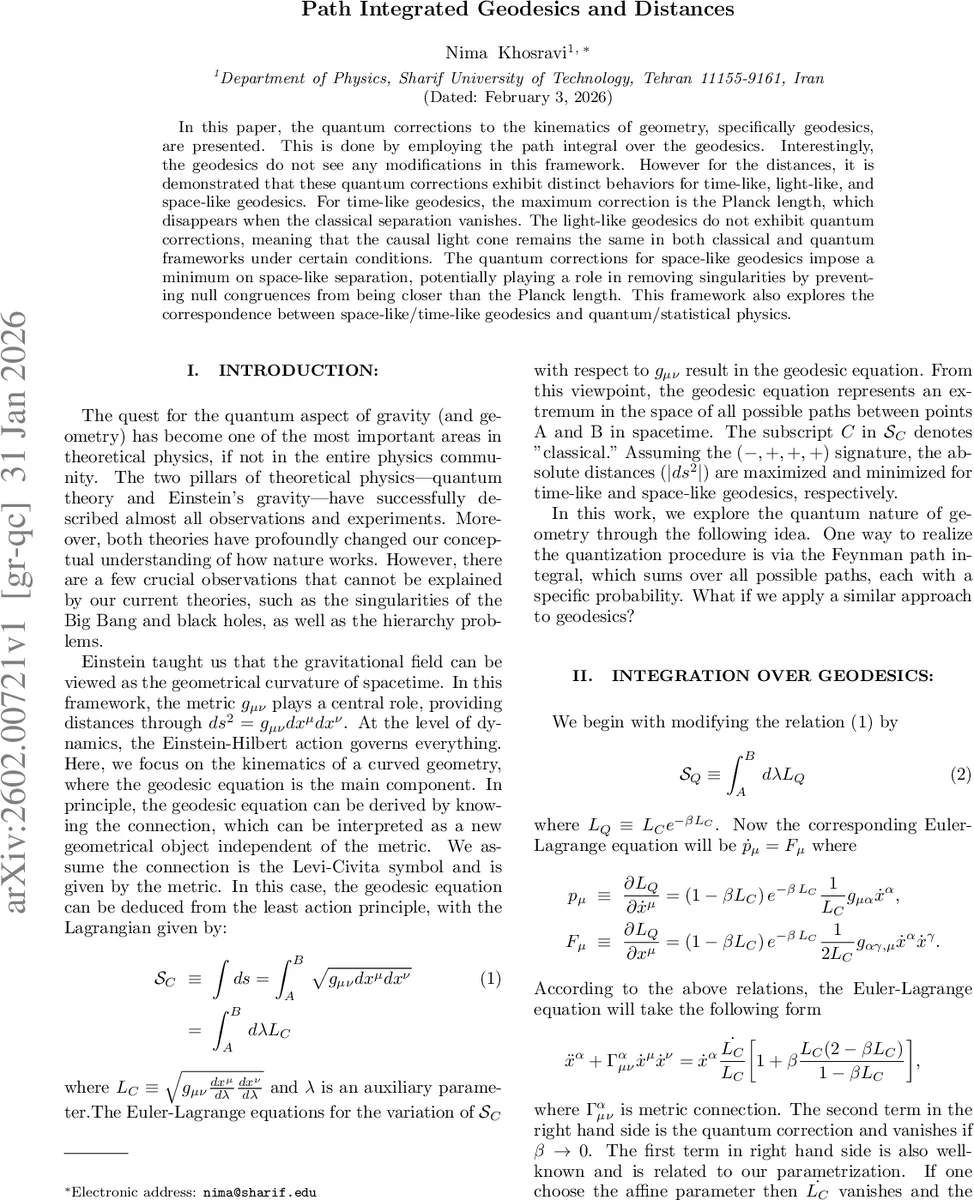
In this paper, the quantum corrections to the kinematics of geometry, specifically geodesics, are presented. This is done by employing the path integral over the geodesics. Interestingly, the geodesics do not see any modifications in this framework. However for the distances, it is demonstrated that these quantum corrections exhibit distinct behaviors for time-like, light-like, and space-like geodesics. For time-like geodesics, the maximum correction is the Planck length, which disappears when the classical separation vanishes. The light-like geodesics do not exhibit quantum corrections, meaning that the causal light cone remains the same in both classical and quantum frameworks under certain conditions. The quantum corrections for space-like geodesics impose a minimum on space-like separation, potentially playing a role in removing singularities by preventing null congruences from being closer than the Planck length. This framework also explores the correspondence between space-like/time-like geodesics and quantum/statistical physics.
💡 Research Summary
The paper proposes a novel way to incorporate quantum effects into the kinematics of curved spacetime by applying the Feynman path‑integral formalism to geodesics. Starting from the classical action S_C = ∫ ds = ∫ dλ L_C with L_C = g_{μν}ẋ^μẋ^ν, the author defines a quantum‑modified Lagrangian L_Q = L_C e^{‑βL_C}. The corresponding Euler‑Lagrange equations contain an extra term proportional to the derivative of L_C, but this term vanishes when an affine parameter is chosen. Consequently, the geodesic equation itself remains unchanged: quantum corrections do not alter the path of a geodesic, only the way distances are evaluated along the ensemble of possible paths.
To quantify the effect on distances, the author evaluates the expectation value
⟨S⟩ = (∫ ds s e^{‑is/l_p})/(∫ ds e^{‑is/l_p})
where s is the proper length of a path and l_p is a constant with dimensions of length, interpreted as analogous to ℏ. The integration is restricted to paths of the same causal type as the classical geodesic (space‑like, null, or time‑like).
For space‑like separations the integral runs from the classical minimal distance l_C to infinity. The calculation yields the simple relation
l_Q² = l_C² + l_p².
Thus even when the classical distance vanishes, the quantum‑corrected distance has a non‑zero lower bound l_p, a Planck‑scale minimal length. The author extends the same procedure to areas and volumes, obtaining minimal values 2 l_p² and 6 l_p³ respectively. This result suggests a mechanism for singularity avoidance: null congruences can never be brought arbitrarily close, potentially regularizing black‑hole and big‑bang singularities.
For null (light‑like) geodesics the proper length is identically zero, so the weighting factor e^{‑is/l_p} reduces to unity and no quantum correction appears. The causal light cone therefore remains exactly the same as in classical general relativity.
For time‑like separations the proper length is purely imaginary, s = iτ, and the weighting factor becomes e^{+τ/l_p}. Because the classical time‑like geodesic maximizes τ, the integration has an upper bound T (the classical proper time). The resulting quantum‑corrected proper time is
T₁ = l_p (1 − e^{‑T/l_p}),
which approaches the classical value for T ≫ l_p, with corrections smaller than a Planck length. When the classical separation tends to zero, the quantum‑corrected separation also tends to zero, unlike the space‑like case.
The paper then explores a duality between time‑like quantum geodesics and statistical physics. By rewriting an expectation value with a positive exponential factor, the author shows that the structure mirrors a Boltzmann average, with β playing the role of inverse temperature after a Wick rotation t → –iβ. However, the author argues that a true correspondence requires the existence of a maximum energy state, which is argued to be physically reasonable because any real system, including the universe, has finite total energy.
In summary, the work demonstrates that while the geodesic equations themselves are immune to the proposed quantum modifications, the measurement of distances, areas, and volumes acquires Planck‑scale corrections that differ for each causal class. The emergence of a minimal space‑like separation offers a concrete, model‑independent avenue toward singularity resolution, and the identified space‑like / time‑like ↔ quantum / statistical physics duality hints at deeper connections between non‑local quantum structures and local thermodynamic behavior. The approach is conceptually appealing but leaves open several technical questions, such as the rigorous convergence of the path integrals, the physical interpretation of the parameters β and l_p, and the integration of this framework with established quantum‑gravity programs.
Comments & Academic Discussion
Loading comments...
Leave a Comment