Global Attractivity of a Nonlocal Delayed Diffusive Dengue Model in a Spatially Homogeneous Environment
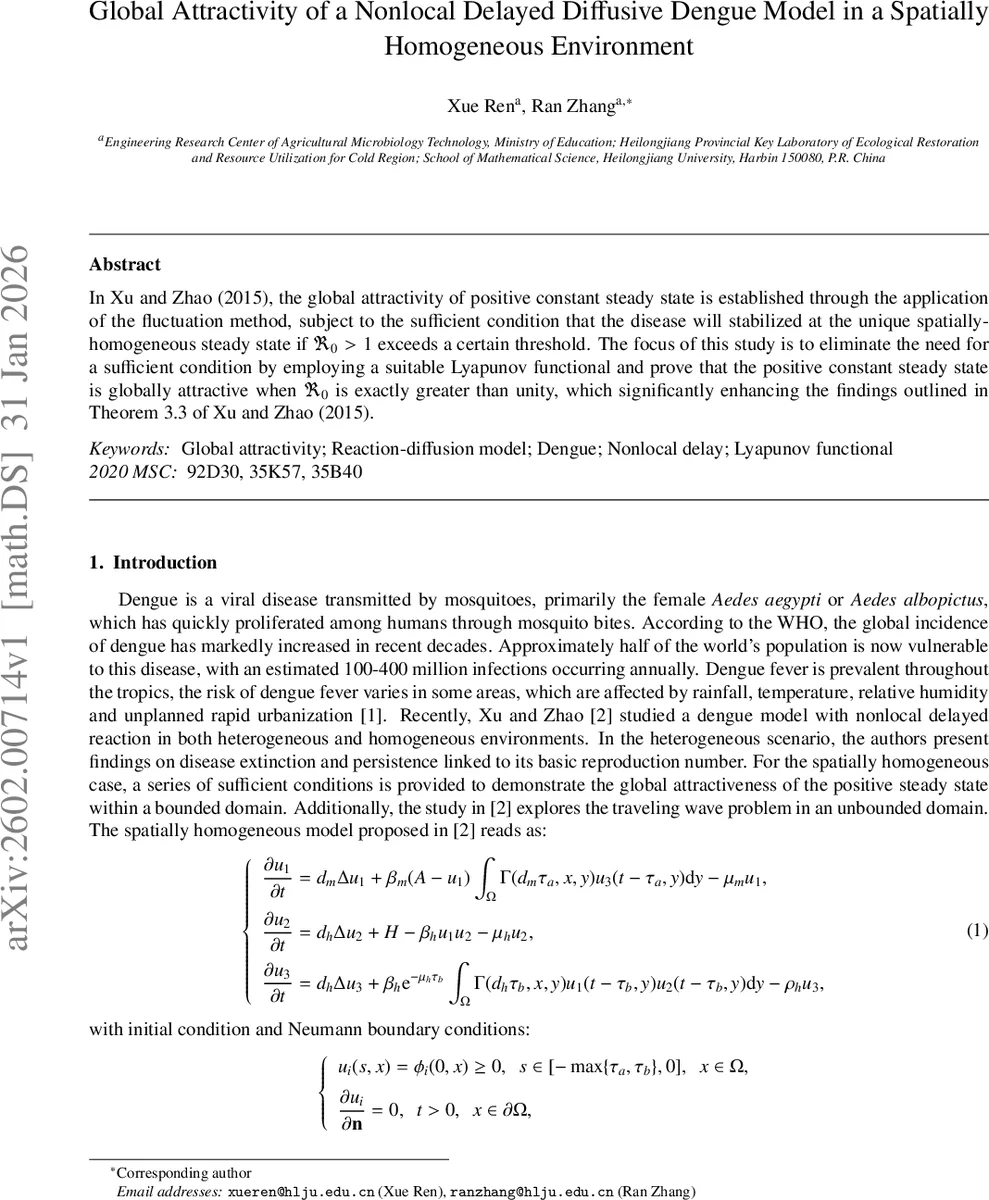
In Xu and Zhao (2015), the global attractivity of positive constant steady state is established through the application of the fluctuation method, subject to the sufficient condition that the disease will stabilized at the unique spatially-homogeneous steady state if $\Re_0>1$ exceeds a certain threshold. The focus of this study is to eliminate the need for a sufficient condition by employing a suitable Lyapunov functional and prove that the positive constant steady state is globally attractive when $\Re_0$ is exactly greater than unity, which significantly enhancing the findings outlined in Theorem 3.3 of Xu and Zhao (2015).
💡 Research Summary
The paper revisits the non‑local delayed diffusive dengue model introduced by Xu and Zhao (2015). Their original work established the global attractivity of the unique positive constant steady state only under a rather restrictive sufficient condition (inequality (2)) in addition to the basic reproduction number ℜ₀ exceeding one. This extra condition limits the applicability of the result because it imposes a rather high threshold on model parameters that may not be realistic in many epidemiological settings.
The authors of the present study aim to remove this unnecessary restriction and prove that ℜ₀ > 1 alone guarantees global attractivity of the endemic equilibrium. To achieve this, they construct a Lyapunov functional V(t) that combines three local terms L₁, L₂, L₃ and two non‑local terms W₁, W₂. Each local term is based on the convex function g(ω)=ω−1−ln ω, which is non‑negative and vanishes only at ω=1, thereby measuring the deviation of each state variable (infectious mosquitoes u₁, infectious humans u₂, and exposed humans u₃) from its steady‑state value u₁, u₂, u*₃. The non‑local terms incorporate the spatial kernels Γ associated with the diffusion operators and the time delays τₐ, τ_b, again through the function g, so that the functional captures the effect of delayed, spatially distributed transmission.
Differentiating V(t) with respect to time, the authors carefully handle the diffusion contributions (which become negative definite integrals of |∇u_i|²) and the reaction terms. By exploiting the properties of the Green’s function (mass conservation) and the equilibrium relations (e.g., β_m(A−u₁)u₃ = μ_m u₁, β_h e^{−μ_h τ_b} u₁ u₂ = ρ_h u₃), the derivative simplifies to
dV/dt ≤ − β_h u₁ u₂ ∫_Ω
Comments & Academic Discussion
Loading comments...
Leave a Comment