The algebraic and geometric classification of right alternative superalgebras
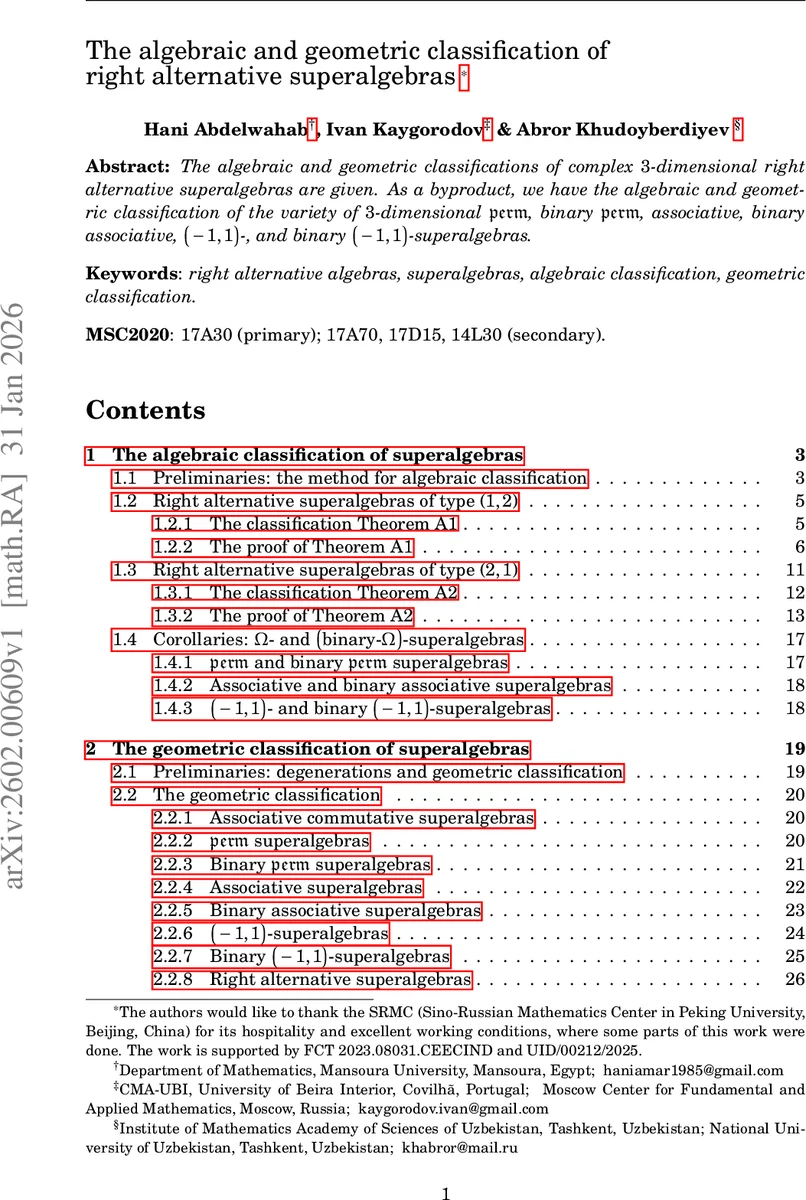
The algebraic and geometric classifications of complex $3$-dimensional right alternative superalgebras are given. As a byproduct, we have the algebraic and geometric classification of the variety of $3$-dimensional $\mathfrak{perm}$, binary $\mathfrak{perm}$, associative, binary associative, $\big(-1,1\big)$-, and binary $\big(-1,1\big)$-superalgebras.
💡 Research Summary
The paper delivers a complete algebraic and geometric classification of complex three‑dimensional right alternative superalgebras (RAS). A right alternative superalgebra is a (\mathbb Z_{2})-graded algebra whose multiplication satisfies the right‑alternative identity ((x,y,z)=-( -1)^{|y||z|}(x,z,y)) for homogeneous elements. The authors adopt a systematic approach based on the relationship between right alternative superalgebras and Jordan superalgebras.
First, they observe that for any Jordan superalgebra ((A,\bullet)) the symmetrized product yields a Jordan structure, and any right alternative superalgebra can be obtained by perturbing the Jordan product with a super‑skew‑symmetric bilinear map (\theta). The set of admissible perturbations is precisely the second cohomology space (Z^{2}(A,A)). The classification problem therefore reduces to three steps: (i) compute (Z^{2}(A,A)) for each underlying Jordan superalgebra, (ii) determine the action of the automorphism group (\operatorname{Aut}(A)) on this space, and (iii) select a representative (\theta) from each orbit to construct the corresponding right alternative superalgebra ((A,*_{\theta})).
The authors treat the two possible ((n,m)) gradings for three‑dimensional algebras: type ((1,2)) (one even, two odd basis elements) and type ((2,1)) (two even, one odd). For type ((1,2)) they list twelve non‑isomorphic Jordan superalgebras (J_{01},\dots,J_{12}). For each (J_k) they compute a basis of (Z^{2}(J_k,J_k)) using explicit super‑skew‑symmetric forms (\Delta_{ij}). By analysing the matrices representing (\operatorname{Aut}(J_k)) they normalize the parameters, obtaining a finite list of non‑isomorphic right alternative superalgebras. The final result (Theorem A1) consists of 28 families (R_{\ast}); most are isolated algebras, while several depend on a continuous parameter (\alpha) (e.g., (R_{\alpha}^{01}, R_{\alpha}^{04})). A single isomorphism relation (R_{\alpha}^{04}\cong R_{-\alpha}^{04}) is noted.
For type ((2,1)) the same procedure yields 24 families (Theorem A2). Again, a few families contain a parameter (\alpha). Together, the algebraic classification provides 52 distinct isomorphism classes (counting parameter families) of three‑dimensional right alternative superalgebras.
The authors then exploit these results to classify several important subvarieties: perm superalgebras, binary perm superalgebras, associative superalgebras, binary associative superalgebras, ((-1,1))-superalgebras, and binary ((-1,1))-superalgebras. Each subvariety corresponds to imposing additional identities on the right‑alternative structure, and the previously obtained families specialize accordingly. Corollaries in Section 1.4 list the resulting algebraic classifications for each subvariety.
The second major contribution is a geometric classification via degenerations. Using the notion of a degeneration (or degeneration graph) the authors study orbit closures in the variety of three‑dimensional right alternative superalgebras under the natural action of (\operatorname{GL}(V_{0})\times\operatorname{GL}(V_{1})). By computing dimensions of orbits and constructing explicit limiting families, they determine which algebras degenerate to which others. The outcome (Theorems G1 and G2) is a degeneration graph consisting of nine irreducible components, each corresponding to one of the subvarieties mentioned above. The graph displays the hierarchy of algebras: for instance, the associative component sits above certain perm components, while binary ((-1,1)) algebras form a separate branch. The authors also identify rigid algebras (those whose orbits are open) and describe all maximal degenerations.
Methodologically, the paper showcases a powerful blend of cohomological techniques (the space (Z^{2}(A,A))), group‑action orbit analysis, and explicit matrix calculations. This framework not only yields a clean classification for the low‑dimensional case but also suggests a pathway for tackling higher‑dimensional right alternative superalgebras or other non‑associative varieties (e.g., Malcev, Zinbiel). The work also recovers known results (e.g., Gainov’s theorem that every three‑dimensional alternative algebra is associative) and extends them to the super setting.
In summary, the authors have achieved a comprehensive algebraic list of all three‑dimensional right alternative superalgebras over (\mathbb C), provided the corresponding classifications for several important subvarieties, and mapped out the geometric landscape of degenerations among these algebras. The paper fills a notable gap in the literature on low‑dimensional non‑associative superalgebras and establishes tools that are likely to be valuable for future investigations in the structure theory of superalgebras.
Comments & Academic Discussion
Loading comments...
Leave a Comment