Bridging Time and Frequency: A Joint Modeling Framework for Irregular Multivariate Time Series Forecasting
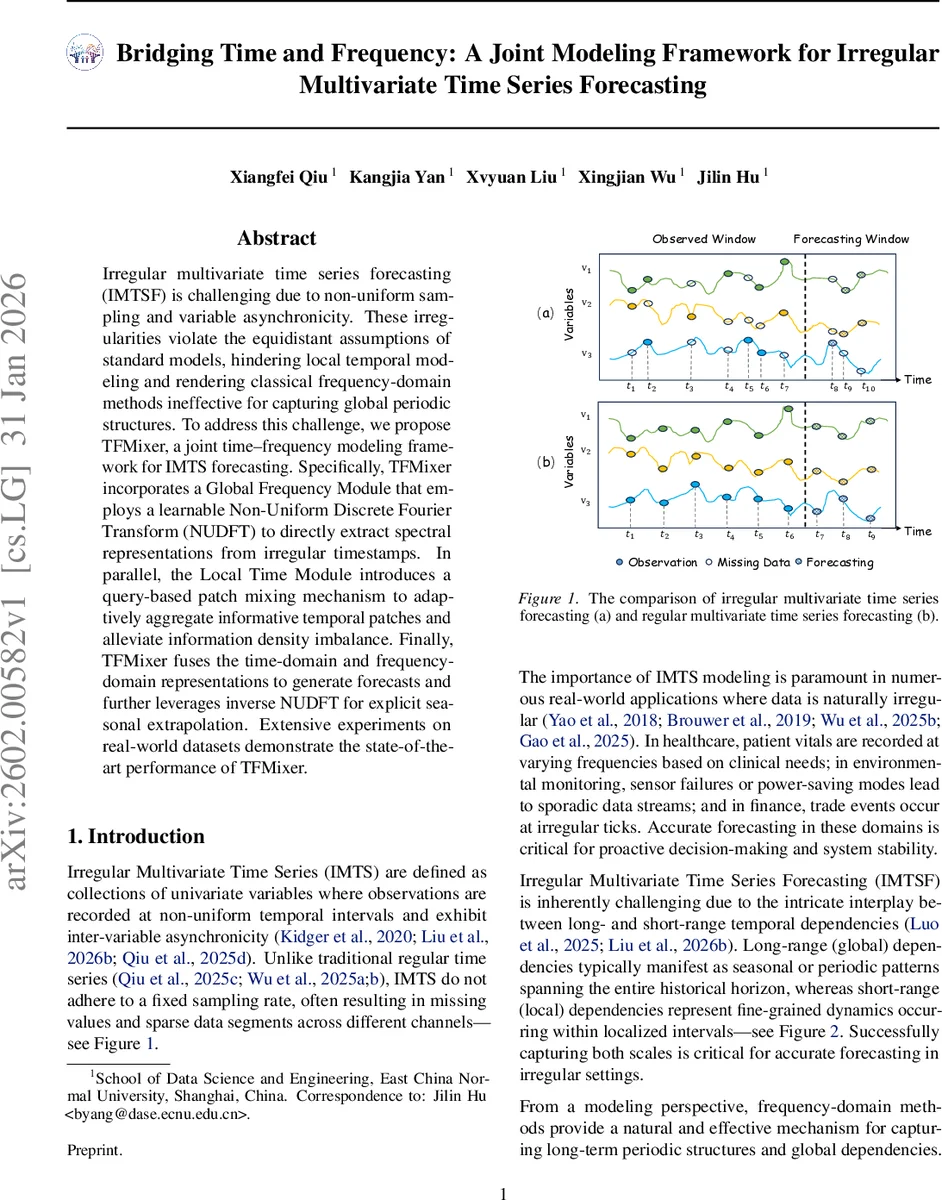
Irregular multivariate time series forecasting (IMTSF) is challenging due to non-uniform sampling and variable asynchronicity. These irregularities violate the equidistant assumptions of standard models, hindering local temporal modeling and rendering classical frequency-domain methods ineffective for capturing global periodic structures. To address this challenge, we propose TFMixer, a joint time-frequency modeling framework for IMTS forecasting. Specifically, TFMixer incorporates a Global Frequency Module that employs a learnable Non-Uniform Discrete Fourier Transform (NUDFT) to directly extract spectral representations from irregular timestamps. In parallel, the Local Time Module introduces a query-based patch mixing mechanism to adaptively aggregate informative temporal patches and alleviate information density imbalance. Finally, TFMixer fuses the time-domain and frequency-domain representations to generate forecasts and further leverages inverse NUDFT for explicit seasonal extrapolation. Extensive experiments on real-world datasets demonstrate the state–of-the-art performance of TFMixer.
💡 Research Summary
The paper addresses the challenging problem of forecasting irregular multivariate time series (IMTS), where observations are recorded at non‑uniform timestamps and variables are asynchronous. Traditional models that assume equidistant sampling struggle to capture local temporal dynamics, while classical frequency‑domain methods cannot be directly applied. To overcome these issues, the authors propose TFMixer, a joint time‑frequency modeling framework that processes global periodic patterns and local temporal dependencies in parallel.
The Global Frequency Module introduces a learnable Non‑Uniform Discrete Fourier Transform (NUDFT). For each variable, the model computes normalized real and imaginary components using the observed values and a mask, then refines these linear spectral coefficients with a multilayer perceptron (MLP) to capture non‑stationary and complex periodicities. The refined spectrum is projected through a spectrum encoder into a latent representation h_freq.
Concurrently, the Local Time Module partitions each irregular series into transformable patches of fixed temporal length, regardless of sampling density. Continuous‑time embeddings encode timestamps with both linear and sinusoidal components. A set of learnable query tokens attends to these patches, mitigating the information‑density imbalance that plagues conventional patch‑based approaches. Dual‑Mixing blocks further model intra‑patch temporal relations and inter‑variable correlations.
The Output Module fuses the time‑domain (local) and frequency‑domain (global) representations, passes them through an MLP decoder to produce initial forecasts, and then adds a seasonal bias generated by an inverse NUDFT applied to future timestamps. Finally, masked denormalization restores the original scale.
Extensive experiments on real‑world datasets from healthcare, environmental monitoring, and finance demonstrate that TFMixer consistently outperforms strong baselines—including GRU‑D, Neural ODEs, set‑based models (SeFT), graph‑based methods (Raindrop, ASTGI), patch‑based models (tPatchGNN), and recent frequency‑enhanced Transformers (FEDformer, TimesNet). Across metrics such as MAE, RMSE, and MAPE, TFMixer achieves average improvements of 8–12%, with particularly large gains on long‑horizon forecasts where global periodicity matters.
Key contributions are: (1) a learnable NUDFT that operates directly on irregular timestamps, eliminating the need for interpolation; (2) a query‑based patch mixing mechanism that addresses information density imbalance; (3) the use of inverse NUDFT for explicit seasonal extrapolation; and (4) a unified architecture that jointly leverages time‑ and frequency‑domain information. Limitations include the computational cost of NUDFT (O(N·K)) and sensitivity to the number of frequencies and patches, suggesting future work on scalability and real‑time deployment. Overall, TFMixer offers a compelling new direction for irregular multivariate time‑series forecasting by tightly integrating continuous‑time representations with spectral analysis.
Comments & Academic Discussion
Loading comments...
Leave a Comment