Vector-Valued Period Polynomials and Zeta Values of Quadratic Fields
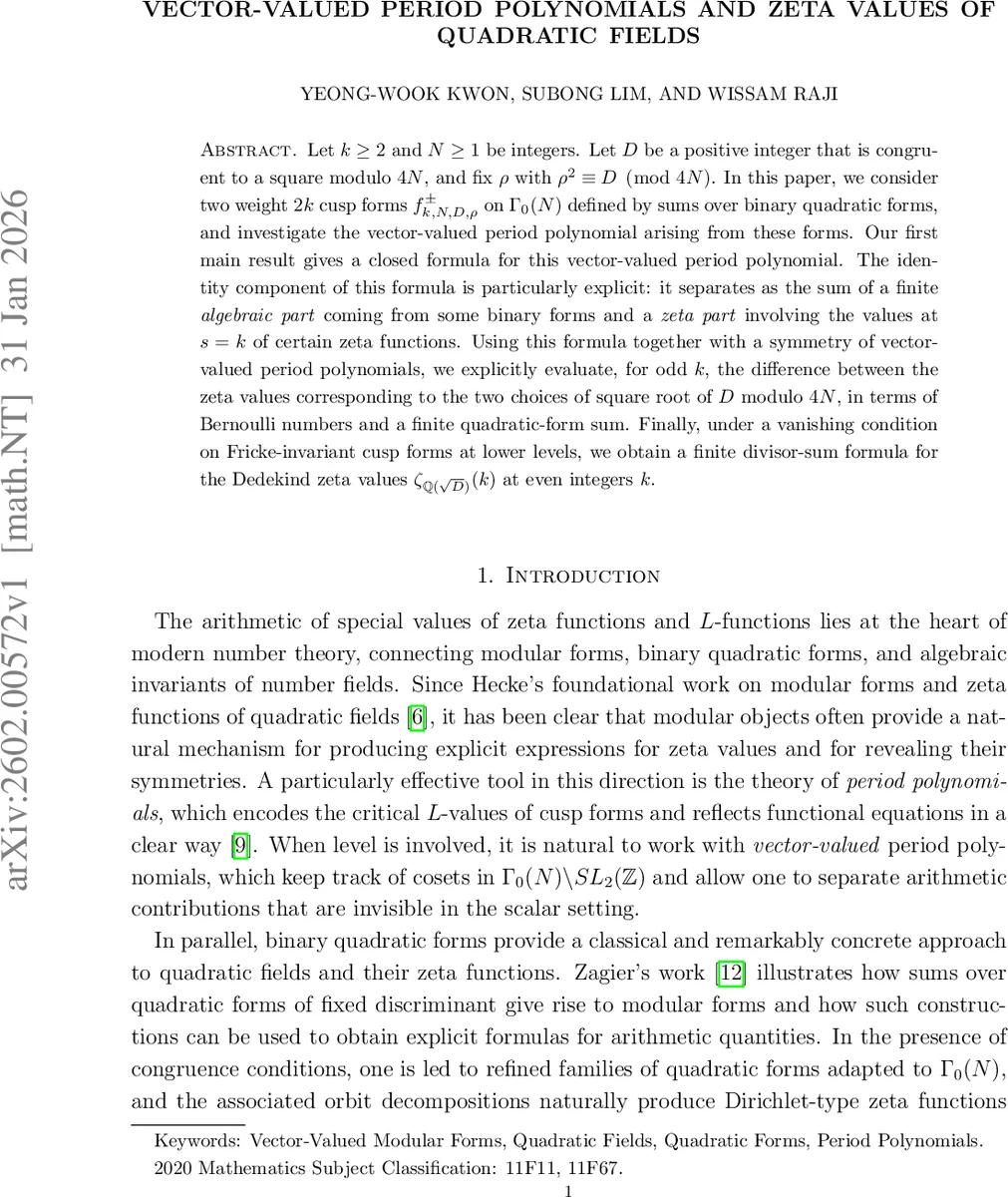
Let $k\ge 2$ and $N\ge 1$ be integers. Let $D$ be a positive integer that is congruent to a square modulo $4N$, and fix $ρ$ with $ρ^2\equiv D\pmod{4N}$. In this paper, we consider two weight $2k$ cusp forms $f^{\pm}{k,N,D,ρ}$ on $Γ_0(N)$ defined by sums over binary quadratic forms, and investigate the vector-valued period polynomial arising from these forms. Our first main result gives a closed formula for this vector-valued period polynomial. The identity component of this formula is particularly explicit: it separates as the sum of a finite \textit{algebraic part} coming from some binary forms and a \textit{zeta part} involving the values at $s=k$ of certain zeta functions. Using this formula together with a symmetry of vector-valued period polynomials, we explicitly evaluate, for odd $k$, the difference between the zeta values corresponding to the two choices of square root of $D$ modulo $4N$, in terms of Bernoulli numbers and a finite quadratic-form sum. Finally, under a vanishing condition on Fricke-invariant cusp forms at lower levels, we obtain a finite divisor-sum formula for the Dedekind zeta values $ζ{\mathbb{Q}(\sqrt{D})}(k)$ at even integers $k$.
💡 Research Summary
The paper investigates a family of weight‑(2k) cusp forms on (\Gamma_{0}(N)) that are built from binary quadratic forms with discriminant (D) satisfying (D\equiv\rho^{2}\pmod{4N}). For each choice of the square root (\rho) the authors define two cusp forms \
Comments & Academic Discussion
Loading comments...
Leave a Comment