NPNet: A Non-Parametric Network with Adaptive Gaussian-Fourier Positional Encoding for 3D Classification and Segmentation
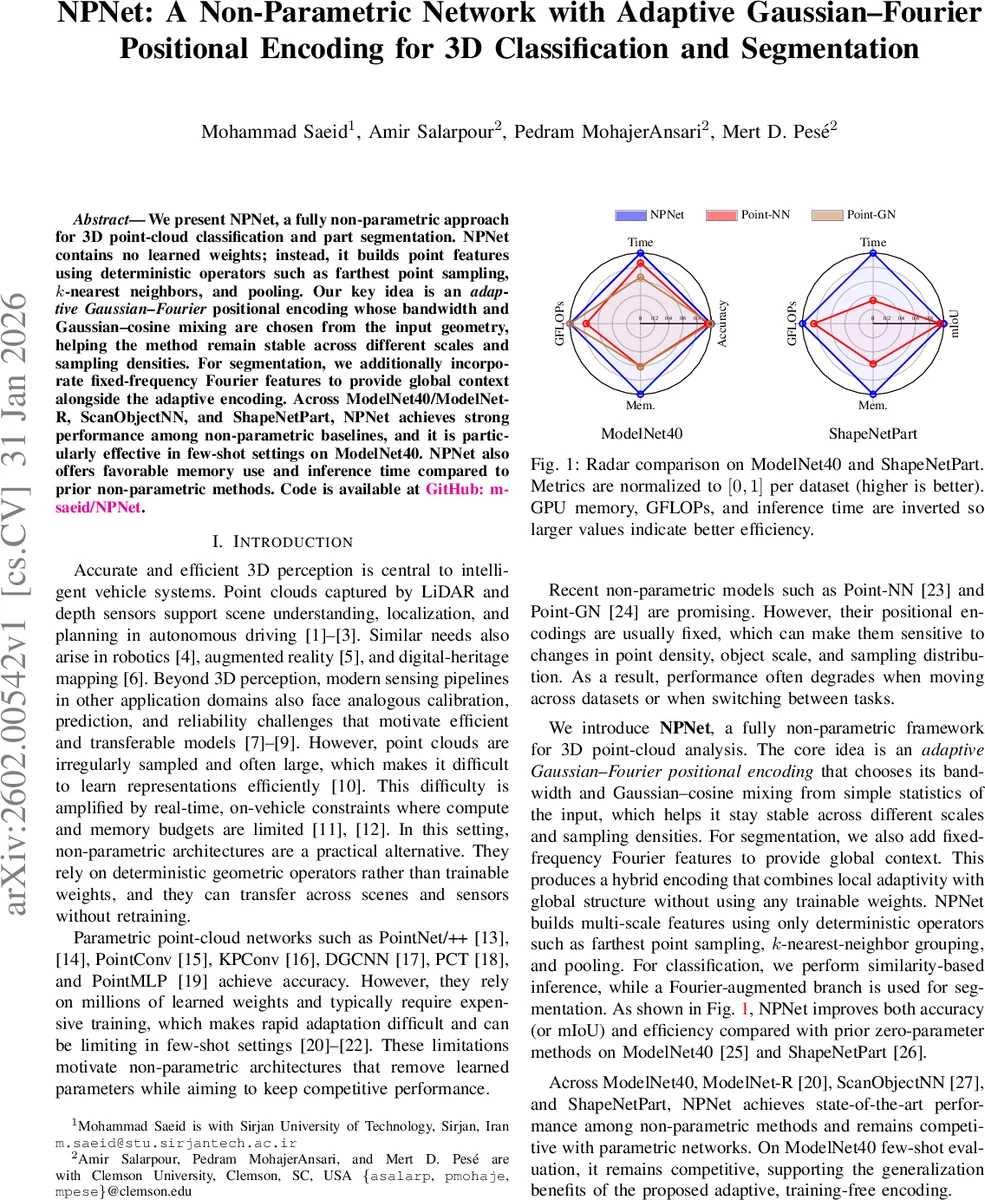
We present NPNet, a fully non-parametric approach for 3D point-cloud classification and part segmentation. NPNet contains no learned weights; instead, it builds point features using deterministic operators such as farthest point sampling, k-nearest neighbors, and pooling. Our key idea is an adaptive Gaussian-Fourier positional encoding whose bandwidth and Gaussian-cosine mixing are chosen from the input geometry, helping the method remain stable across different scales and sampling densities. For segmentation, we additionally incorporate fixed-frequency Fourier features to provide global context alongside the adaptive encoding. Across ModelNet40/ModelNet-R, ScanObjectNN, and ShapeNetPart, NPNet achieves strong performance among non-parametric baselines, and it is particularly effective in few-shot settings on ModelNet40. NPNet also offers favorable memory use and inference time compared to prior non-parametric methods
💡 Research Summary
NPNet introduces a fully non‑parametric framework for 3D point‑cloud classification and part segmentation that relies exclusively on deterministic geometric operators (farthest point sampling, k‑nearest‑neighbor grouping, and pooling) and a novel adaptive Gaussian‑Fourier positional encoding. The method contains no learnable weights; all feature extraction is performed by fixed, data‑driven computations.
The adaptive encoding consists of two components. First, a bandwidth σ_a and a mixing coefficient λ are derived from simple statistics of the input point set: the average per‑axis standard deviation σ_g is computed, then σ_a = σ_0·(1+σ_g) and λ = sigmoid((σ_g−τ)·κ). For a set of fixed anchor points, a Gaussian radial‑basis function (RBF) and a cosine kernel are evaluated at each point using σ_a. The final adaptive response is λ·RBF + (1−λ)·cosine, allowing the representation to emphasize smooth Gaussian responses in dense regions while retaining cosine‑based high‑frequency information in sparse regions.
For segmentation, a second “Fourier channel” is added. Multiple fixed frequencies ω_j = α_j/L are used to compute sin(β·x/ω_j) and cos(β·x/ω_j) for each coordinate, providing global context that is independent of the adaptive bandwidth. The hybrid code H_pos =
Comments & Academic Discussion
Loading comments...
Leave a Comment