DSCD-Nav: Dual-Stance Cooperative Debate for Object Navigation
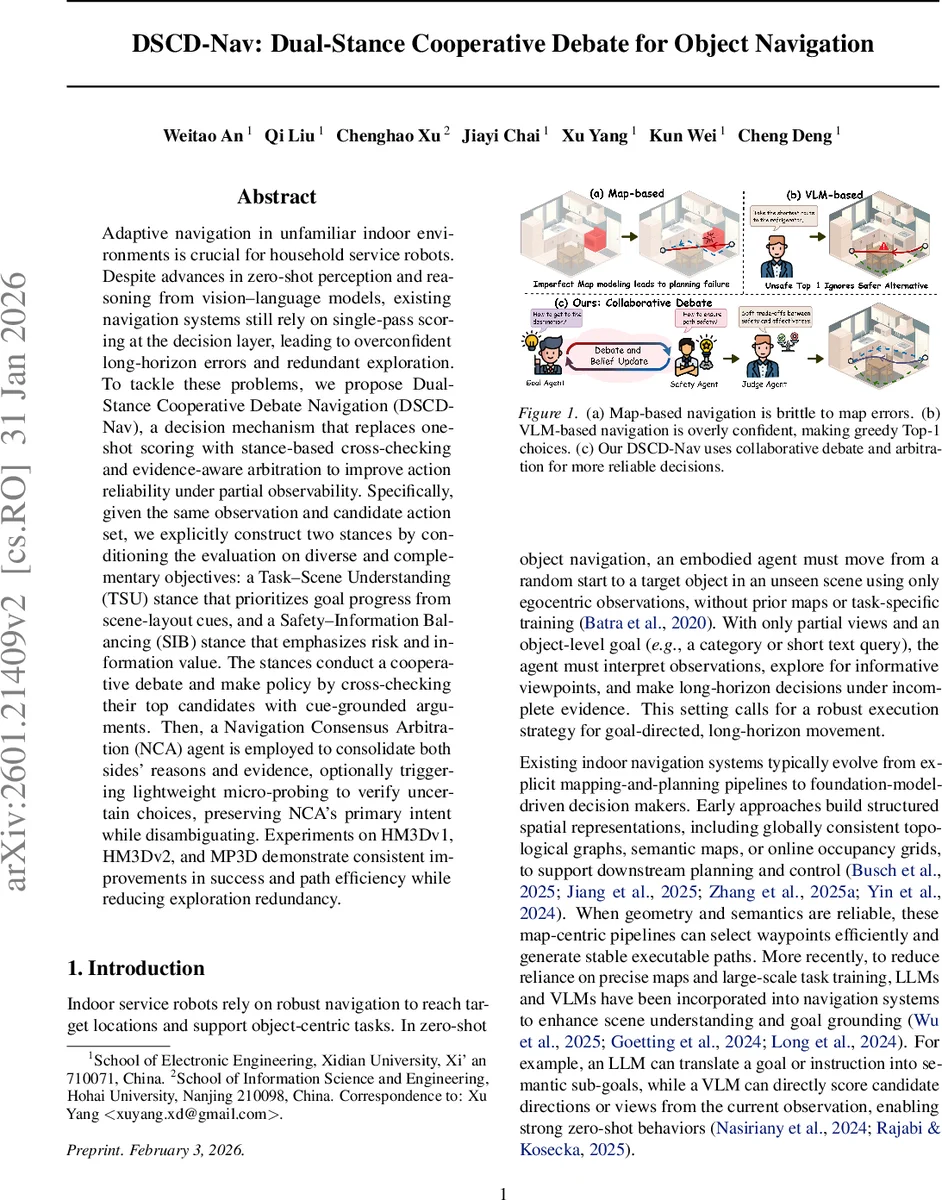
Adaptive navigation in unfamiliar indoor environments is crucial for household service robots. Despite advances in zero-shot perception and reasoning from vision-language models, existing navigation systems still rely on single-pass scoring at the decision layer, leading to overconfident long-horizon errors and redundant exploration. To tackle these problems, we propose Dual-Stance Cooperative Debate Navigation (DSCD-Nav), a decision mechanism that replaces one-shot scoring with stance-based cross-checking and evidence-aware arbitration to improve action reliability under partial observability. Specifically, given the same observation and candidate action set, we explicitly construct two stances by conditioning the evaluation on diverse and complementary objectives: a Task-Scene Understanding (TSU) stance that prioritizes goal progress from scene-layout cues, and a Safety-Information Balancing (SIB) stance that emphasizes risk and information value. The stances conduct a cooperative debate and make policy by cross-checking their top candidates with cue-grounded arguments. Then, a Navigation Consensus Arbitration (NCA) agent is employed to consolidate both sides’ reasons and evidence, optionally triggering lightweight micro-probing to verify uncertain choices, preserving NCA’s primary intent while disambiguating. Experiments on HM3Dv1, HM3Dv2, and MP3D demonstrate consistent improvements in success and path efficiency while reducing exploration redundancy.
💡 Research Summary
The paper tackles the long‑standing problem of over‑confidence in zero‑shot indoor object navigation, where agents must locate a target object in an unseen environment using only egocentric observations. While recent vision‑language model (VLM) and large language model (LLM) based approaches have removed the need for explicit maps, they still rely on a single‑pass scoring of candidate actions. This “one‑shot” decision making collapses all sources of uncertainty—goal progress, safety, and information gain—into a single scalar, leading to premature commitments, long‑horizon errors, and redundant exploration.
To address these issues, the authors propose Dual‑Stance Cooperative Debate Navigation (DSCD‑Nav), a decision‑layer framework that replaces the single scorer with a structured debate between two complementary stances, followed by evidence‑aware arbitration. The system operates on the same set of candidate actions supplied by any upstream generator (e.g., a VLM that proposes polar actions). A lightweight wrapper converts each candidate into a “card” containing an ID, distance, yaw, and a natural‑language description, without altering the underlying scores.
The two stances are:
-
Task‑Scene Understanding (TSU) stance – Goal‑oriented. TSU treats the target description as the primary constraint and leverages scene layout cues, common room‑object co‑occurrences, and any weak memory evidence to estimate which candidate most likely advances toward the goal. Its output each round is a preferred candidate ID, a concise “why” statement, and supporting evidence grounded in visual observations.
-
Safety‑Information Balancing (SIB) stance – Goal‑agnostic. SIB audits the TSU proposal and the whole candidate set from the perspective of collision risk, occlusion, and the potential to acquire new informative viewpoints. It can either agree with TSU or counter with a safer or more informative alternative, again providing a “why” and evidence.
During a debate round, both agents read each other’s previous arguments, generate new evidence, and update implicit belief states over the candidates. The authors formalize this as a Bayesian‑style belief update, but the actual computation is performed implicitly via successive LLM prompts. Evidence is categorized as “support” (strengthening a candidate) or “attack” (weakening the opponent’s choice), and the set of relations R(k) grows across rounds.
After a few rounds (typically two to three), a Navigation Consensus Arbitration (NCA) module consumes the full debate transcript and the candidate cards. NCA computes a multi‑objective score that balances three factors: (i) task progress, (ii) safety, and (iii) information value, each with tunable weights. If the two stances converge on the same candidate, NCA directly returns it. If they disagree but the angular difference between their top choices is small (below a preset threshold), NCA triggers a lightweight “micro‑probing” step: the robot executes a short, low‑risk probe (small forward step and slight yaw) to empirically test the contested direction. The outcome of this probe is fed back into the arbitration, allowing NCA to resolve the conflict with concrete evidence rather than pure speculation.
The framework is deliberately “plug‑and‑play”: it does not modify the candidate generator, the visual encoder, or any training pipeline. It only adds a decision‑layer wrapper, making it compatible with existing VLM‑based navigation systems.
Experiments were conducted on three large‑scale indoor simulation benchmarks: HM3Dv1, HM3Dv2, and MP3D. The authors evaluated standard ObjectNav metrics—Success Rate, SPL (Success weighted by Path Length), average trajectory length, and collision count—against strong VLM baselines that use single‑pass scoring. DSCD‑Nav consistently improved Success Rate by 4–7 percentage points and SPL by 3–5 points. Average navigation distance decreased by roughly 10–15 %, and collisions dropped by over 20 %. Qualitative analysis of debate logs showed TSU focusing on layout‑consistent progress (e.g., “move toward the hallway that leads to the bedroom”), while SIB flagged risky moves (e.g., “the corridor ahead is narrow and partially occluded”). NCA’s final decisions aligned closely with human expert judgments, demonstrating interpretability.
Key contributions highlighted by the authors are:
- Introduction of a dual‑stance debate mechanism that explicitly separates goal‑progress reasoning from safety/information reasoning.
- Design of an evidence‑grounded arbitration module (NCA) that can optionally invoke micro‑probing to resolve high‑uncertainty conflicts.
- Demonstration that this architecture yields measurable gains in success and efficiency without any changes to perception or candidate generation components.
The paper also discusses limitations: the additional debate rounds and micro‑probing introduce computational overhead, which may affect real‑time deployment on physical robots; the quality of the debate depends heavily on prompt engineering for the LLMs; and the current system only uses two stances, leaving room for extending to multi‑stance or hierarchical debates.
Future work suggested includes scaling the number of stances to incorporate energy consumption or exploration‑exploitation trade‑offs, learning a lightweight evidence‑scoring model to replace pure LLM prompting, and transferring the approach to real‑world robotic platforms where sensor noise and latency are significant factors.
In summary, DSCD‑Nav offers a novel, modular, and interpretable decision‑making paradigm for embodied navigation. By forcing the agent to articulate and cross‑examine evidence from complementary perspectives, it mitigates over‑confidence, reduces unnecessary exploration, and improves both safety and efficiency in complex indoor environments.
Comments & Academic Discussion
Loading comments...
Leave a Comment