Evaluating Spatialized Auditory Cues for Rapid Attention Capture in XR
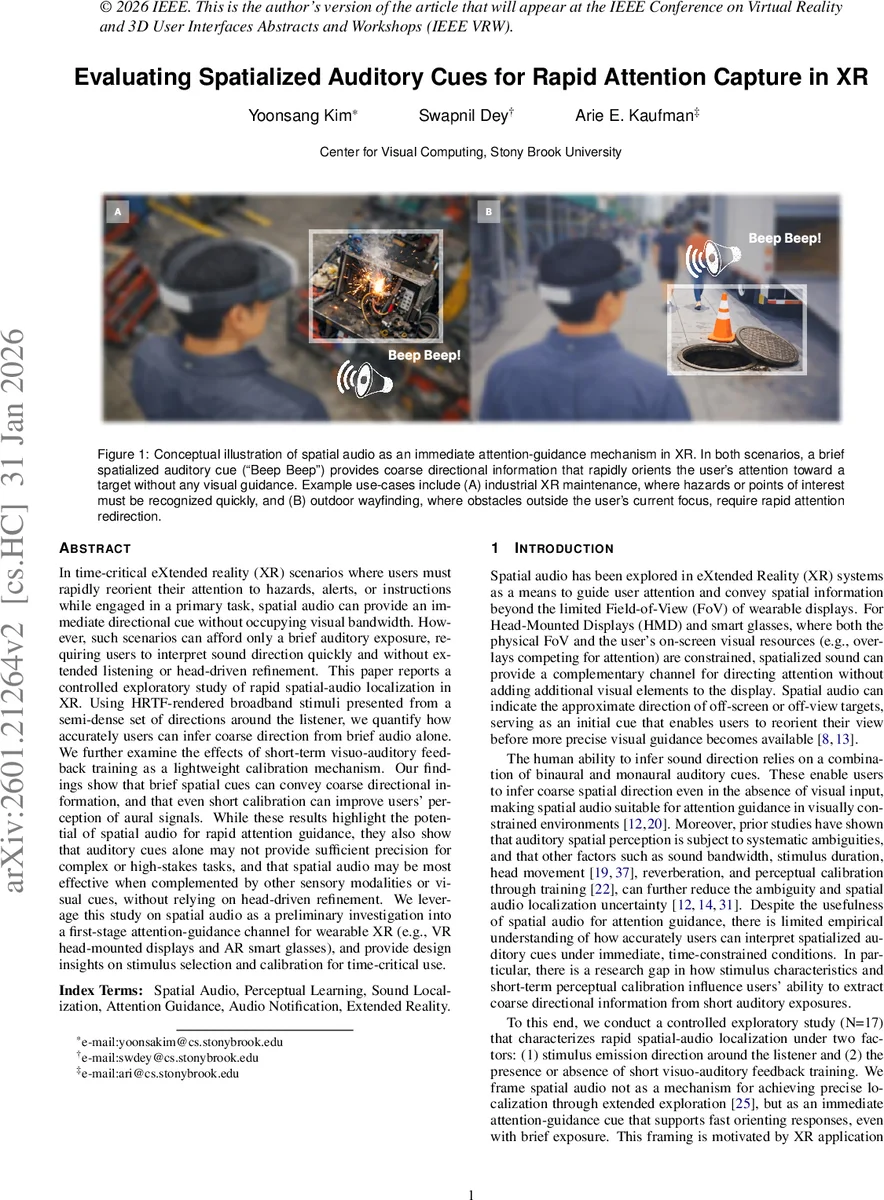
In time-critical eXtended reality (XR) scenarios where users must rapidly reorient their attention to hazards, alerts, or instructions while engaged in a primary task, spatial audio can provide an immediate directional cue without occupying visual bandwidth. However, such scenarios can afford only a brief auditory exposure, requiring users to interpret sound direction quickly and without extended listening or head-driven refinement. This paper reports a controlled exploratory study of rapid spatial-audio localization in XR. Using HRTF-rendered broadband stimuli presented from a semi-dense set of directions around the listener, we quantify how accurately users can infer coarse direction from brief audio alone. We further examine the effects of short-term visuo-auditory feedback training as a lightweight calibration mechanism. Our findings show that brief spatial cues can convey coarse directional information, and that even short calibration can improve users’ perception of aural signals. While these results highlight the potential of spatial audio for rapid attention guidance, they also show that auditory cues alone may not provide sufficient precision for complex or high-stakes tasks, and that spatial audio may be most effective when complemented by other sensory modalities or visual cues, without relying on head-driven refinement. We leverage this study on spatial audio as a preliminary investigation into a first-stage attention-guidance channel for wearable XR (e.g., VR head-mounted displays and AR smart glasses), and provide design insights on stimulus selection and calibration for time-critical use.
💡 Research Summary
This paper investigates whether spatialized audio can serve as a rapid, first‑stage attention‑guidance channel in time‑critical extended‑reality (XR) scenarios where visual bandwidth is limited or the user’s gaze is elsewhere. The authors conducted a controlled exploratory study with 17 participants, using head‑related transfer functions (HRTFs) to render broadband noise (covering low‑frequency ITD cues, mid‑frequency ILD cues, and high‑frequency spectral cues) from 90 virtual sound sources arranged on a sphere (azimuth steps of 20°, elevation steps of 30°). Participants kept their heads fixed and received no visual information during the audio presentation, thereby isolating pure auditory spatial perception.
The experiment comprised three phases: (1) a pre‑calibration session where participants identified the direction of each brief (≈1 s) sound by selecting one of six coarse categories (front, back, left, right, up, down); (2) a short calibration/learning phase in which each sound was paired with a visual indicator of its true location, providing immediate cross‑modal feedback for about five minutes; and (3) a post‑calibration session identical to the first. Accuracy, angular error, and self‑reported confidence were measured before and after calibration.
Results show that even with a single, brief exposure, participants could infer coarse direction with a baseline accuracy of ~58 %. After the brief visual‑auditory feedback, overall accuracy rose to ~70 %, with the most notable improvement in front‑back discrimination (confusion rate dropped from 22 % to 9 %). Directional error was smallest for left/right (≈20°), larger for front/back (≈30°), and largest for up/down (≈35‑45°), reflecting the known difficulty of elevation and front‑back cues when using generic HRTFs. Confidence ratings increased from an average of 2.9/5 to 4.7/5 after training. A supplemental manipulation of stimulus duration indicated that exposures shorter than ~150 ms cause a steep decline in performance, suggesting a practical lower bound for XR alert design.
The study contributes several key insights: (i) Spatial audio can convey enough information for rapid, coarse orientation even when visual cues are unavailable, making it a viable “first alert” modality in XR. (ii) A lightweight, short‑duration visual‑auditory calibration can significantly boost both objective accuracy and subjective confidence, supporting the inclusion of brief training or adaptive calibration in real systems. (iii) Limitations remain for precise elevation and front‑back discrimination, implying that spatial audio should be complemented by visual highlights, haptic cues, or personalized HRTFs for high‑stakes tasks. (iv) By fixing head orientation, the authors measured a lower bound on performance; allowing natural head movements would likely improve outcomes, an avenue for future work.
Limitations include reliance on a generic HRTF (which may not capture individual pinna effects), a laboratory setting with minimal reverberation, a short calibration period that does not assess long‑term learning, and the artificial head‑fixed condition. Future research should explore personalized HRTF pipelines, longer or repeated training sessions, dynamic head‑movement conditions, and multimodal integration (audio‑visual‑haptic) in realistic industrial or outdoor navigation contexts. Overall, the paper provides empirical grounding for using spatialized sound as an immediate attention‑capture mechanism in wearable XR devices.
Comments & Academic Discussion
Loading comments...
Leave a Comment