Odd but Error-Free FastTwoSum: More General Conditions for FastTwoSum as an Error-Free Transformation for Faithful Rounding Modes
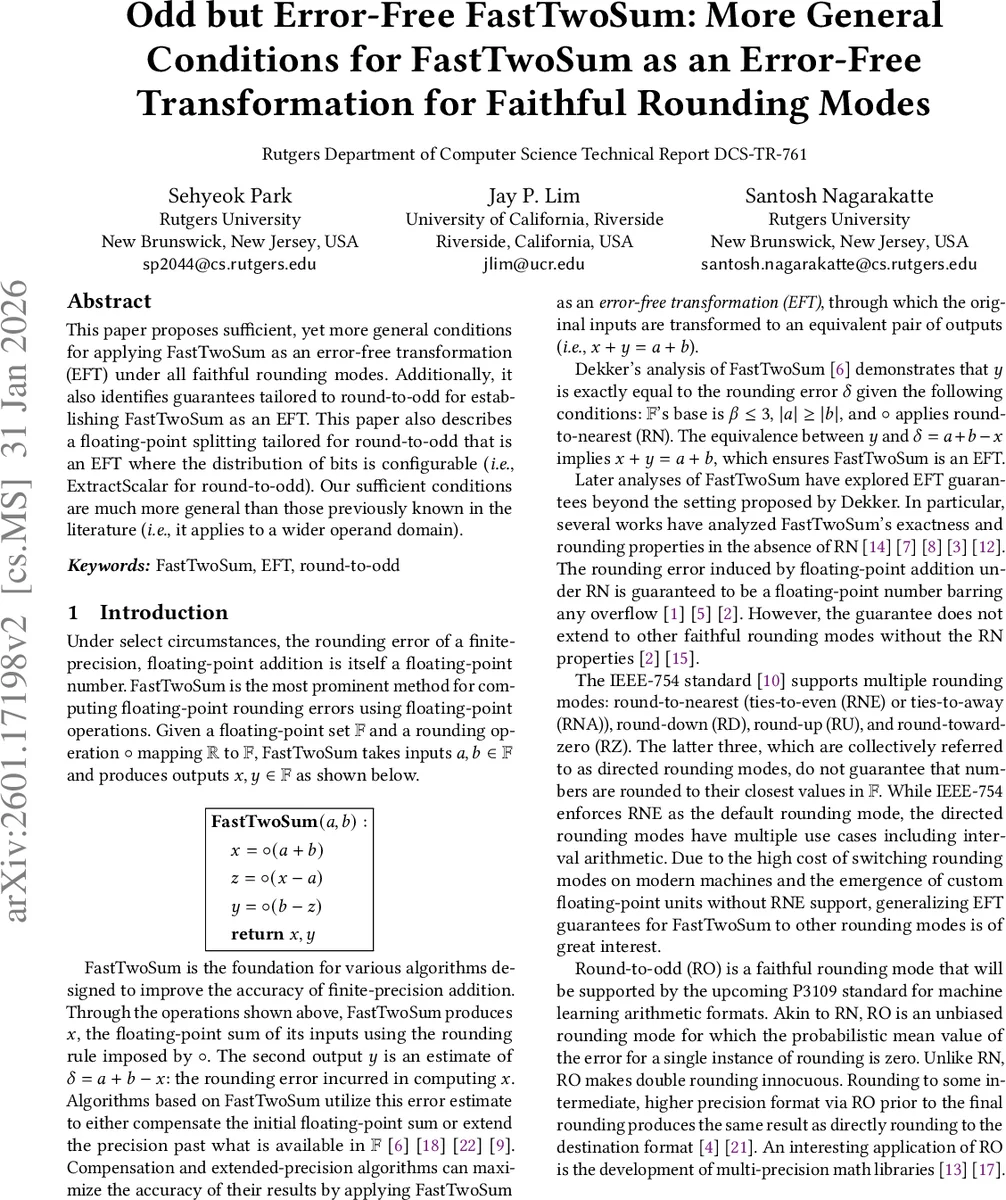
This paper proposes sufficient, yet more general conditions for applying FastTwoSum as an error-free transformation (EFT) under all faithful rounding modes. Additionally, it also identifies guarantees tailored to round-to-odd for establishing FastTwoSum as an EFT. This paper also describes a floating-point splitting tailored for round-to-odd that is an EFT where the distribution of bits is configurable (i.e., ExtractScalar for round-to-odd). Our sufficient conditions are much more general than those previously known in the literature (i.e., it applies to a wider operand domain).
💡 Research Summary
This technical report presents a significant expansion of the applicability of the FastTwoSum algorithm, a cornerstone for accurate floating-point error analysis, by establishing more general sufficient conditions for it to act as an Error-Free Transformation (EFT) under all faithful rounding modes.
Core Problem and Context: FastTwoSum takes two floating-point inputs a and b and computes their rounded sum x = ◦(a+b) and an estimate y of the rounding error. When y equals the exact error δ = a+b-x (i.e., x+y = a+b), the transformation is error-free. EFTs are fundamental for precision-enhancing algorithms like compensation and multi-precision arithmetic. Prior work, starting with Dekker, established EFT conditions primarily for round-to-nearest (RN) with constraints like |a| ≥ |b|. Generalizing these guarantees to all faithful rounding (FR) modes—which include RN and the directed modes (RD, RU, RZ)—and to the emerging round-to-odd (RO) mode has been limited, with previous sufficient conditions restricting the exponent difference between operands to p or p+1.
Methodology and Key Contributions: For FastTwoSum to be an EFT, two properties must hold: (P1) the intermediate computation z = ◦(x - a) must be exact, and (P2) the true rounding error δ must be representable in the floating-point set F. The authors note that (P1) is guaranteed for all FR modes if a is an integer multiple of ulp(b). Their primary innovation lies in deriving much broader conditions to guarantee (P2).
-
Generalized EFT Conditions for All Faithful Rounding Modes: The paper proves that FastTwoSum is an EFT for any
◦ ∈ FRif the following two conditions are met: (i)ais an integer multiple ofulp(b). (ii)bis an integer multiple of2u²·ufp(a), whereuis the unit round-off. The power of these conditions lies in the exponent difference they tolerate. They allow the exponent ofaandbto differ by up to2^(p-1), nearly doubling the permissible range compared to the previously known bound ofp. The proof cleverly combines the bounded magnitude of the rounding error (|δ| < ulp(a+b)) with the fact thatδlies on a specific discrete grid (e.g.,δ ∈ 4u²·ufp(a)Z), invoking a corollary that any real number within a certain magnitude bound and on such a grid must be a floating-point number. -
EFT Guarantees Tailored for Round-to-Odd: RO, slated for inclusion in upcoming machine learning arithmetic standards, rounds to the nearest floating-point number with an odd integer significand. It has desirable properties like making double rounding harmless. The authors identify additional, specific sufficient conditions for FastTwoSum to be an EFT under RO. These conditions can be less restrictive than the general FR conditions and, importantly, do not impose constraints on the signs of the operands—a limitation required for EFT guarantees under directed rounding modes like RD or RU.
-
Design of an ExtractScalar Algorithm for RO: ExtractScalar is an EFT that splits a single floating-point number into two, preserving the original value. Existing versions rely on RN. The authors design a new variant of ExtractScalar tailored for RO, ensuring it maintains the splitting property as an EFT under this non-standard rounding mode. This provides a practical tool for future multi-precision libraries targeting RO hardware.
Significance: This work substantially broadens the theoretical understanding and practical utility of FastTwoSum. The new general conditions allow algorithm designers to safely employ FastTwoSum in a wider array of numerical scenarios. Furthermore, by providing the first comprehensive analysis and dedicated tools (like the RO-specific ExtractScalar) for FastTwoSum under round-to-odd, the paper lays crucial groundwork for developing accurate numerical software for next-generation computing platforms that may adopt this rounding mode.
Comments & Academic Discussion
Loading comments...
Leave a Comment