Emergent ac Effect in Nonreciprocal Coupled Condensates
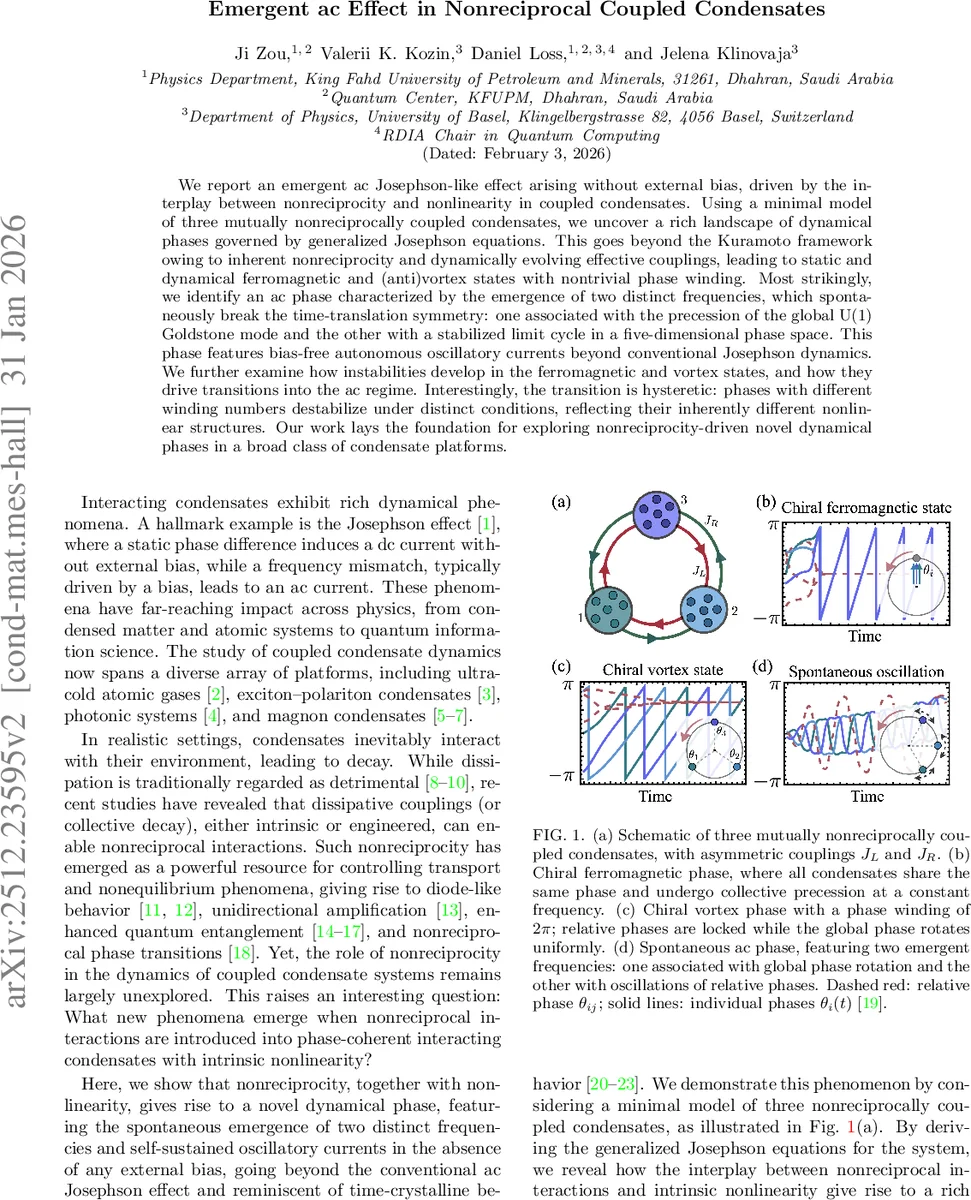
We report an emergent ac Josephson-like effect arising without external bias, driven by the interplay between nonreciprocity and nonlinearity in coupled condensates. Using a minimal model of three mutually nonreciprocally coupled condensates, we uncover a rich landscape of dynamical phases governed by generalized Josephson equations. This goes beyond the Kuramoto framework owing to inherent nonreciprocity and dynamically evolving effective couplings, leading to static and dynamical ferromagnetic and (anti)vortex states with nontrivial phase winding. Most strikingly, we identify an ac phase characterized by the emergence of two distinct frequencies, which spontaneously break the time-translation symmetry: one associated with the precession of the global U(1) Goldstone mode and the other with a stabilized limit cycle in a five-dimensional phase space. This phase features bias-free autonomous oscillatory currents beyond conventional Josephson dynamics. We further examine how instabilities develop in the ferromagnetic and vortex states, and how they drive transitions into the ac regime. Interestingly, the transition is hysteretic: phases with different winding numbers destabilize under distinct conditions, reflecting their inherently different nonlinear structures. Our work lays the foundation for exploring nonreciprocity-driven novel dynamical phases in a broad class of condensate platforms.
💡 Research Summary
The paper investigates a minimal system of three mutually non‑reciprocally coupled condensates and demonstrates that the interplay of non‑reciprocity and intrinsic nonlinearity can generate a self‑sustained alternating‑current (ac) Josephson‑like effect without any external bias. Starting from the macroscopic wavefunctions ψ_i = √N_i e^{iθ_i}, the authors derive generalized Josephson equations that include a coherent symmetric coupling J, an antisymmetric (D) component, and a dissipative non‑reciprocal coupling G. The effective coupling vectors J_L^i(t) and J_R^i(t) depend dynamically on the particle numbers N_i(t), a feature that distinguishes the model from the conventional Kuramoto description where couplings are static.
In the limit of constant particle numbers the system reduces to a non‑reciprocal Kuramoto model. The sign of G determines the static phase configuration: G < 0 favors ferromagnetic alignment (all phases equal), while G > 0 induces frustration and stabilizes vortex or anti‑vortex states with a 2π/3 phase winding around the three sites. When the full dynamics of both phases and populations are retained, the authors perform a linear stability analysis around the ferromagnetic fixed point V_F. They find that the ferromagnetic state remains stable as long as G(G + 4γ) < 12 J², showing that a finite coherent coupling J can extend stability into the G > 0 regime. This stabilization originates from the feedback between the number sector (which is intrinsically damped) and the phase sector.
Beyond the stability boundary, a Poincaré‑Andronov‑Hopf bifurcation occurs on a reduced five‑dimensional manifold M = (T² × ℝ³₊) consisting of two relative phases and three populations. The Hopf threshold is given by G_c = 2√(3J² + γ²) − γ. Above G_c, the relative phases develop a limit‑cycle oscillation with amplitude A ∝ √(G − G_c) while the global U(1) phase Φ continues to rotate uniformly at frequency Ω = −2J. Consequently, the system exhibits two independent frequencies: Ω associated with the Goldstone mode (global phase precession) and ω ≈ √3 D associated with the emergent limit cycle. This “ac” phase spontaneously breaks time‑translation symmetry, reminiscent of discrete time‑crystalline behavior, yet it requires no external drive.
The vortex (or anti‑vortex) fixed point V_V is analyzed separately. Its stability condition, G(G + 4γ)² + 72(D + J/√3)²(G + γ) < 0, differs qualitatively from the ferromagnetic case because the linearized operator around V_V has a distinct structure. Importantly, the instability thresholds for the two phases depend on the direction of parameter change, leading to hysteresis: the ferromagnetic state can persist into a region where the vortex state is also stable, and vice versa. This hysteretic behavior is absent in the purely non‑reciprocal Kuramoto model, where the transition is symmetric about G = 0.
The authors map out a comprehensive phase diagram showing four dynamical regimes: (i) static ferromagnetic, (ii) chiral ferromagnetic (global phase rotation without external bias), (iii) the autonomous ac regime with two frequencies, and (iv) vortex/anti‑vortex states. Transitions between these regimes are mediated by either Hopf bifurcations (ferromagnetic → ac) or global bifurcations (ac → vortex) when the limit‑cycle amplitude exceeds a critical value. The work highlights how non‑reciprocal dissipative coupling can act as both a source of frustration and a driver of novel collective oscillations.
Potential experimental platforms are discussed. In magnon condensates, non‑reciprocal coupling arises naturally via spin‑transfer across non‑magnetic spacers. Photonic condensates can engineer G and D through tailored lossy reservoirs or auxiliary modes, while ultracold atomic gases can implement chiral waveguides or structured optical baths to realize the required non‑reciprocity. The findings therefore open a route to explore bias‑free, self‑oscillating currents, time‑crystalline dynamics, and hysteretic phase transitions in a broad class of driven‑dissipative quantum fluids.
Comments & Academic Discussion
Loading comments...
Leave a Comment