The GLEAM 4-Jy (G4Jy) Sample: III. Further host-galaxy identification, and redshift assessment
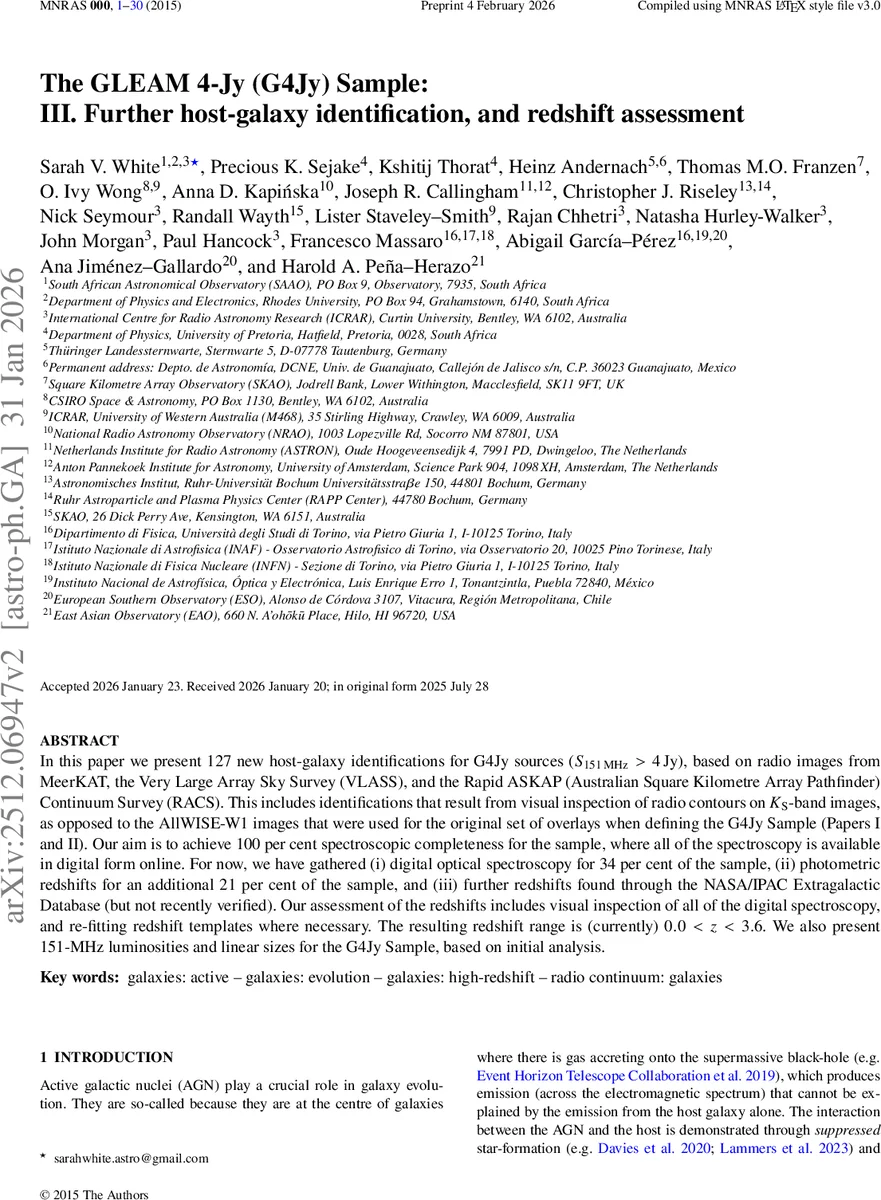
In this paper we present 127 new host-galaxy identifications for G4Jy sources (S_151MHz > 4 Jy), based on radio images from MeerKAT, the Very Large Array Sky Survey (VLASS), and the Rapid ASKAP (Australian Square Kilometre Array Pathfinder) Continuum Survey (RACS). This includes identifications that result from visual inspection of radio contours on K_s-band images, as opposed to the AllWISE-W1 images that were used for the original set of overlays when defining the G4Jy Sample (Papers I and II). Our aim is to achieve 100 per cent spectroscopic completeness for the sample, where all of the spectroscopy is available in digital form online. For now, we have gathered (i) digital optical spectroscopy for 34 per cent of the sample, (ii) photometric redshifts for an additional 21 per cent of the sample, and (iii) further redshifts found through the NASA/IPAC Extragalactic Database (but not recently verified). Our assessment of the redshifts includes visual inspection of all of the digital spectroscopy, and re-fitting redshift templates where necessary. The resulting redshift range is (currently) 0.0 < z < 3.6. We also present 151-MHz luminosities and linear sizes for the G4Jy Sample, based on initial analysis.
💡 Research Summary
The paper presents a substantial update to the host‑galaxy identifications and redshift information for the GLEAM 4‑Jy (G4Jy) sample, a complete low‑frequency radio catalogue of 1,863 sources brighter than 4 Jy at 151 MHz in the southern sky (Declination < +30°). Building on the earlier Papers I and II, which relied primarily on AllWISE‑W1 mid‑infrared overlays, the authors employ higher‑resolution radio imaging from MeerKAT, the VLA Sky Survey (VLASS), and the Rapid ASKAP Continuum Survey (RACS), together with near‑infrared Kₛ‑band data from the VISTA Hemisphere Survey (VHS). By visually inspecting radio contours over Kₛ‑band images, they add 127 new host‑galaxy identifications, particularly for sources where dust obscuration or complex radio morphology made the previous WISE‑based identifications ambiguous. When AllWISE counterparts were absent, the deeper CatWISE2020 catalogue was consulted, improving completeness for faint or crowded fields.
Redshift compilation proceeds in three tiers. First, the authors retrieve digital optical spectra for 34 % of the sample, manually inspect each spectrum, and refit redshift templates where necessary, ensuring high reliability. Second, photometric redshifts are gathered from a variety of optical and near‑infrared surveys (e.g., 6dFGS, SDSS, DES), covering an additional 21 % of the sources. The remaining 45 % rely on redshifts listed in the NASA/IPAC Extragalactic Database (NED); these have not been recently re‑verified but are included for completeness. The combined redshift distribution now spans 0 < z < 3.6, providing a broad baseline for evolutionary studies.
Using the GLEAM sub‑band flux densities (20 bands from 72 to 231 MHz), the authors compute 151‑MHz radio luminosities for the entire sample. Linear sizes are estimated from the 45‑arcsecond resolution images of SUMSS (Southern sky) and NVSS (Northern sky), which remain the basis for angular‑size measurements in this work. Preliminary analysis shows a substantial population of high‑luminosity (L₁₅₁ > 10²⁶ W Hz⁻¹) and large‑scale (linear size > 1 Mpc) radio galaxies, confirming that the low‑frequency selection captures powerful AGN out to high redshift without orientation bias. The authors argue that the improved host‑galaxy identifications and redshift completeness make the G4Jy sample an ideal target list for upcoming facilities such as the Square Kilometre Array (SKA) and ALMA, enabling detailed investigations of AGN feedback, star‑formation suppression, and environmental effects across cosmic time.
Key contributions of the paper include (1) the addition of 127 robust host‑galaxy identifications using multi‑wavelength overlays, (2) the assembly and critical assessment of spectroscopic and photometric redshifts achieving >55 % completeness, (3) the provision of initial 151‑MHz luminosities and linear sizes for the full sample, and (4) a discussion of the scientific potential of the G4Jy catalogue for future multi‑wavelength and high‑resolution studies of radio‑loud AGN. The work sets the stage for the forthcoming Paper IV, which will deliver a full multi‑wavelength catalogue and deeper physical analyses.
Comments & Academic Discussion
Loading comments...
Leave a Comment