MOBIUS: A Multi-Modal Bipedal Robot that can Walk, Crawl, Climb, and Roll
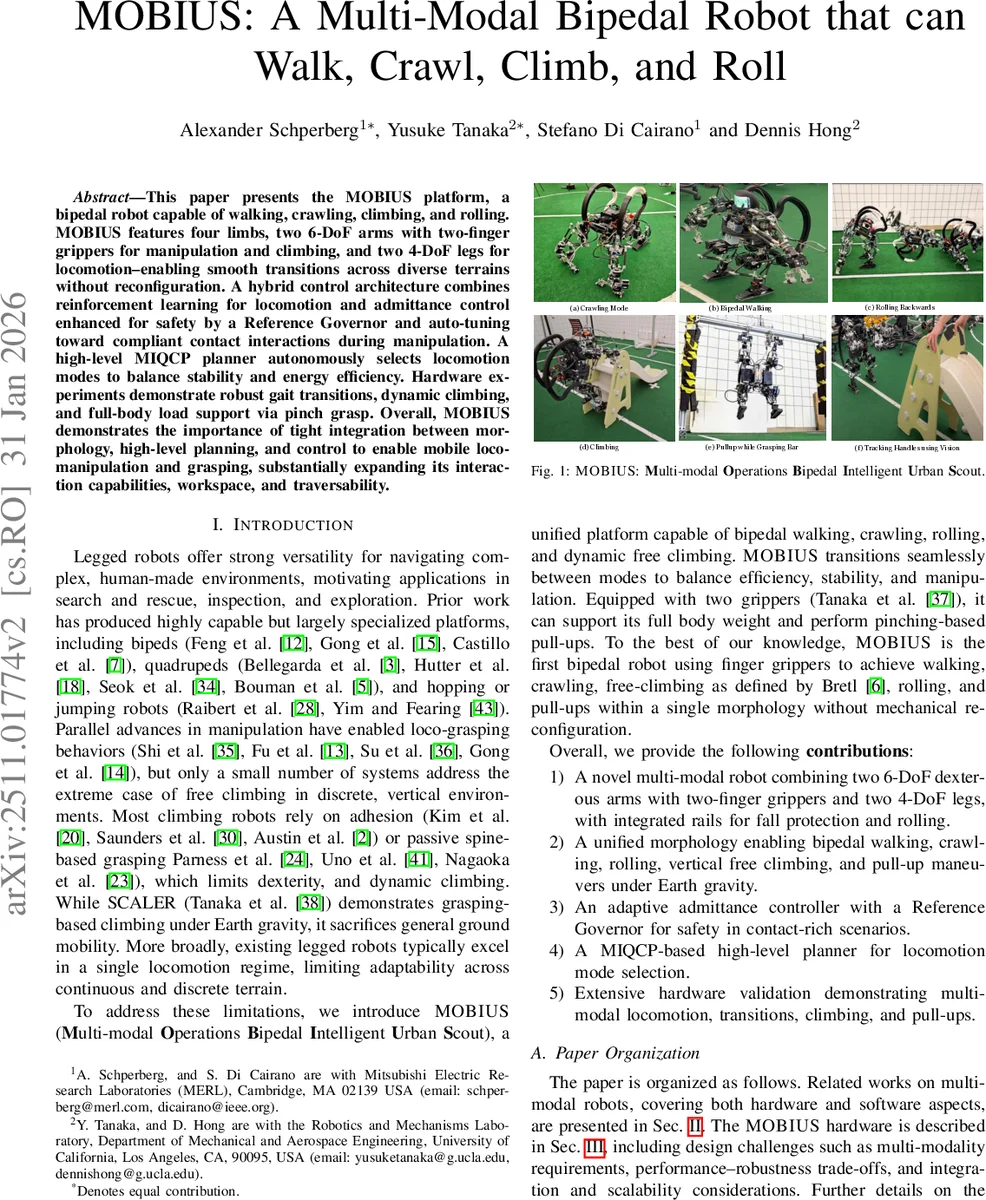
This paper presents the MOBIUS platform, a bipedal robot capable of walking, crawling, climbing, and rolling. MOBIUS features four limbs, two 6-DoF arms with two-finger grippers for manipulation and climbing, and two 4-DoF legs for locomotion–enabling smooth transitions across diverse terrains without reconfiguration. A hybrid control architecture combines reinforcement learning for locomotion and force control for compliant contact interactions during manipulation. A high-level MIQCP planner autonomously selects locomotion modes to balance stability and energy efficiency. Hardware experiments demonstrate robust gait transitions, dynamic climbing, and full-body load support via pinch grasp. Overall, MOBIUS demonstrates the importance of tight integration between morphology, high-level planning, and control to enable mobile loco-manipulation and grasping, substantially expanding its interaction capabilities, workspace, and traversability.
💡 Research Summary
The paper introduces MOBIUS, a unified multi‑modal bipedal robot capable of walking, crawling, climbing, and rolling without any mechanical reconfiguration. The platform integrates two 6‑DoF dexterous arms equipped with two‑finger spine‑based grippers and two 4‑DoF legs with flat feet. The same grippers serve both as manipulation end‑effectors and as load‑bearing contacts for crawling, climbing, and pull‑up maneuvers, enabling seamless transitions between locomotion and manipulation tasks.
The authors first review related work in two categories: (i) hardware designs that achieve multi‑modal locomotion (e.g., Harpy, LEONARDO, AuxBots, ANYmal‑Wheel) and (ii) planning and control frameworks that coordinate multiple locomotion regimes (e.g., hierarchical whole‑body control, hybrid learning approaches). They argue that most prior systems rely on mode‑specific appendages or mechanical reconfiguration, which adds mass and complexity. MOBIUS, by contrast, achieves four distinct locomotion modes with a single morphology.
Hardware design challenges are discussed in detail. The robot must support its full body weight on a single limb during bipedal walking while still providing sufficient swing velocity and stability. To meet these conflicting requirements, the authors design limb kinematics that balance force and velocity isotropy, resulting in a 210° arm workspace and a 105° leg workspace. Parallel mechanisms in the limbs improve impact resistance, and passive back rails guide the robot into recoverable postures after backward falls. The two‑finger gripper, originally developed for SCALER, is repurposed for high‑force pinch grasps, enabling the robot to support its entire weight while hanging from a bar.
The software architecture consists of three main layers. The low‑level locomotion controller for walking and crawling is based on model‑free reinforcement learning (RL). The authors formulate the problem as a partially observable Markov decision process (POMDP) and train policies with Proximal Policy Optimization (PPO). Observations include trunk state, joint angles, previous actions, desired velocities, and a short observation history; actions are target joint positions filtered through a moving average. The reward function balances stability (penalizing vertical motion, pitch/roll rates, foot slip), tracking accuracy, and smoothness, while rewarding planar velocity tracking and sufficient foot airtime.
For contact‑rich tasks such as climbing and pull‑up, the authors implement an adaptive admittance controller that maps measured wrench to desired motion. The controller parameters (desired mass, damping, stiffness, and wrench scaling) are auto‑tuned online following prior work. To guarantee safety, a Reference Governor (RG) is added; it modifies the reference trajectory in real time to keep the closed‑loop system within a Maximal Output Admissible Set (MOAS), thus preventing constraint violations while staying as close as possible to the original command.
High‑level mode selection is handled by a Mixed‑Integer Quadratically Constrained Program (MIQCP) planner. Given the robot’s current state and a 2‑D map of the environment (including terrain, obstacles, and graspable features), the planner optimizes a cost that captures energy consumption while respecting stability and reachability constraints. The planner autonomously selects the most appropriate locomotion mode (walk, crawl, roll, or climb) and triggers the corresponding low‑level controller. This enables both joystick‑driven operation and fully autonomous mode switching.
Experimental validation is extensive. The authors demonstrate: (1) robust transitions between walking, crawling, and rolling, including fall recovery via the back rails; (2) dynamic free‑climbing on vertical bars and ladders, with rapid gripper re‑grasping and body rotation; (3) full‑body load support using a pinch‑grasp pull‑up from a dead‑hang configuration; (4) a quantitative comparison between the RL locomotion policy and a model‑based Model Predictive Control (MPC) baseline, showing a 30 % higher success rate for RL on rough terrain; (5) the effectiveness of the admittance‑RG controller in mitigating external disturbances during climbing; and (6) the MIQCP planner’s ability to reduce overall energy consumption by selecting energy‑efficient modes.
The paper acknowledges limitations: rolling speed is constrained by reliance on the passive rails, the gripper’s force capacity limits prolonged full‑weight support, and the current planner operates on a 2‑D map, which may not capture complex 3‑D environments. Future work is suggested in lightweight high‑strength materials, real‑time 3‑D perception and planning, and integration into human‑robot collaborative scenarios such as disaster response.
In summary, MOBIUS showcases a tightly integrated approach that combines a versatile morphology, hybrid RL‑based and model‑based control, and an optimization‑based high‑level planner to achieve seamless multi‑modal locomotion and manipulation. The results demonstrate that a single robot can autonomously navigate and interact with highly varied terrains, expanding the operational workspace and functional capabilities of legged robots.
Comments & Academic Discussion
Loading comments...
Leave a Comment