Transient and steady-state chaos in dissipative quantum systems
Dissipative quantum chaos plays a central role in the characterization and control of information scrambling, non-unitary evolution, and thermalization, but it still lacks a precise definition. The Grobe-Haake-Sommers conjecture, which links Ginibre level repulsion to classical chaotic dynamics, was recently shown to fail [Phys. Rev. Lett. 133, 240404 (2024)]. We properly restore the quantum-classical correspondence through a dynamical approach based on entanglement entropy and out-of-time-order correlators (OTOCs), which reveal signatures of chaos beyond spectral statistics. Focusing on the open anisotropic Dicke model, we identify two distinct regimes: transient chaos, marked by rapid early-time growth of entanglement and OTOCs followed by low saturation values, and steady-state chaos, characterized by high long-time values. We introduce a random matrix toy model and show that Ginibre spectral statistics signals short-time chaos rather than steady-state chaos. Our results establish entanglement dynamics and OTOCs as reliable diagnostics of dissipative quantum chaos across different timescales.
💡 Research Summary
The paper tackles the long‑standing problem of defining chaos in open (dissipative) quantum systems. While the Grobe‑Haake‑Sommers (GHS) conjecture linked classical chaotic attractors to Ginibre level repulsion in the Liouvillian spectrum, recent work (Phys. Rev. Lett. 133, 240404 (2024)) demonstrated that this correspondence fails in general. The authors therefore propose a dynamical approach based on two time‑dependent quantities: the von Neumann entropy (VNE) of subsystems and out‑of‑time‑order correlators (OTOCs). Both are evaluated for the open anisotropic Dicke model (ADM) with photon loss described by a Lindblad master equation.
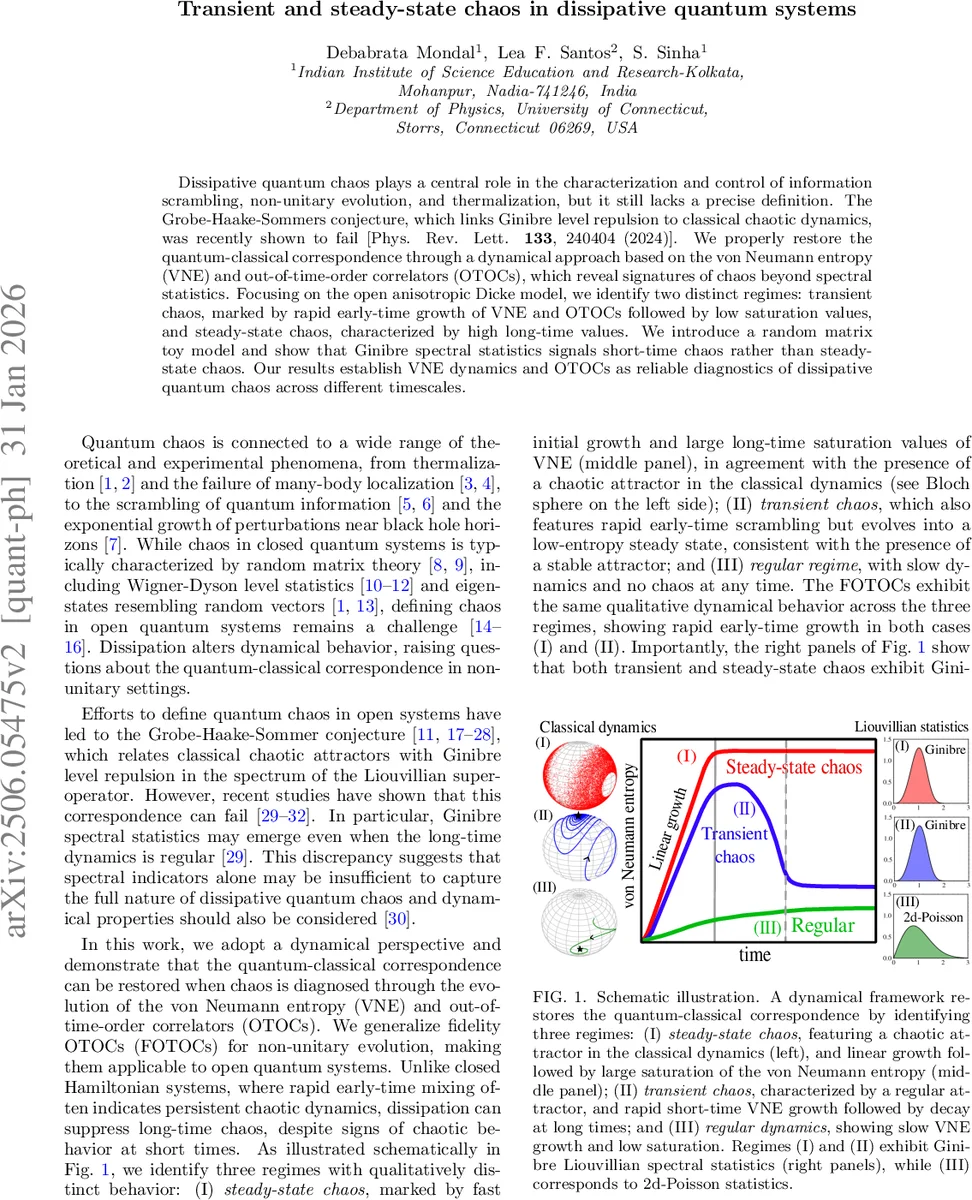
Three dynamical regimes are identified. (I) Steady‑state chaos: the classical system possesses a chaotic attractor; the quantum VNE and OTOC grow rapidly at early times and saturate at high values, reflecting persistent chaotic dynamics in the steady state. (II) Transient chaos: early‑time growth of VNE and OTOC is equally fast, but dissipation eventually drives the system to a regular attractor, leading to low long‑time saturation values. (III) Regular regime: both growth and saturation are weak, indicating the absence of chaos. The authors verify that the long‑time Lyapunov exponent Λ_ss and the steady‑state VNE S_VN^ss are strongly correlated across the λ_±–κ parameter plane, both in the isolated (κ = 0) and dissipative (κ > 0) cases. This demonstrates that VNE, unlike Liouvillian level statistics, faithfully tracks classical chaos even under dissipation.
To make OTOCs applicable to non‑unitary dynamics, the authors generalize fidelity OTOCs (FOTOCs) by evolving the operator W with the adjoint Liouvillian L†. In the perturbative limit (small rotation δϕ), the FOTOC reduces to 1 − δϕ²(ΔG(t))², where ΔG(t) is the variance of a Hermitian operator G. The early‑time exponential growth of ΔG(t) mirrors the Lyapunov exponent, while its steady‑state value ΔG_ss serves as an additional chaos indicator.
The Dicke limit (λ_− = λ_+ = λ) is used to illustrate transient versus steady‑state chaos. With increasing photon loss κ, the finite‑time Lyapunov exponent Λ_t decays to zero, the VNE growth rate remains large initially but its long‑time plateau drops, and ΔS_z(t) (the spin‑z variance extracted from the FOTOC) shows the same pattern. Moreover, the early‑time VNE slope S_VN^slope and the short‑time averaged Lyapunov exponent scale almost linearly with the coupling λ, confirming that VNE is a sensitive probe of transient chaotic behavior.
To separate the role of spectral statistics from dynamical signatures, a random‑matrix toy model is introduced. The Hamiltonian consists of a tridiagonal random matrix H_TD plus a tunable perturbation μ H_I, where H_I can be a full GOE matrix or a GOE matrix projected to protect certain eigenstates. Dissipation is added via a jump operator L that yields a Lindblad Liouvillian. When μ = 1 the Liouvillian spectrum follows Ginibre statistics; when μ = 0 it follows two‑dimensional Poisson statistics. Simulations show that in the Ginibre regime the VNE of a subsystem grows rapidly and saturates near its maximal value, indicating both short‑time and steady‑state chaos. In the Poisson regime the entropy grows slowly and saturates at a low value, reflecting regular dynamics. By introducing a projection parameter χ that shields the dominant eigenstates of the steady‑state density matrix, the authors can generate a situation where the early‑time VNE growth remains fast (signalling transient chaos) while the long‑time entropy stays low (signalling regular steady state). This demonstrates that Ginibre level repulsion captures only the presence of early‑time chaotic mixing, not the nature of the asymptotic state.
Overall, the work establishes that in dissipative quantum systems, spectral diagnostics alone are insufficient. Time‑resolved VNE and OTOC dynamics provide a robust, experimentally accessible framework to distinguish transient from steady‑state chaos, restoring the quantum‑classical correspondence across all timescales. These findings have broad implications for quantum information scrambling, thermalization, and the design of non‑unitary quantum control protocols.
Comments & Academic Discussion
Loading comments...
Leave a Comment