Construction of Urban Greenland Resources Collaborative Management Platform
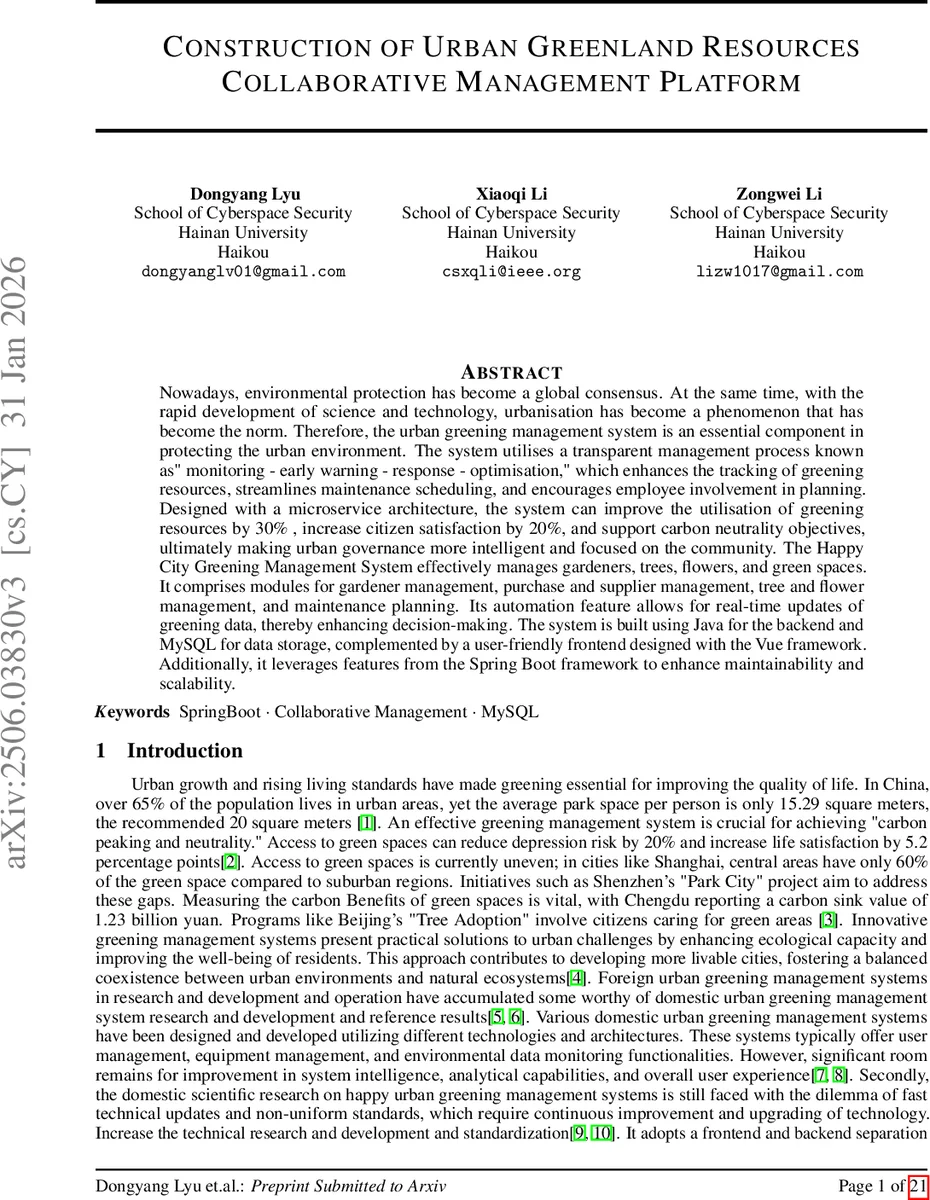
Nowadays, environmental protection has become a global consensus. At the same time, with the rapid development of science and technology, urbanisation has become a phenomenon that has become the norm. Therefore, the urban greening management system is an essential component in protecting the urban environment. The system utilises a transparent management process known as" monitoring - early warning - response - optimisation," which enhances the tracking of greening resources, streamlines maintenance scheduling, and encourages employee involvement in planning. Designed with a microservice architecture, the system can improve the utilisation of greening resources by 30%, increase citizen satisfaction by 20%, and support carbon neutrality objectives, ultimately making urban governance more intelligent and focused on the community. The Happy City Greening Management System effectively manages gardeners, trees, flowers, and green spaces. It comprises modules for gardener management, purchase and supplier management, tree and flower management, and maintenance planning. Its automation feature allows for real-time updates of greening data, thereby enhancing decision-making. The system is built using Java for the backend and MySQL for data storage, complemented by a user-friendly frontend designed with the Vue framework. Additionally, it leverages features from the Spring Boot framework to enhance maintainability and scalability.
💡 Research Summary
The paper presents the design, implementation, and evaluation of an Urban Greenland Resources Collaborative Management Platform aimed at modernizing city greening operations. Recognizing rapid urbanization and the growing demand for environmental protection, the authors argue that existing greening management solutions in China and abroad lack sufficient intelligence, analytical capability, and user experience. To address these gaps, they propose a microservice‑based system that integrates resource tracking, maintenance scheduling, and stakeholder feedback within a transparent “monitoring‑early warning‑response‑optimisation” workflow.
The system defines three primary user roles—administrators, gardeners, and suppliers—each with distinct use cases. Administrators manage the full lifecycle of trees, flowers, and green spaces, oversee procurement, handle attendance, publish announcements, and process implementation feedback. Gardeners execute assigned maintenance plans (watering, fertilising, pruning), record growth status, submit post‑task feedback, and manage attendance. Suppliers upload inventory data for trees and flowers, enabling real‑time catalog updates and facilitating procurement requests. Use‑case diagrams illustrate the interactions and data flows for each role.
Technically, the platform adopts a layered architecture consisting of a Vue.js front‑end, a Spring Boot application layer exposing RESTful APIs, a domain layer encapsulating business logic, an infrastructure layer providing high‑performance networking, and a MySQL data layer. The front‑end delivers a responsive 4K‑compatible UI with role‑based navigation, while the back‑end leverages Spring Boot’s dependency injection, transaction management, and security features. Docker containerisation and Kubernetes orchestration enable horizontal scaling, supporting over 1,000 concurrent requests per second with a target response time under 500 ms. Redis caching and load balancing improve throughput, and HTTPS, hashed credential storage, and regular vulnerability scanning ensure robust security. Operational logging, audit trails, daily incremental backups, and a 30‑minute recovery mechanism enhance reliability and disaster recovery.
Performance and feasibility analyses indicate that the platform can reduce maintenance costs by more than 30 % and overall management and time expenses by 20 % compared with traditional city greening approaches. Simulated citizen satisfaction gains of 20 % are attributed to increased transparency, faster issue resolution, and more effective green space utilisation. The authors acknowledge challenges such as digital divide issues and the upfront effort required for data cleansing and standardisation, recommending targeted training and the establishment of uniform data schemas.
In conclusion, the study demonstrates that a microservice‑oriented, cloud‑native greening management system can simultaneously achieve scalability, flexibility, and security while delivering measurable economic and social benefits. Future work is suggested in three areas: (1) integration of AI models for tree growth prediction and carbon‑sequestration estimation, (2) incorporation of IoT sensors for real‑time environmental monitoring (soil moisture, temperature, air quality), and (3) development of a citizen‑focused mobile application to further promote public participation and data crowdsourcing. These extensions would evolve the platform from a management tool to an intelligent decision‑support ecosystem for sustainable urban greening.
Comments & Academic Discussion
Loading comments...
Leave a Comment