Extended circular nim
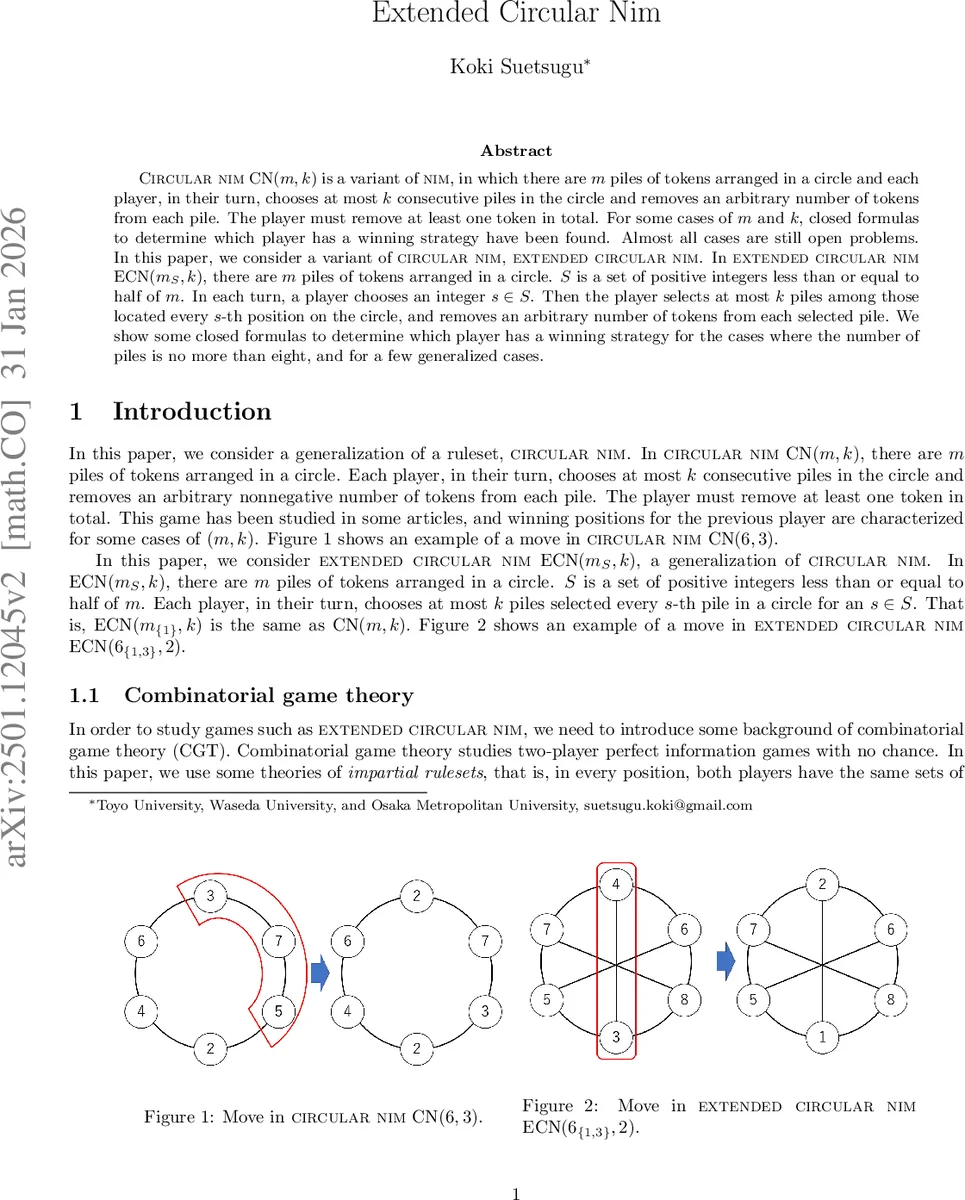
Circular nim $CN(m, k)$ is a variant of nim, in which there are $m$ piles of tokens arranged in a circle and each player, in their turn, chooses at most $k$ consecutive piles in the circle and removes an arbitrary number of tokens from each pile. The player must remove at least one token in total. For some cases of $m$ and $k$, closed formulas to determine which player has a winning strategy have been found. Almost all cases are still open problems. In this paper, we consider a variant of circular nim, extended circular nim. In extended circular nim $ECN(m_S, k)$, there are $m$ piles of tokes arranged in a circle. $S$ is a set of positive integers less than or equal to half of $m$. In each turn, a player chooses an integer $s \in S$. Then the player selects at most $k$ piles among those located every $s$-th position on the circle, and removes an arbitrary number of tokens from each selected pile. We show some closed formulas to determine which player has a winning strategy for the cases where the number of piles is no more than eight, and for a few generalized cases.
💡 Research Summary
The paper introduces a new impartial combinatorial game called Extended Circular Nim (ECN), which generalizes the well‑studied Circular Nim (CN). In ECN there are m piles arranged in a circle, a set S of allowed step sizes (each s ≤ ⌊m/2⌋), and a bound k on the number of piles that may be selected in a single move. On a turn a player first chooses an s ∈ S, then may remove any positive number of tokens from at most k piles that lie every s‑th position around the circle. The game ends under normal play convention (the player unable to move loses).
The authors first place ECN in the context of existing games: when S ={1} it coincides with CN, and for certain choices of a ≥ 4 and b ∈ S they prove isomorphisms with Moore’s Nim (MN) or with lower‑parameter ECN instances (Theorem 7). This observation allows many ECN instances to be reduced to already solved games, dramatically simplifying the analysis.
Using these reductions, the paper quickly resolves all ECN instances with fewer than six piles. For example, ECN(4,{2},2) can be viewed as a two‑pile Nim after pairing opposite piles, while ECN(5,{1,2},2) and ECN(5,{1,2},3) are isomorphic to MN(5,2) and MN(5,3) respectively.
The core contribution lies in the exhaustive treatment of the cases m = 6, 7, 8. For each value the authors derive closed‑form characterizations of the P‑positions (previous‑player winning positions). These characterizations are expressed as systems of linear equalities, minimum/maximum constraints, and XOR (binary exclusive‑or) conditions, mirroring the known formulas for ordinary CN but adapted to the richer move set introduced by S.
-
For m = 6, the paper shows that when k = 3 the P‑positions satisfy two linear equations (n₀+n₁ = n₃+n₄ and n₁+n₂ = n₄+n₅), exactly as in CN(6,3). When k = 4 an additional XOR condition (n₀⊕n₂⊕n₄ = 0) and a minimum‑value condition appear, reflecting the extra flexibility of selecting four piles.
-
For m = 7, the P‑positions split into four families (P₁–P₄) involving equalities among subsets of piles, constraints on minima, and ordering relations. The authors demonstrate how each family persists or transforms when the step set S contains 1, 2, or 3, exploiting the rotational and reflective symmetries of the circle.
-
For m = 8, the characterization again involves a zero‑pile condition, equalities among sums of selected piles, and a minimum‑value condition that depends on the sum of two non‑adjacent piles. The analysis shows that when S includes the half‑step (s = 4), the game effectively decomposes into two independent 4‑pile subgames.
Beyond these concrete cases, the paper presents three general theorems (Theorems 11, 14, 16) that describe how the structure of S and the relationship between k and the greatest common divisor of the step sizes dictate the form of the P‑positions for arbitrary m. The key insight is that if the common multiple of the allowed steps does not exceed k, the player can select any subset of piles, making the game isomorphic to Moore’s Nim with parameter k. Otherwise, the allowed selections are constrained, leading to mixed linear‑XOR conditions.
The authors also discuss the Sprague‑Grundy (SG) theory for ECN. By treating each step size s as an independent subgame, the SG value of a position is the XOR of the SG values of the subgames. This observation extends the classic SG analysis of Nim and Moore’s Nim to the more complex ECN framework and provides a pathway for analyzing selective sums (where a player may move in several components simultaneously).
In the concluding section the paper emphasizes that the complete classification of ECN for m ≤ 8 fills a notable gap in the literature on circular Nim variants. It also outlines future directions: extending the closed‑form results to larger numbers of piles, exploring arbitrary step‑sets S (beyond the simple {1,…,⌊m/2⌋}), and developing algorithmic methods for computing SG values in the general case. The work thus not only resolves a set of previously open problems but also establishes a methodological bridge between circular Nim, Moore’s Nim, and broader impartial game theory.
Comments & Academic Discussion
Loading comments...
Leave a Comment