EEO-TFV: Escape-Explore Optimizer for Web-Scale Time-Series Forecasting and Vision Analysis
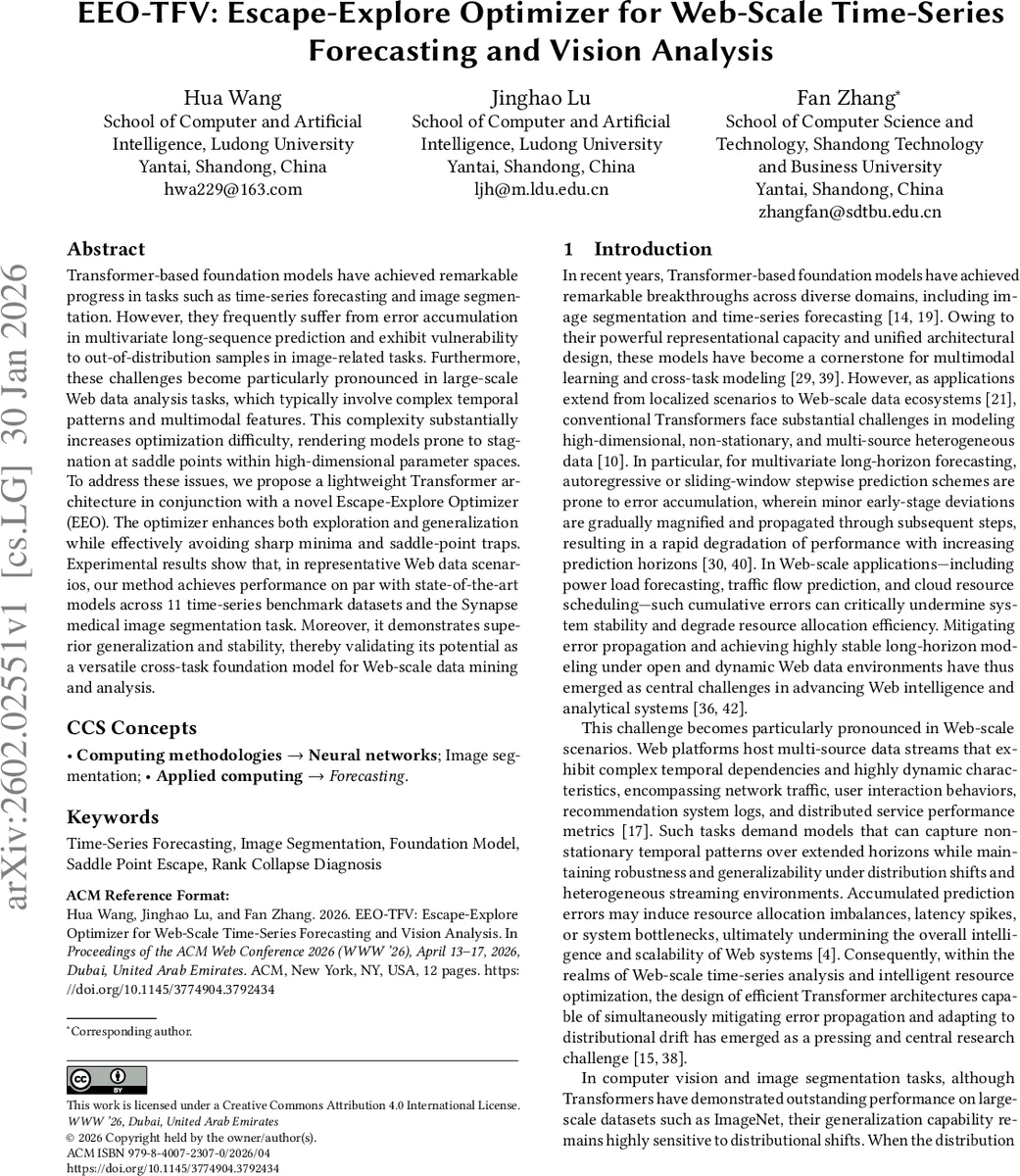
Transformer-based foundation models have achieved remarkable progress in tasks such as time-series forecasting and image segmentation. However, they frequently suffer from error accumulation in multivariate long-sequence prediction and exhibit vulnerability to out-of-distribution samples in image-related tasks. Furthermore, these challenges become particularly pronounced in large-scale Web data analysis tasks, which typically involve complex temporal patterns and multimodal features. This complexity substantially increases optimization difficulty, rendering models prone to stagnation at saddle points within high-dimensional parameter spaces. To address these issues, we propose a lightweight Transformer architecture in conjunction with a novel Escape-Explore Optimizer (EEO). The optimizer enhances both exploration and generalization while effectively avoiding sharp minima and saddle-point traps. Experimental results show that, in representative Web data scenarios, our method achieves performance on par with state-of-the-art models across 11 time-series benchmark datasets and the Synapse medical image segmentation task. Moreover, it demonstrates superior generalization and stability, thereby validating its potential as a versatile cross-task foundation model for Web-scale data mining and analysis.
💡 Research Summary
The paper introduces EEO‑TFV, a unified framework that couples a lightweight, channel‑wise attention Transformer with a novel optimization algorithm called the Escape‑Explore Optimizer (EEO). The authors motivate the work by highlighting three major challenges that arise when applying Transformer‑based foundation models to web‑scale multimodal data: (1) error accumulation in long‑horizon multivariate time‑series forecasting, (2) vulnerability to out‑of‑distribution (OOD) samples in vision tasks, and (3) difficulty escaping sharp minima or saddle points in the high‑dimensional loss landscape. To address these, the proposed Transformer reduces architectural complexity by focusing on channel‑wise self‑attention, which mitigates entropy collapse and rank degradation that are known to impair representational capacity in deep attention stacks.
EEO builds on Sharpness‑Aware Minimization (SAM) but adds two complementary mechanisms. The first, negative‑curvature escape, approximates Hessian‑vector products via finite differences and uses power iteration to locate directions of negative curvature. An “escape kick” is then applied along these directions, pushing the parameters out of sharp saddle regions that would otherwise trap the optimizer. The second, stochastic exploration, injects controlled Gaussian noise through Stochastic Gradient Langevin Dynamics (SGLD) and simultaneously maintains an exponential moving average (EMA) of the parameters. This combination encourages broader exploration of the parameter space while smoothing out high‑frequency fluctuations, leading to flatter minima and improved generalization.
Theoretical analysis shows that EEO inherits SAM’s flat‑region convergence guarantees and, thanks to the curvature‑based perturbations, satisfies known conditions for escaping strict saddles in non‑convex optimization. Moreover, the SGLD‑EMA component is shown to converge to a Gibbs distribution, providing a probabilistic justification for its regularizing effect.
Empirically, the authors evaluate EEO‑TFV on eleven public time‑series benchmarks (including ETT, Traffic, Electricity, and others) and on the Synapse 3D medical image segmentation dataset. In forecasting, EEO‑TFV achieves lower Mean Squared Error (MSE) and Mean Absolute Error (MAE) than strong baselines such as Informer, Autoformer, TimesFM, and Chronos, with gains of roughly 3‑5 % on average and especially pronounced improvements for horizons of 96‑192 steps, where error propagation is most severe. For segmentation, the model attains higher Dice scores and lower Hausdorff distances than SAM‑based counterparts, improving by 2‑4 % and demonstrating robustness under OOD perturbations (e.g., blurred or noisy scans). Training curves reveal reduced loss volatility and comparable or slightly faster convergence relative to standard optimizers.
Overall, EEO‑TFV demonstrates that a modest reduction in Transformer complexity, when paired with a curvature‑aware escape phase and a noise‑driven exploration phase, can substantially improve stability, generalization, and scalability of foundation models across disparate tasks. The work positions EEO‑TFV as a promising candidate for web‑scale intelligence platforms that must handle heterogeneous time‑series streams and multimodal visual data while remaining resilient to distribution shifts and optimization pitfalls.
Comments & Academic Discussion
Loading comments...
Leave a Comment