Memory effects govern scale-free dynamics beyond universality classes
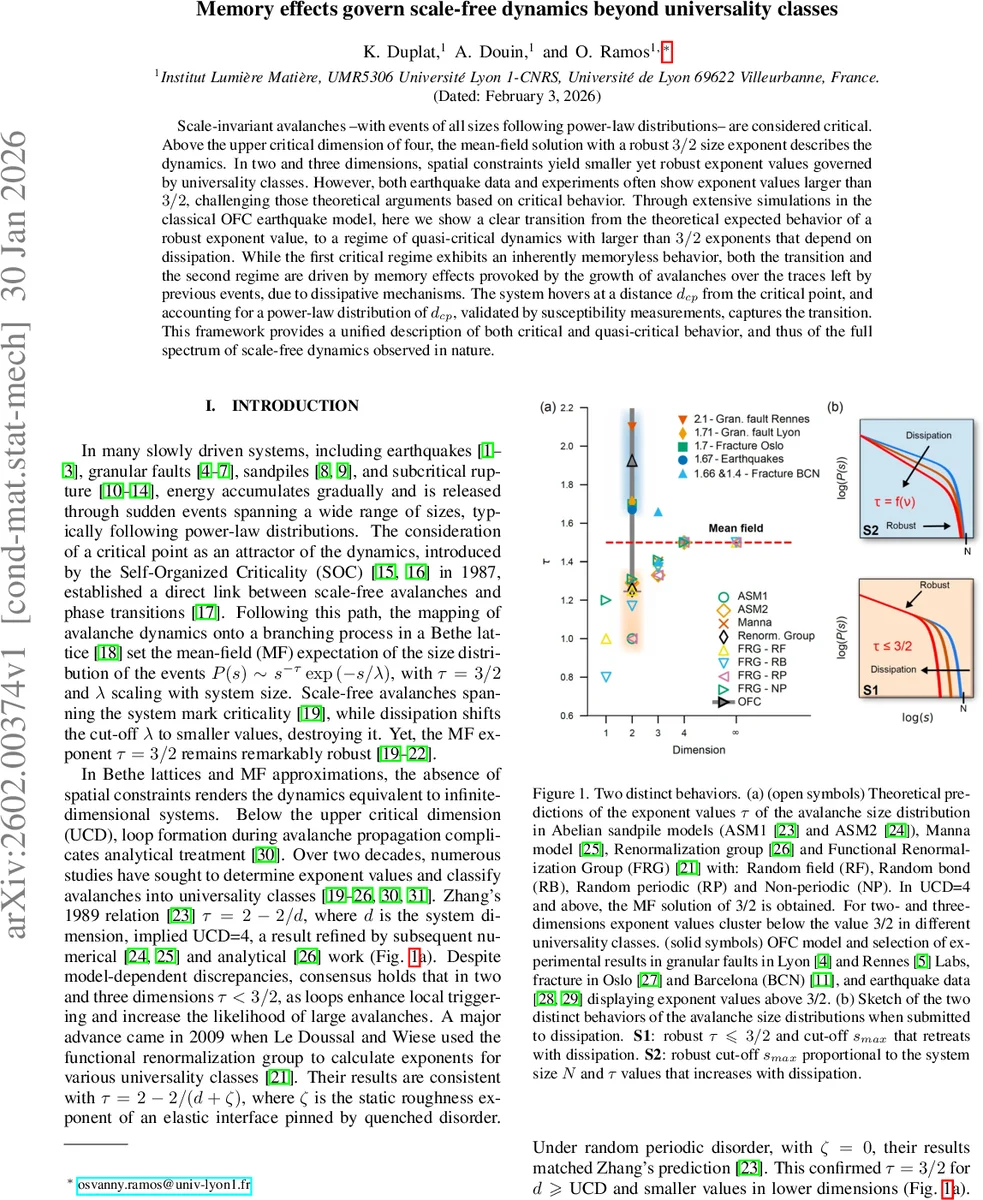
Scale-invariant avalanches – with events of all sizes following power-law distributions – are considered critical. Above the upper critical dimension of four, the mean-field solution with a robust $3/2$ size exponent describes the dynamics. In two and three dimensions, spatial constraints yield smaller yet robust exponent values governed by universality classes. However, both earthquake data and experiments often show exponent values larger than $3/2$, challenging those theoretical arguments based on critical behavior. Through extensive simulations in the classical OFC earthquake model, here we show a clear transition from the theoretical expected behavior of a robust exponent value, to a regime of quasi-critical dynamics with larger than $3/2$ exponents that depend on dissipation. While the first critical regime exhibits an inherently memoryless behavior, both the transition and the second regime are driven by memory effects provoked by the growth of avalanches over the traces left by previous events, due to dissipative mechanisms. The system hovers at a distance $d_{cp}$ from the critical point, and accounting for a power-law distribution of $d_{cp}$, validated by susceptibility measurements, captures the transition. This framework provides a unified description of both critical and quasi-critical behavior, and thus of the full spectrum of scale-free dynamics observed in nature.
💡 Research Summary
The paper tackles a long‑standing discrepancy between the classic self‑organized criticality (SOC) picture of scale‑free avalanches—where the avalanche‑size distribution follows a mean‑field power law P(s)∝s⁻³ᐟ²—and the empirical observation that many natural and laboratory systems (earthquakes, granular faults, fracture experiments) display exponents larger than 3/2. Using extensive numerical simulations of the Olami‑Feder‑Christensen (OFC) earthquake model on two‑dimensional lattices, the authors uncover two distinct dynamical regimes separated by a sharp transition controlled by the dissipation parameter ν=1‑4α.
In the low‑dissipation regime (ν < 2 %), the system behaves like a memory‑less branching process on a Bethe lattice. The avalanche‑size distribution exhibits a robust exponent τ≈1.22, and the cutoff size s_max recedes with increasing ν. Inter‑event times follow a Poisson distribution, indicating the absence of temporal correlations. The thin “trace” left by each avalanche (quantified by the thickness δz) is insufficient to affect subsequent events, so the dynamics are essentially memory‑free (the authors label this S1).
When dissipation exceeds about 2 %, a second regime (S2) emerges. The trace thickness grows sharply, and the product ⟨δz⟩·⟨s⟩¹ᐟ²—representing a boundary layer that combines trace thickness and the rim of the avalanche—reaches a maximum at the transition. In S2, inter‑event times develop a power‑law tail (exponent γ increasing with ν), signalling strong memory effects and temporal clustering. The avalanche‑size distribution remains scale‑free but the exponent τ now exceeds 3/2 and increases with ν, while the cutoff no longer retreats; instead s_max scales with the system size N, allowing system‑spanning events. Thus, dissipation alone does not generate the transition; the accumulation of traces (memory) is essential.
To isolate the role of memory, the authors introduce a “democratic triggering” algorithm that forces a randomly chosen site to topple at each loading step, thereby destroying any correlation between successive avalanches while preserving the redistribution rules. Under this protocol, regardless of ν, the system stays in the S1‑type behavior (τ≈1.22, retreating cutoff, Poisson inter‑event times) and no spatial patches form. This experiment confirms that memory effects, not dissipation per se, drive the S1‑to‑S2 crossover.
The paper also revisits the definition of criticality. Using a maximum‑susceptibility protocol χ_max(ν), they measure the largest avalanche size s_c that can be triggered from a given configuration. A configuration satisfies the “criticality criterion” (CC) if s_c ≥ N/4, meaning an arbitrarily small perturbation can generate a system‑spanning event. In the conservative case (ν = 0) almost all configurations meet CC, but as ν grows the fraction of CC‑satisfying configurations drops, especially in the S2 regime. This shows that dissipation first destroys, then gradually restores, a form of criticality mediated by memory.
Finally, the authors argue that the S2 regime provides a natural explanation for the quasi‑critical exponents observed in real earthquakes (τ≈1.67) and laboratory fracture experiments (τ > 3/2). They propose that the distance from the critical point, d_cp, follows a power‑law distribution; incorporating this distribution into the scaling analysis reproduces the observed transition and exponent variation.
In summary, the study demonstrates that scale‑free avalanche dynamics are not confined to a single universality class. Instead, they can reside in a memory‑less (S1) or a memory‑driven (S2) regime, with a dissipation‑controlled crossover governed by the accumulation of avalanche traces. This unified framework reconciles mean‑field predictions with empirical data across a wide range of driven systems, offering new insights for earthquake physics, fracture mechanics, and the broader theory of self‑organized criticality.
Comments & Academic Discussion
Loading comments...
Leave a Comment