Analysis of a numerical scheme for 3-wave kinetic equations
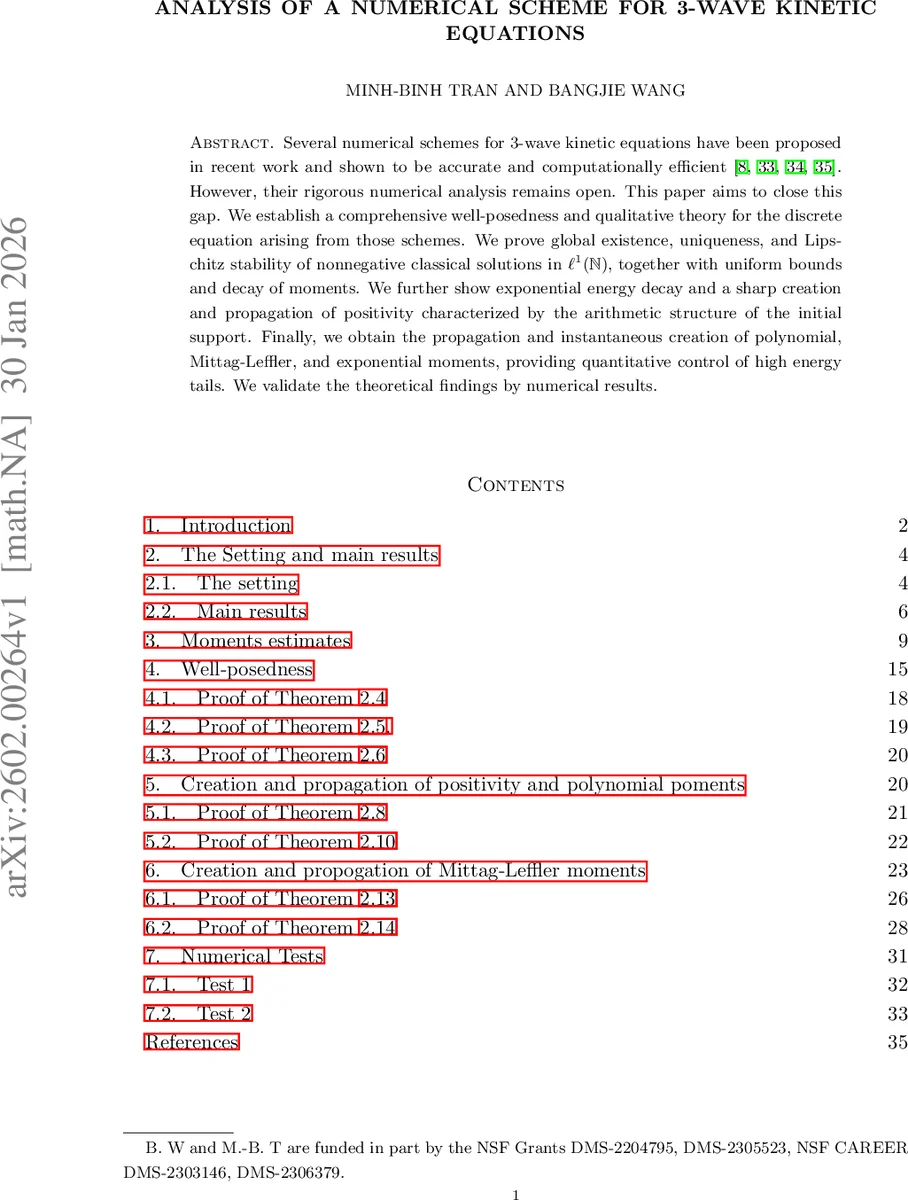
Several numerical schemes for 3-wave kinetic equations have been proposed in recent work and shown to be accurate and computationally efficient [8,33,34,35]. However, their rigorous numerical analysis remains open. This paper aims to close this gap. We establish a comprehensive well-posedness and qualitative theory for the discrete equation arising from those schemes. We prove global existence, uniqueness, and Lipschitz stability of nonnegative classical solutions in $\ell^1(\mathbb{N})$, together with uniform bounds and decay of moments. We further show exponential energy decay and a sharp creation and propagation of positivity characterized by the arithmetic structure of the initial support. Finally, we obtain the propagation and instantaneous creation of polynomial, Mittag-Leffler, and exponential moments, providing quantitative control of high energy tails. We validate the theoretical findings by numerical results.
💡 Research Summary
This paper delivers a rigorous mathematical foundation for a class of finite‑volume schemes recently introduced to approximate the isotropic three‑wave kinetic equation, a cornerstone model in wave turbulence theory. Starting from the continuous kinetic equation, the authors adopt the coagulation‑fragmentation approximation of Connaughton and Newell and discretize the frequency domain using a uniform mesh of size h, leading to the discrete system (2.1). The interaction kernels are assumed symmetric and of the form Kₙ(i,j)=i^{αₙ}j^{αₙ}(i+j)^{βₙ}, while the linear damping term is γ(i)=i^{δ}, with parameters satisfying δ > maxₙ(αₙ+βₙ) and δ > 2α₁+β₁−1.
The core contributions are:
-
Global existence, uniqueness, and Lipschitz stability (Theorems 2.4–2.5). By constructing a forward‑invariant set that simultaneously enforces non‑negativity, bounded total mass, and bounded higher‑order energy (κ‑th moment), the authors prove that the vector field points inward on the boundary of this set. Consequently, solutions remain inside for all time, yielding global classical solutions in ℓ¹(ℕ) and an exponential bound on the ℓ¹‑distance between two solutions.
-
Exponential decay of the first moment (Theorem 2.6). The linear damping term forces the total “energy” m₁(t)=∑ i f_i(t) to decay like e^{−hδt}, guaranteeing pointwise convergence to zero as t → ∞.
-
Sharp creation and propagation of positivity (Theorem 2.8). Defining I = { i | f₀(i)>0 } and g = gcd(I), the authors show that for any t > 0 the solution is strictly positive exactly on the arithmetic lattice g·ℕ and vanishes elsewhere. The proof hinges on a “positivity propagation” mechanism: gain terms generate new positive modes by adding existing ones, while loss terms cannot cancel this effect, and a number‑theoretic argument identifies the reachable set as the sublattice generated by g.
-
Propagation and instantaneous creation of polynomial moments (Corollary 2.9, Theorem 2.10). If a polynomial moment of order k is finite initially, it remains uniformly bounded for all time. Moreover, for any k > 1, even when the initial k‑th moment is infinite, the solution acquires a finite k‑th moment instantly, with an explicit bound involving the first moment and a kernel‑dependent constant B_k.
-
Propagation of Mittag‑Leffler moments and exponential tails (Theorem 2.13). Introducing the Mittag‑Leffler function E_a(x)=∑_{m≥1} x^m/Γ(am+1), the authors prove that under the stronger condition δ > 2α₁+β₁, and for a suitable λ>0, the weighted sum ∑ f_i(t) E_a(λ i^a) stays bounded by 1 for all t≥0 provided it holds initially. Since E_a behaves like exp(x^{1/a}), this result yields quantitative control of high‑energy tails, including the classical exponential moment case a=1.
The analytical strategy is built around four pillars: (i) identification of a forward‑invariant region, (ii) geometric tangency arguments for the nonlinear operator, (iii) differential‑inequality techniques for moment estimates that avoid the need for continuity in time, and (iv) a truncation‑then‑limit procedure that removes artificial cut‑offs while preserving the a‑priori bounds.
Section 7 presents two numerical experiments that corroborate the theory. The first demonstrates the lattice‑restricted positivity pattern predicted by Theorem 2.8. The second validates the moment bounds and the exponential tail decay, showing excellent agreement between the theoretical constants and the observed numerical behavior.
In summary, the paper closes a significant gap in the literature by providing a complete well‑posedness, stability, and qualitative analysis for the finite‑volume discretization of the three‑wave kinetic equation. Its results not only guarantee the reliability of the previously proposed schemes but also deepen the understanding of how discrete wave interactions generate positivity, control high‑frequency energy, and produce exponential decay, thereby offering valuable insights for both analysts and computational physicists working on wave turbulence.
Comments & Academic Discussion
Loading comments...
Leave a Comment