Fermionic magic resources in disordered quantum spin chains
Fermionic non-Gaussianity quantifies a quantum state’s deviation from a classically tractable free-fermionic description, constituting a necessary resource for computational quantum advantage. Here we use fermionic antiflatness (FAF) to measure this deviation across ergodic and many-body localized (MBL) regimes. We focus on the paradigmatic disordered spin-$1!/2$ XXZ chain and its impurity variant with local interactions. Across highly excited eigenstates, FAF evolves from typical-state behavior at weak disorder to strongly suppressed values deep in the MBL regime, with volume-law scaling in the XXZ chain and an area-law bound in the impurity setting. Rare long range catlike eigenstates exhibit a pronounced enhancement of FAF, making it a sensitive diagnostic of mechanisms proposed to destabilize MBL. Starting from product states, we find that in the MBL regime FAF grows slowly in time, approaching saturation via a power-law relaxation. Overall, our results show that MBL suppresses fermionic non-Gaussianity, and the associated complexity beyond free fermions, while ergodicity restores it, motivating explorations of fermionic non-Gaussianity in other ergodicity-breaking phenomena.
💡 Research Summary
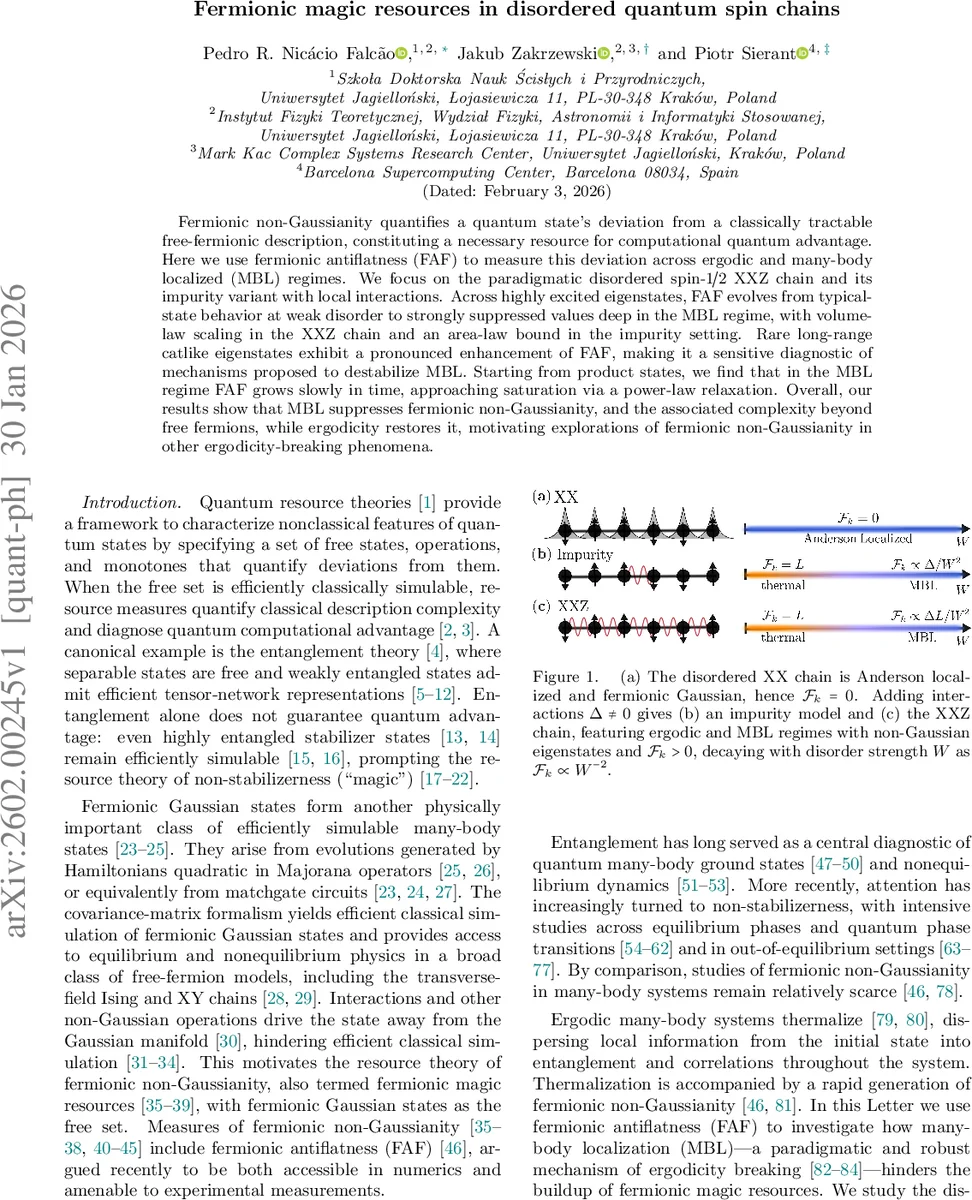
This paper investigates fermionic non‑Gaussianity—also called fermionic “magic”—as a quantitative resource for quantum computational advantage, using the recently introduced fermionic antiflatness (FAF) measure. The authors focus on two paradigmatic one‑dimensional disordered spin‑½ models: (i) the XXZ chain with random on‑site fields and a nearest‑neighbour Ising interaction Δ ∑σ_j^zσ_{j+1}^z, and (ii) an impurity variant where the interaction is confined to a single bond at the centre of the chain. By applying the Jordan–Wigner transformation the non‑interacting part H_xx becomes a quadratic Majorana Hamiltonian, whose eigenstates are fermionic Gaussian and thus have FAF = 0. The interaction terms are quartic in Majorana operators and break the free‑fermion structure, generating non‑Gaussian states.
The authors compute FAF for highly excited eigenstates across the ergodic‑to‑many‑body‑localized (MBL) crossover. Using the POLFED algorithm they obtain a representative set of mid‑spectrum eigenstates for system sizes up to L = 20 (XXZ) and L = 18 (impurity model), averaging over at least 1 000 disorder realizations. The FAF density ⟨f₁⟩ = ⟨F₁⟩/L exhibits two distinct regimes. For weak disorder (W ≲ 5 in the XXZ chain, W ≲ 1 in the impurity model) ⟨f₁⟩ approaches unity as L grows, reflecting the “typical‑state” volume‑law scaling of non‑Gaussianity in ergodic phases. In the strong‑disorder MBL regime, ⟨f₁⟩ decays as W⁻², confirming that disorder suppresses fermionic magic. Importantly, the scaling with system size differs between the two models: the XXZ chain retains a volume‑law ⟨F₁⟩ ∝ L even deep in the MBL phase, whereas the impurity model shows an area‑law bound where ⟨F₁⟩ becomes independent of L. This distinction is traced back to the number of interacting bonds N_int (extensive for the XXZ chain, unity for the impurity model) that contribute to the non‑Gaussian perturbation.
A perturbative analysis based on the decomposition of the interaction into components parallel and orthogonal to the Anderson‑localized integrals of motion (ALIOMs) explains the observed W⁻² scaling. The orthogonal component H_⊥, which genuinely breaks Gaussianity, has a norm scaling as Δ N_int W⁻¹. In the large‑W limit the quasi‑local dressing unitary U_M = e^S (with S anti‑Hermitian and ‖S‖ ∝ Δ N_int W⁻²) transforms the Majorana operators, leading to a correction δM in the covariance matrix. Expanding FAF to first order yields F_k ∝ Δ N_int W⁻², in agreement with numerics. The authors also verify that FAF grows linearly with the interaction strength Δ at fixed strong disorder, while at weak disorder even infinitesimal Δ triggers a rapid, extensive increase of FAF, signalling the onset of ergodicity.
Beyond typical eigenstates, the paper highlights rare “cat‑like” resonant states that span a macroscopic distance (≈ L/2) and exhibit long‑range spin correlations. By examining the expectation values ⟨σ_i^z⟩ for such states, the authors confirm that the resonant region contains about seven spins, and the corresponding FAF value is F₁ ≈ 7, matching the number of participating spins. Because FAF is additive for tensor‑product states, it isolates the contribution of the cat component, making FAF a highly sensitive probe of many‑body resonances—mechanisms that have been proposed to destabilize MBL.
The dynamical aspect is addressed by initializing the system in a Néel product state (which is Gaussian, FAF = 0) and evolving under the full interacting Hamiltonian. In the MBL regime, the disorder‑averaged FAF ⟨F₁(t)⟩ grows extremely slowly, following a power‑law relaxation over several decades in time before saturating at a sub‑extensive value. This mirrors the well‑known logarithmic growth of entanglement entropy in MBL and contrasts sharply with the rapid, volume‑law saturation observed in ergodic dynamics. Similar slow dynamics are observed in the impurity model.
Overall, the study demonstrates that fermionic antiflatness provides a unified quantitative framework to (i) diagnose the ergodic‑to‑MBL transition, (ii) capture the dependence of non‑Gaussian resources on disorder strength and interaction range, (iii) detect rare resonant cat‑like eigenstates that may trigger MBL breakdown, and (iv) characterize the slow buildup of fermionic magic in time‑evolution within the localized phase. By linking a resource‑theoretic measure to concrete many‑body phenomena, the work opens new avenues for exploring computational complexity, quantum advantage, and the role of non‑Gaussianity in a broad class of ergodicity‑breaking settings.
Comments & Academic Discussion
Loading comments...
Leave a Comment