Geometric Quantization by Paths, Part III: The Metaplectic Anomaly
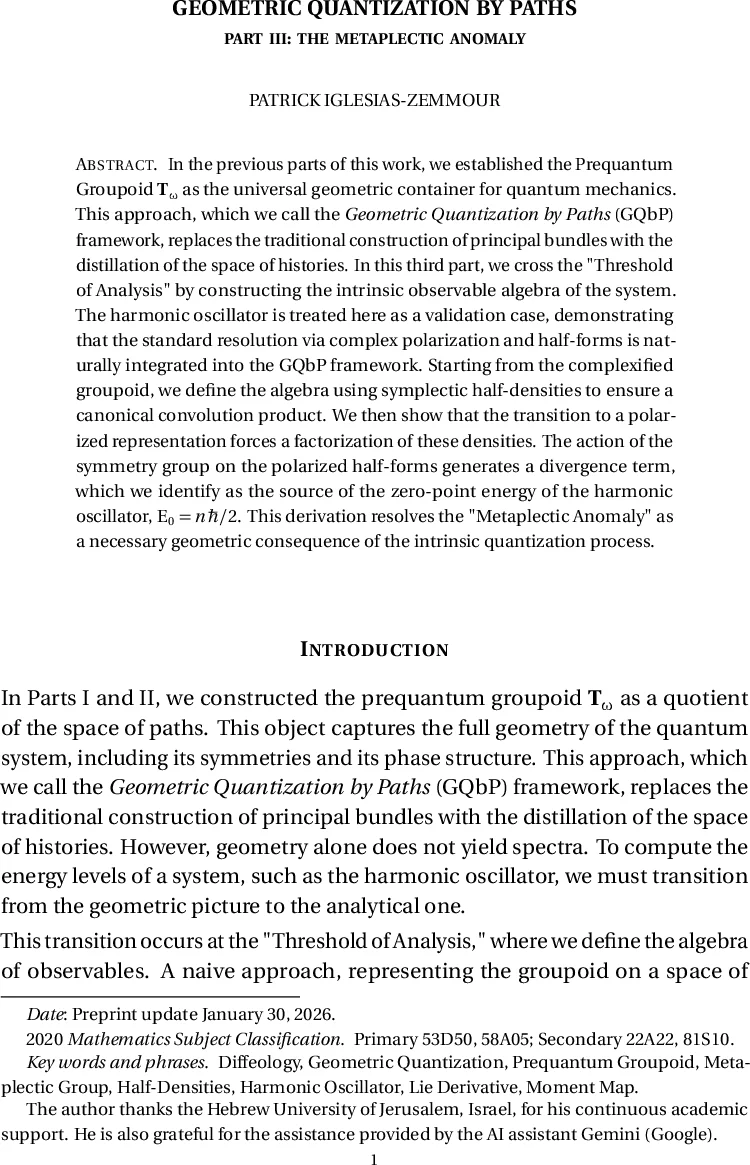
In the previous parts of this work, we established the Prequantum Groupoid $\mathbf{T}_ω$ as the universal geometric container for quantum mechanics. This approach, which we call the “Geometric Quantization by Paths” (GQbP) framework, replaces the traditional construction of principal bundles with the distillation of the space of histories. In this third part, we cross the “Threshold of Analysis” by constructing the intrinsic observable algebra of the system. The harmonic oscillator is treated here as a validation case, demonstrating that the standard resolution via complex polarization and half-forms is naturally integrated into the GQbP framework. Starting from the complexified groupoid, we define the algebra using symplectic half-densities to ensure a canonical convolution product. We then show that the transition to a polarized representation forces a factorization of these densities. The action of the symmetry group on the polarized half-forms generates a divergence term, which we identify as the source of the zero-point energy of the harmonic oscillator, $E_0 = n\hbar/2$. This derivation resolves the “Metaplectic Anomaly” as a necessary geometric consequence of the intrinsic quantization process.
💡 Research Summary
This paper continues the “Geometric Quantization by Paths” (GQbP) program by addressing the long‑standing metaplectic anomaly in a fully geometric way. The authors start from the prequantum groupoid 𝑇_ω constructed in Parts I and II as a quotient of the infinite‑dimensional path space of a symplectic manifold. For the harmonic oscillator they take the complexified phase space X = ℂⁿ with the standard symplectic form ω = (i/2)∑dz_k∧d\bar z_k and a symmetric primitive ε that is invariant under rotations. The groupoid’s arrows are triples (z, t, z′) where t ∈ ℝ/hℤ represents the relative action along a path from z to z′. A global 1‑form ϑ on the groupoid is built from ε and dt, encoding both the symplectic connection and the action variable.
The central technical contribution is the definition of an intrinsic observable algebra without invoking any external Haar measure. The authors require that the convolution product be defined purely from the geometry of the groupoid, which forces the algebra’s elements to be symplectic half‑densities. Concretely, an element is written as
Ψ(z, t, z′) = σ(z, t, z′) · (vol_ω z)^{‑½} ⊗ (vol_ω z′)^{½},
where σ is an h‑periodic scalar function. By Fourier expanding σ in the action variable one obtains σ(z, t, z′)=e^{i t/ħ}K(z, z′) with a kernel K on the base space. The convolution of two such sections reduces to an integral over the intermediate point w∈X:
(Ψ₁∗Ψ₂)(z, t, z′) = ∫_X K₁(z, w) K₂(w, z′) vol_ω(w) · (vol_ω z)^{‑½} ⊗ (vol_ω z′)^{½}.
Because the tensor product of the two half‑densities at w yields the canonical 1‑density vol_ω(w), the integration measure is supplied intrinsically, and no arbitrary choice of volume form is needed. This construction yields a closed, associative algebra that faithfully reflects the groupoid’s geometry.
To obtain a physically relevant Hilbert space, the authors then polarize the algebra by choosing the holomorphic (Kähler) polarization. The symplectic volume form factorizes as
vol_ω^{½} = vol_{hol}^{½} ⊗ vol_{anti}^{½},
and the polarization discards the anti‑holomorphic factor, leaving only sections of the holomorphic half‑form bundle:
ψ(z) = ϕ(z) · vol_{hol}^{½}.
Thus the representation space consists of holomorphic half‑densities, exactly as in the traditional half‑form correction of geometric quantization.
The metaplectic anomaly emerges naturally from this polarization. While the full symplectic group preserves the total half‑density, it does not preserve the holomorphic and anti‑holomorphic factors separately; a rotation R_t acts by a phase on vol_{hol}^{½} that is compensated by the opposite phase on vol_{anti}^{½}. After fixing the polarization, only the holomorphic phase remains, producing a non‑trivial cocycle. Computing the Lie derivative of the holomorphic half‑form with respect to the Hamiltonian vector field ξ_H (the generator of rotations) gives
L_{ξ_H} vol_{hol}^{½} = (i n/2) vol_{hol}^{½}.
Consequently the quantum Hamiltonian operator
Ĥ = iħ L_{ξ_H}
acts on a polarized state ψ as
Ĥ ψ = (ħ ∑k z_k ∂{z_k}) ψ + (ħ n/2) ψ.
The first term reproduces the classical energy levels, while the second term is a geometric correction equal to nħ/2, i.e. the zero‑point energy of the n‑dimensional harmonic oscillator. This shows that the zero‑point shift is not an ad‑hoc addition but a direct consequence of the divergence term arising from the factorization of the half‑density.
The authors extend the analysis to the multidimensional case using the Atiyah‑Bott fixed‑point formula applied to the half‑density bundle. The rotation flow has a unique fixed point at the origin, and the trace of the induced automorphism on the algebra yields the character
χ(t) = ∏{k=1}^n e^{i t/2}/(1 − e^{i t}) = ∑{m_1,…,m_n≥0} e^{i t(∑ m_k + n/2)}.
Expanding this series reproduces the full spectrum
E_{m_1,…,m_n} = ħ(∑ m_k + n/2),
confirming that the zero‑point energy appears as the global metaplectic weight of the vacuum, independent of any polarization choice.
In the concluding discussion the paper emphasizes that the metaplectic correction, historically introduced as an external “fix”, is here derived as an intrinsic geometric necessity of the GQbP framework. By insisting on a measure‑free convolution algebra, by employing half‑densities, and by selecting a polarization, the anomaly and the associated ħ/2 shift emerge automatically. This unifies the path‑integral intuition of Feynman with the operator‑algebraic rigor of Dirac, positioning the prequantum groupoid as a bridge between the two foundational approaches to quantization. The work thus validates GQbP as a robust, mathematically precise, and physically faithful quantization scheme.
Comments & Academic Discussion
Loading comments...
Leave a Comment