Ensuring Semantics in Weights of Implicit Neural Representations through the Implicit Function Theorem
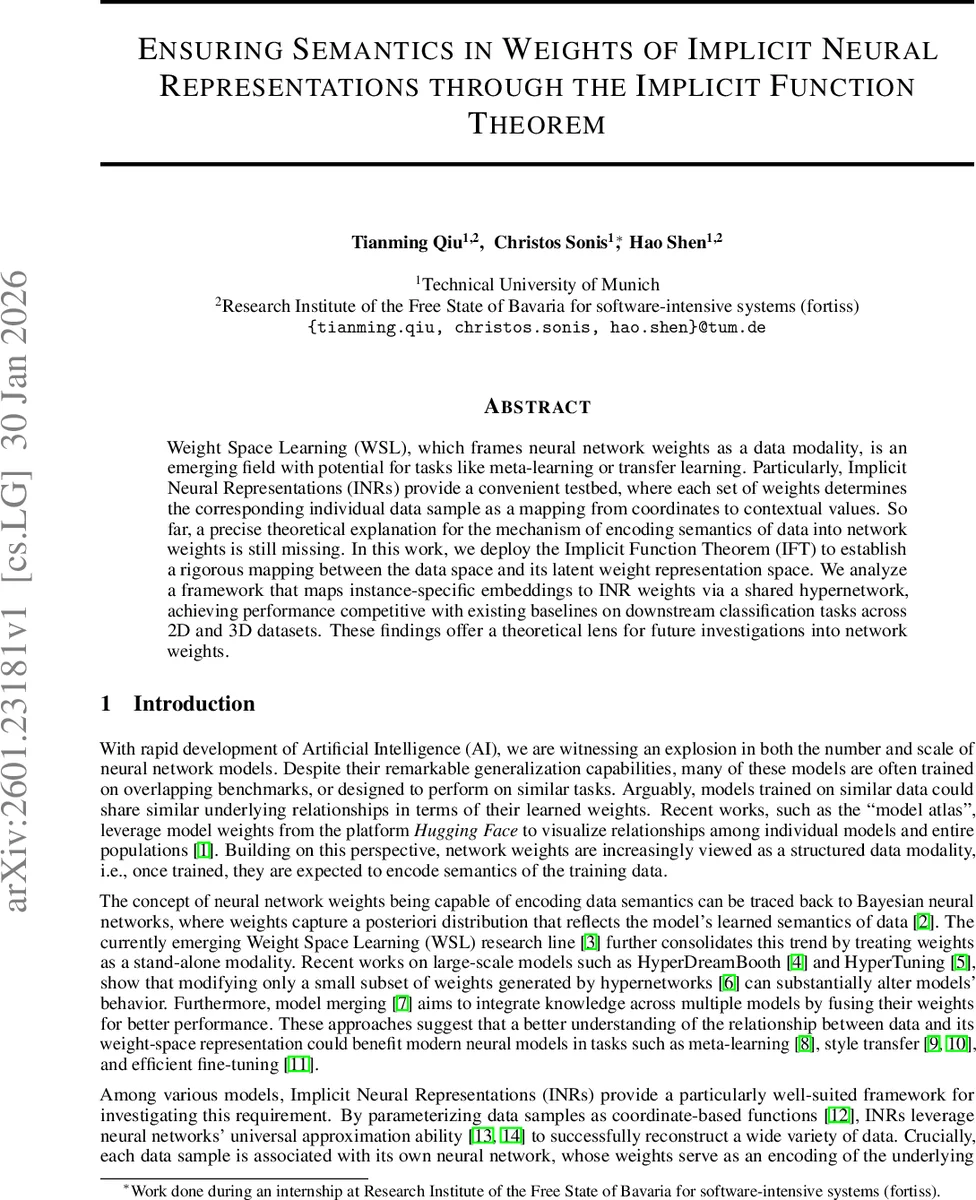
Weight Space Learning (WSL), which frames neural network weights as a data modality, is an emerging field with potential for tasks like meta-learning or transfer learning. Particularly, Implicit Neural Representations (INRs) provide a convenient testbed, where each set of weights determines the corresponding individual data sample as a mapping from coordinates to contextual values. So far, a precise theoretical explanation for the mechanism of encoding semantics of data into network weights is still missing. In this work, we deploy the Implicit Function Theorem (IFT) to establish a rigorous mapping between the data space and its latent weight representation space. We analyze a framework that maps instance-specific embeddings to INR weights via a shared hypernetwork, achieving performance competitive with existing baselines on downstream classification tasks across 2D and 3D datasets. These findings offer a theoretical lens for future investigations into network weights.
💡 Research Summary
The paper tackles a fundamental question in Weight Space Learning (WSL): how can the semantics of data be faithfully encoded in the parameters of Implicit Neural Representations (INRs)? To answer this, the authors introduce a HyperINR framework in which a shared hypernetwork ϕ(v,·) maps a low‑dimensional latent code z∈ℝ^l to the full weight vector w∈ℝ^d of a coordinate‑based INR f(w,·). The hypernetwork parameters v are shared across all instances, while each data sample X_j has its own latent embedding z_j. Training jointly optimizes v and all z_j to minimize a reconstruction loss ℓ(v, z_j, X_j) that measures the Frobenius norm between the INR output and the ground‑truth pixel or unsigned distance values at a set of sampled coordinates {p_i}.
The core theoretical contribution is an application of the Implicit Function Theorem (IFT). By defining ξ_v(z, X)=∇_z ℓ(v, z, X) and examining its Jacobian D₁ξ_v, the authors show that D₁ξ_v is a sum of n positive semi‑definite matrices of rank at most c (the output dimension). Consequently, a sufficient condition for D₁ξ_v to be full rank (rank = l) is nc ≥ l, where n is the number of coordinate samples per instance. Under this condition, the global IFT guarantees a unique smooth mapping g: X→Z such that ξ_v(g(X), X)=0, i.e., each data point has a unique latent code that yields zero gradient of the loss. Locally, the classic IFT ensures that in a neighbourhood of any training sample X_j there exists a diffeomorphic mapping between the data manifold and the latent weight space. Thus, if the Jacobian is full rank for all training samples, the learned embeddings preserve the local semantics of the data; with enough samples, this local preservation can extend to global semantics.
Experimentally, the authors follow a two‑phase pipeline. Phase A jointly learns the hypernetwork and embeddings on training data, then freezes v* and infers embeddings for test data by minimizing the same reconstruction loss. Phase B uses the resulting embeddings as features for downstream classification. Five benchmarks are used: MNIST and FashionMNIST (2‑D images) and ModelNet40, ShapeNet10, ScanNet10 (3‑D shapes). Classification is performed with simple linear or MLP classifiers. HyperINR consistently outperforms permutation‑invariant baselines such as DWSNet, NFN, and MWT, achieving 2–4 percentage points higher accuracy across datasets. Moreover, the embeddings form well‑separated clusters in latent space, confirming that the Jacobian full‑rank condition translates into meaningful semantic organization.
The paper’s contributions are threefold: (1) a rigorous mathematical formulation of HyperINR using the Implicit Function Theorem; (2) a proof that the full‑rank Jacobian condition (nc ≥ l) is sufficient for preserving data semantics in the weight‑latent space; (3) empirical validation that a minimal, jointly optimized HyperINR pipeline can achieve state‑of‑the‑art performance on both 2‑D and 3‑D tasks without extensive preprocessing or complex architectures.
Limitations are acknowledged. Satisfying the nc ≥ l condition may require many coordinate samples, which can be computationally demanding for high‑resolution 3‑D data. The Jacobian’s rank depends on network architecture, activation functions, and data manifold geometry, and a complete characterization remains an open research direction. Future work may explore adaptive sampling strategies, alternative hypernetwork designs, or extensions to meta‑learning, style transfer, and efficient fine‑tuning.
In summary, by grounding the relationship between data and INR weights in the Implicit Function Theorem, the authors provide both a theoretical lens and a practical method for ensuring that weight representations faithfully encode the semantics of the underlying data. This work lays a solid foundation for further exploration of weight‑as‑modality approaches in deep learning.
Comments & Academic Discussion
Loading comments...
Leave a Comment