Magnetic field control of the excitonic transition in Ta$_2$NiSe$_5$
The formation of excitonic insulator phases in quantum materials is often masked by structural distortions caused by the coupling between electronic and phononic order parameters. Here we show that the candidate material Ta$_2$NiSe$_5$ is characterized by a metastable excitonic insulating phase that is decoupled from the lattice, and that can be stabilized for sufficiently high applied magnetic fields. By considering the interplay between the excitonic and structural instabilities, we predict a magnetic field induced transition from the low-temperature structurally distorted semiconducting phase to an undistorted excitonic insulator phase with ground state loop currents. Before the transition, the existence of a latent excitonic phase can be detected by the magnetic field softening of the phonon mode associated with the structural distortion. These results highlight an unbiased route towards the disentanglement of the coupled excitonic-structural transition in Ta$_2$NiSe$_5$, and uncover a general mechanism for magnetic field control of competing phases in quantum materials.
💡 Research Summary
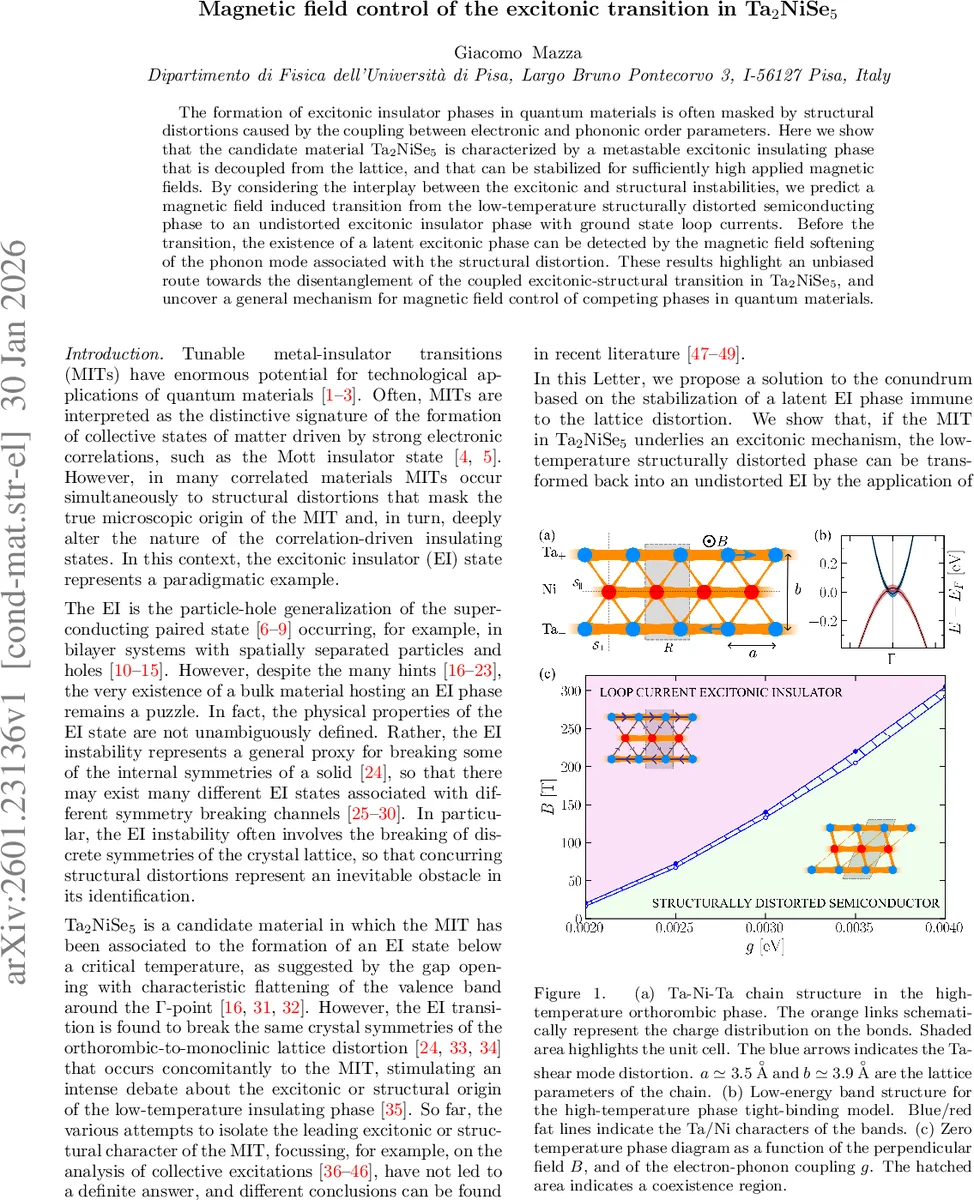
The paper tackles the long‑standing ambiguity surrounding the low‑temperature metal‑insulator transition (MIT) in the layered compound Ta₂NiSe₅, where it is unclear whether the transition is driven primarily by an excitonic insulator (EI) instability or by a structural distortion induced by strong electron‑phonon coupling. The authors construct a minimal microscopic model that captures the essential physics of the material: a one‑dimensional Ta–Ni–Ta chain with tight‑binding hoppings, long‑range density‑density interactions (U on‑site, V inter‑chain), a shear phonon mode of the Ta atoms (frequency ω₀≈10 meV), and a linear electron‑phonon coupling g. Using a mean‑field Hartree‑Fock decoupling, they solve the electronic sector self‑consistently and identify two distinct EI solutions when the inter‑chain interaction V exceeds a critical value (~0.8 eV).
The first solution (φ = 0) corresponds to a conventional charge‑distorted (CD) excitonic state. It breaks the same crystal symmetries as the experimentally observed monoclinic phase, producing an asymmetric charge distribution on the Ta⁺‑Ni and Ta⁻‑Ni bonds. The second solution (φ = π/2) is a loop‑current (LC) excitonic state: the charge density retains the orthorhombic symmetry, but a pattern of circulating currents forms on the Ta‑Ni and Ta‑Ta bonds, generating a finite orbital magnetic moment. Energetically the two states are nearly degenerate; the CD state is slightly lower in energy when the electron‑phonon coupling g is finite, while the LC state remains metastable for g = 0.
Crucially, the electron‑phonon coupling stabilizes the CD state by inducing a static shear displacement ⟨X⁺⟩ = −⟨X⁻⟩ that grows linearly with g, reproducing the experimentally measured monoclinic tilt (≈0.5°) for realistic g values (2–5 meV). Conversely, the LC state is destroyed by the same coupling for g ≳ 1.5 meV, disappearing from the mean‑field solution.
To overcome this destabilization, the authors introduce a perpendicular magnetic field B through Peierls phases in the hopping amplitudes and a Zeeman term (g_s = 2). The Zeeman splitting remains negligible compared with the gap, so the field acts primarily via orbital effects. As B increases, the shear displacement continuously diminishes and vanishes at a critical field B_c that depends inversely on g. For B > B_c the lattice reverts to the high‑temperature orthorhombic structure, and the LC excitonic phase becomes the ground state. The orbital magnetic moment μ grows linearly with B, with a susceptibility that scales as 1/g; all curves collapse onto a single g‑independent line for B > B_c, reflecting the universal nature of the LC state.
The authors further compute the phonon spectral function A_ph(ω) using time‑dependent Hartree‑Fock. They find a pronounced magnetic‑field softening of the shear phonon mode for B < B_c, with ω_ph → 0 as B approaches B_c, followed by a hardening for B > B_c. This softening provides a clear experimental fingerprint of the latent LC excitonic phase even before the structural transition is completed. If the MIT were driven solely by electron‑phonon coupling, the phonon frequency would be essentially field‑independent, offering a decisive way to discriminate between the two mechanisms.
In summary, the paper demonstrates that (i) Ta₂NiSe₅ hosts two competing excitonic orders—charge‑distorted and loop‑current—(ii) electron‑phonon coupling selects the CD state while a perpendicular magnetic field can suppress the lattice distortion and stabilize the LC state, and (iii) magnetic‑field‑dependent phonon spectroscopy can detect the hidden excitonic phase and resolve the origin of the MIT. The proposed magnetic‑field control scheme provides a general route to disentangle intertwined electronic and structural orders in quantum materials, and suggests that similar strategies could be applied to other systems where strong electron‑phonon coupling masks exotic electronic phases.
Comments & Academic Discussion
Loading comments...
Leave a Comment