Seminoetherian Modules over Non-Primitive HNP rings
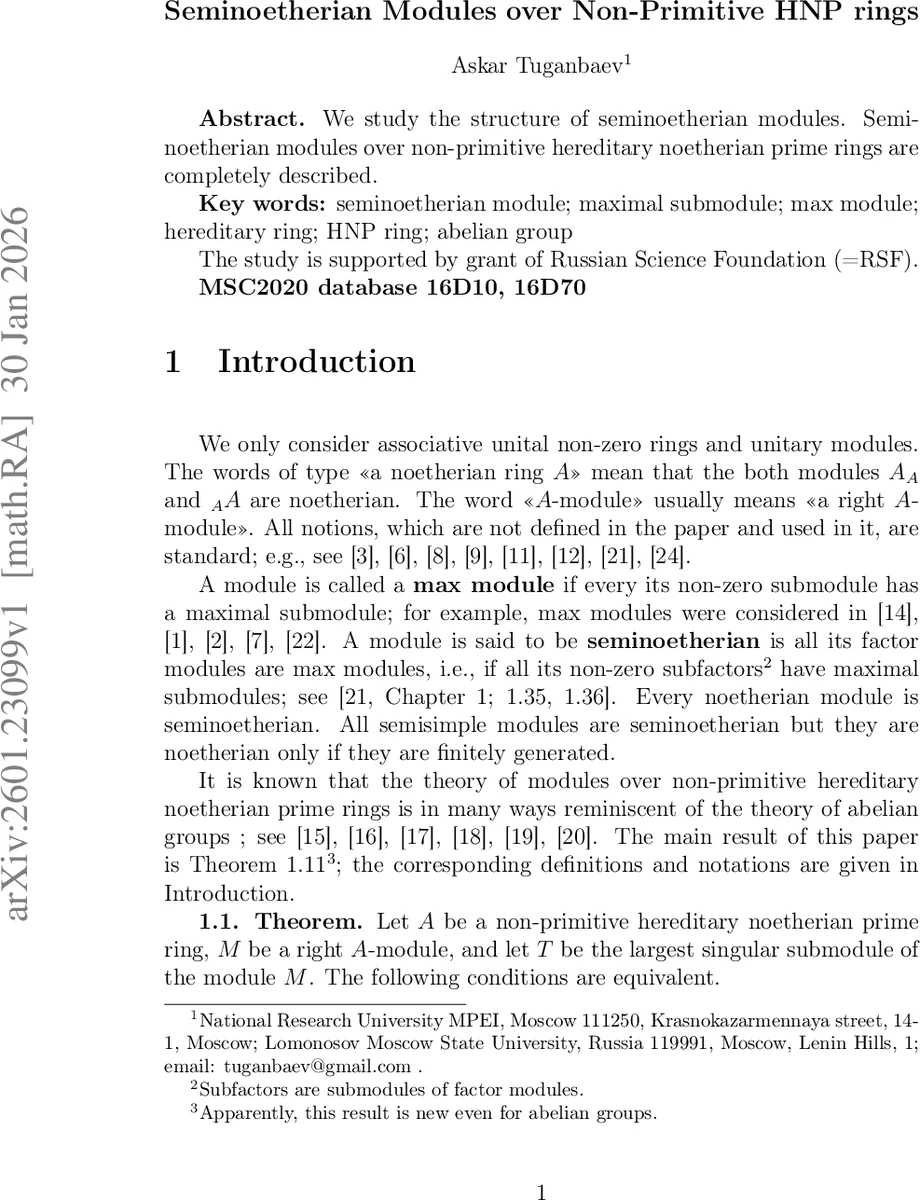
We study the structure of seminoetherian modules. Seminoetherian modules over non-primitive hereditary noetherian prime rings are completely described.
💡 Research Summary
The paper investigates the class of seminoetherian modules over non‑primitive hereditary Noetherian prime (HNP) rings. After fixing notation, the authors recall that a “max module” is one whose every non‑zero subfactor possesses a maximal submodule, and a module is called seminoetherian if all its factor modules are max modules. Consequently every Noetherian module is seminoetherian, and all semisimple modules are seminoetherian (though only finitely generated ones are Noetherian).
The authors focus on HNP rings that are not primitive. By a classical result (Remark 1.2) such rings are exactly the bounded, non‑artinian HNP rings. They introduce the singular submodule Sing M, the torsion part T(M), and recall basic facts about Goldie dimension, regular elements, and invertible ideals. In particular, for a semiprime right Goldie ring the singular and torsion notions coincide, and every non‑torsion module contains a non‑zero non‑singular submodule.
The central result is Theorem 1.1, which gives a complete structural description of a right A‑module M over a non‑primitive HNP ring A. Let T be the largest singular submodule of M. The following are equivalent:
1. M is seminoetherian.
2. Each primary component of T is a direct sum of cyclic uniserial modules, with the total sum of their composition lengths finite; the quotient M/T is a non‑singular module of finite Goldie dimension; there exists a submodule X with T ⊆ X ⊆ M such that X/T is a Noetherian, projective, essential submodule of M/T; and every primary component of the further quotient M/X is again a direct sum of cyclic uniserial modules whose total composition length is bounded.
Thus a seminoetherian module splits into a “torsion” part built from finitely many cyclic uniserial pieces and a “torsion‑free” part that is finite‑dimensional in the Goldie sense, together with a well‑behaved intermediate submodule X.
To prove this, the paper develops several auxiliary results. Proposition 2.1 shows that the seminoetherian property is inherited by submodules and factor modules. Lemma 2.4 establishes that in a prime right Goldie ring every non‑zero ideal is essential and contains a regular element, and that any non‑singular module of infinite Goldie dimension contains a free submodule of the same rank. Using these facts, Proposition 2.6 proves that for a ring possessing a countably generated non‑cyclic uniserial module, a module M is seminoetherian iff Sing M is seminoetherian and M/Sing M is a finite‑dimensional non‑singular seminoetherian module.
Section 3 treats injective modules over non‑primitive HNP rings. Proposition 3.2 describes the unique (up to isomorphism) indecomposable singular injective module E associated with a maximal invertible ideal P. E is a non‑cyclic uniserial P‑primary module without maximal submodules; its proper submodules form a countable chain with simple successive quotients, and the chain has a period n (the “period” of E). Various properties of cyclic uniserial P‑primary modules are derived: every finitely generated submodule of any singular module is a finite direct sum of such cyclic uniserial modules; any non‑injective singular module contains a non‑zero cyclic uniserial direct summand; and epimorphisms from suitable direct sums of cyclic uniserial modules onto E are constructed. Moreover, the authors exhibit families of P‑primary modules whose composition lengths are unbounded, showing that infinite direct sums of such modules need not be seminoetherian.
Proposition 3.3 gives a characterization of injectivity for singular modules: a singular module M is injective iff each of its primary components M(P_i) is injective, which in turn is equivalent to each component being a direct sum of copies of the indecomposable injective E.
Overall, the paper achieves a full classification of seminoetherian modules over non‑primitive HNP rings: the singular part is a finite direct sum of cyclic uniserial modules, while the non‑singular part is Goldie‑finite dimensional. The work extends the well‑known analogy between modules over HNP rings and abelian groups, providing new structural theorems even in the classical abelian‑group setting. The results also clarify the role of maximal invertible ideals, the behavior of injective uniserial modules, and the limitations of seminoetherianity under infinite direct sums, thereby laying groundwork for further investigations into module theory over non‑primitive hereditary Noetherian prime rings.
Comments & Academic Discussion
Loading comments...
Leave a Comment