A Universal Convolution-Based Pre-processor to Correct the Prevalence-Incidence Gap in SIR, SEIR, and SIRS Modeling
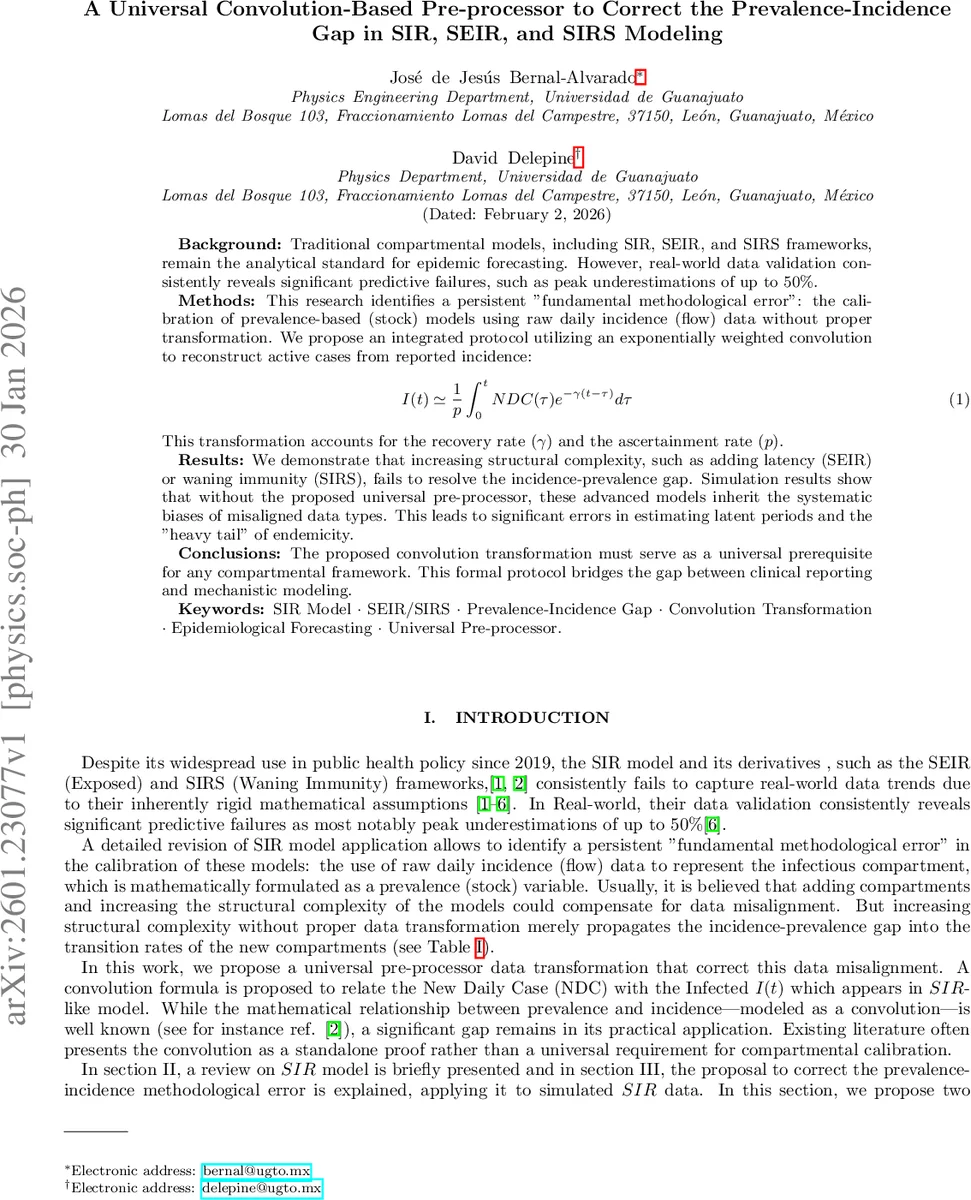
Traditional compartmental models, including SIR, SEIR, and SIRS frameworks, remain the analytical standard for epidemic forecasting. However, real-world data validation consistently reveals significant predictive failures, such as peak underestimations of up to 50%. This research identifies a persistent fundamental methodological error: the calibration of prevalence-based (stock) models using raw daily incidence (flow) data without proper transformation. We propose an integrated protocol utilizing an exponentially weighted convolution to reconstruct active cases from reported incidence: $I(t) \approx \frac{1}{p} \int_{0}^{t} NDC(τ) e^{-γ(t-τ)} dτ$. This transformation accounts for the recovery rate $γ$ and the ascertainment rate $p$. We demonstrate that increasing structural complexity, such as adding latency (SEIR) or waning immunity (SIRS), fails to resolve the incidence-prevalence gap. Simulation results show that without the proposed universal pre-processor, these advanced models inherit the systematic biases of misaligned data types, leading to significant errors in estimating latent periods and the “heavy tail” of endemicity. The proposed convolution transformation must serve as a universal prerequisite for any compartmental framework, bridging the gap between clinical reporting and mechanistic modeling.
💡 Research Summary
The paper “A Universal Convolution-Based Pre‑processor to Correct the Prevalence‑Incidence Gap in SIR, SEIR, and SIRS Modeling” identifies a pervasive methodological flaw in epidemic compartmental modeling: practitioners routinely calibrate prevalence‑based (stock) models using raw daily incidence (flow) data. This mismatch leads to systematic under‑estimation of epidemic peaks—often by up to 50 %—and mis‑placement of the peak in time, especially evident in the classic SIR framework and its extensions (SEIR, SIRS).
The authors first restate the standard SIR differential equations and emphasize that the infectious compartment I(t) represents active cases (prevalence), whereas the reported New Daily Cases (NDC) correspond to the flow from Susceptible to Infectious, i.e., the derivative of the susceptible pool. Treating NDC as if it were I(t) ignores the integral relationship between flow and stock and therefore corrupts parameter inference.
To remedy this, the paper proposes a two‑step mathematical correction. The first, a simple moving‑average over the average infectious period (1/γ), shifts the peak but still under‑estimates its magnitude because it assumes a deterministic, step‑function recovery. The second, and central, contribution is an exponentially weighted convolution:
\
Comments & Academic Discussion
Loading comments...
Leave a Comment