Uncoupled Dirac-Yang-Mills Pairs on Closed Riemannian Spin Manifolds
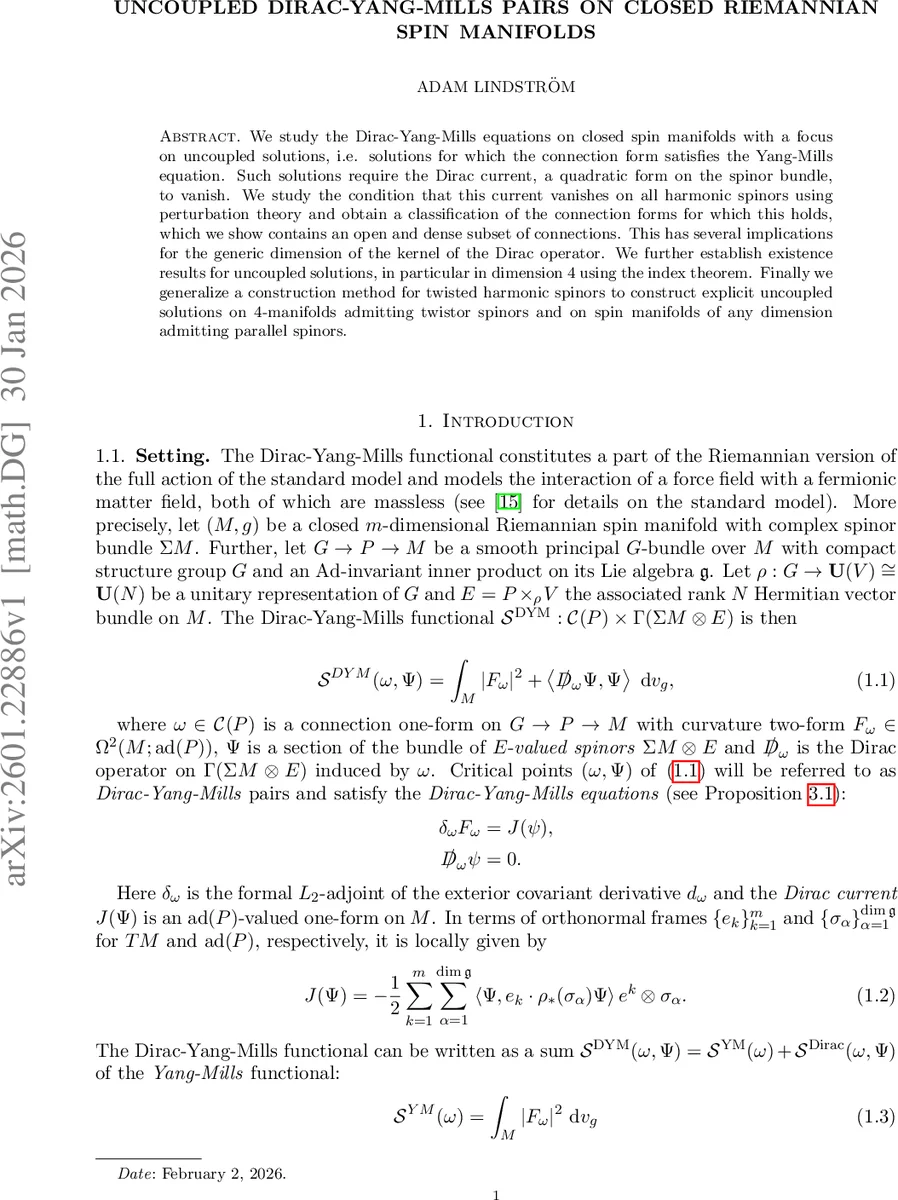
We study the Dirac-Yang-Mills equations on closed spin manifolds with a focus on uncoupled solutions, i.e. solutions for which the connection form satisfies the Yang-Mills equation. Such solutions require the Dirac current, a quadratic form on the spinor bundle, to vanish. We study the condition that this current vanishes on all harmonic spinors using perturbation theory and obtain a classification of the connection forms for which this holds, which we show contains an open and dense subset of connections. This has several implications for the generic dimension of the kernel of the Dirac operator. We further establish existence results for uncoupled solutions, in particular in dimension $4$ using the index theorem. Finally we generalize a construction method for twisted harmonic spinors to construct explicit uncoupled solutions on $4$-manifolds admitting twistor spinors and on spin manifolds of any dimension admitting parallel spinors.
💡 Research Summary
The paper investigates the Dirac‑Yang‑Mills (DYM) system on closed Riemannian spin manifolds, focusing on “uncoupled” solutions—pairs ((\omega,\Psi)) where the connection (\omega) satisfies the Yang‑Mills equation (\delta_\omega F_\omega=0) and the Dirac current (J(\Psi)) vanishes. The DYM functional is the sum of the Yang‑Mills term (\int_M |F_\omega|^2) and the Dirac term (\int_M \langle !!\not! D_\omega\Psi,\Psi\rangle). Critical points satisfy the coupled equations (\delta_\omega F_\omega=J(\Psi)) and (!!\not! D_\omega\Psi=0). The current is a quadratic form on the spinor bundle given locally by (J(\Psi)=-\frac12\sum_{k,\alpha}\langle\Psi, e_k\cdot\rho_*(\sigma_\alpha)\Psi\rangle,e_k\otimes\sigma_\alpha).
Main contributions
-
Vanishing of the current on chiral spinors.
Theorem 1.1 shows that on any even‑dimensional spin manifold the Dirac current vanishes identically on sections of the chiral bundles (\Sigma^\pm M\otimes E). This follows from the Clifford algebra property that the current is odd under the chirality operator, so it is forced to be zero on each eigenspace. Consequently, any harmonic chiral spinor automatically yields an uncoupled DYM pair provided the underlying connection is Yang‑Mills. -
Perturbative characterisation of decoupling connections.
Using analytic perturbation theory, the authors prove (Theorem 1.2) that a connection (\omega) is decoupling (i.e. (\ker!!\not! D_\omega\subset\ker J)) iff for every Lie‑algebra‑valued 1‑form (\eta) the eigenvalues (\lambda(t)) of the perturbed operator (!!\not! D_\omega+t\eta) satisfy (\lambda(0)=0\Rightarrow \lambda’(0)=0). Lemma 5.6 guarantees analyticity of eigenvalues for all (\omega); thus the essential condition is the vanishing of the first derivative at zero. -
Genericity via perturbation‑minimal connections.
A connection is called perturbation‑minimal if it minimises the dimension of (\ker!!\not! D_\omega) locally in the space of connections. Proposition 1.3 proves that the set (C_{\mathrm{pm}}(P)) of such connections is open and dense in the (C^\infty) topology, and the kernel dimension is constant on each connected component. Hence the decoupling condition is generic. -
Lower bounds for uncoupled solutions.
Theorem 1.4 states that if there exists a perturbation‑minimal connection (\vartheta) with (\dim\ker!!\not! D_\vartheta=k_{\mathrm{pm}}(E)>0), then for any connection (\omega) one can find a subspace (V\subset\ker!!\not! D_\omega) of dimension at least (k_{\mathrm{pm}}(E)) on which the current vanishes. Thus every Yang‑Mills connection carries at least (k_{\mathrm{pm}}(E)) uncoupled DYM pairs. -
Obstruction results.
When (\ker J=0) the above lower bound disappears. Theorem 1.5 gives a concrete example: on any closed 3‑manifold with a principal (SU(N)) or (U(N)) bundle, every decoupling connection is perturbation‑minimal and (\dim\ker!!\not! D_\omega=0). Hence no non‑trivial uncoupled solutions exist in this setting. -
Existence via index theory.
For manifolds with vanishing (\widehat A)-genus, the Atiyah‑Singer index theorem provides non‑zero index for the twisted Dirac operator in several cases (Theorem 1.6, 1.7). In dimension four, if the bundle admits an (anti‑)self‑dual Yang‑Mills connection, the index equals the dimension of the kernel, giving a precise count of uncoupled solutions. Positive scalar curvature manifolds (hence (\widehat A=0)) provide explicit families where instanton connections are perturbation‑minimal, achieving the lower bound. -
Explicit constructions using twistor and parallel spinors.
Building on a method from
Comments & Academic Discussion
Loading comments...
Leave a Comment