Millimeter and submillimeter spectroscopy of methylallene, CH$_3$CHCCH$_2$
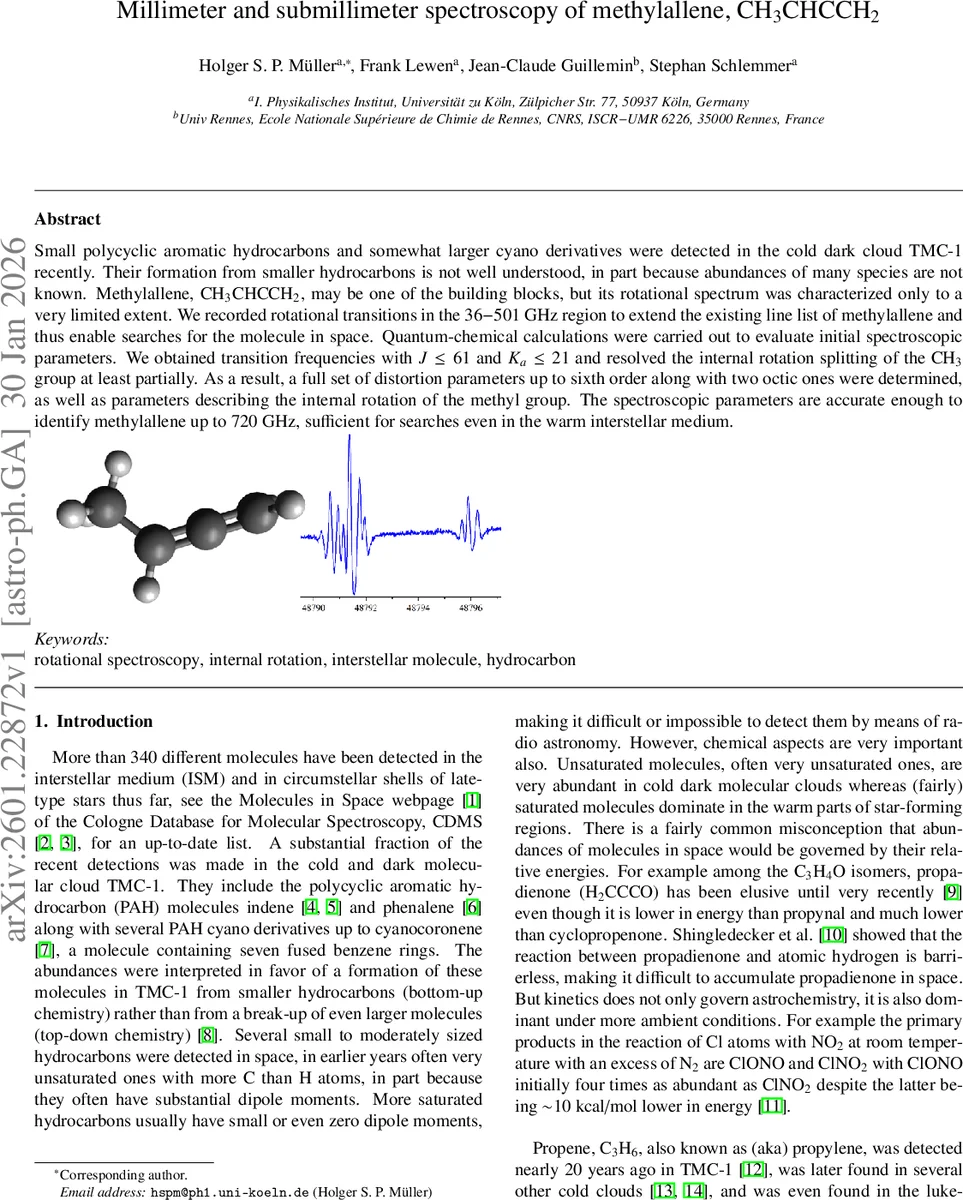
Small polycyclic aromatic hydrocarbons and somewhat larger cyano derivatives were detected in the cold dark cloud TMC-1 recently. Their formation from smaller hydrocarbons is not well understood, in part because abundances of many species are not known. Methylallene, CH$_3$CHCCH$_2$, may be one of the building blocks, but its rotational spectrum was characterized only to a very limited extent. We recorded rotational transitions in the 36$-$501 GHz region to extend the existing line list of methylallene and thus enable searches for the molecule in space. Quantum-chemical calculations were carried out to evaluate initial spectroscopic parameters. We obtained transition frequencies with $J \le 61$ and $K_a \le 21$ and resolved the internal rotation splitting of the CH$_3$ group at least partially. As a result, a full set of distortion parameters up to sixth order along with two octic ones were determined, as well as parameters describing the internal rotation of the methyl group. The spectroscopic parameters are accurate enough to identify methylallene up to 720 GHz, sufficient for searches even in the warm interstellar medium.
💡 Research Summary
The paper presents a comprehensive high‑frequency rotational spectroscopic study of methylallene (CH₃CHCCH₂), a molecule that may serve as a key building block for larger hydrocarbons detected in interstellar space. Motivated by recent detections of polycyclic aromatic hydrocarbons (PAHs) and their cyano derivatives in the cold dark cloud TMC‑1, the authors aim to provide accurate laboratory data that enable astronomers to search for methylallene both in cold, quiescent environments and in warmer star‑forming regions.
Quantum‑chemical groundwork – Using Gaussian 16, the authors performed B3LYP/aug‑cc‑pVTZ calculations to obtain an equilibrium geometry, harmonic and anharmonic force fields, and to predict the rotational constants (A≈34 735 MHz, B≈4 181 MHz, C≈3 920 MHz) as well as quartic centrifugal distortion parameters. The internal rotation barrier of the methyl group was calculated to be V₃≈556 cm⁻¹ (≈800 K), consistent with earlier microwave work. These theoretical values served as starting points for the spectroscopic fit.
Experimental methodology – Two complementary spectrometer setups at the University of Cologne were employed. A 7 m glass cell with Schottky diode detection covered 35–165 GHz, while a 5 m double‑pass cell equipped with a rotating polarizer accessed 344–501 GHz. Sample preparation involved vacuum distillation of freshly synthesized methylallene, yielding a 68 % pure product with minimal ethanol contamination. Pressures between 2 and 7 Pa and frequency‑modulation (2f demodulation) ensured narrow, high‑signal‑to‑noise lines. In total, 961 individual transitions were recorded, spanning J up to 61 and Kₐ up to 21, including both a‑type (ΔKₐ=0) and b‑type (ΔKₐ=±1) transitions.
Spectral analysis and Hamiltonian – The data were fitted with the ERHAM program, which treats an asymmetric top coupled to a three‑fold internal rotor. Low‑order internal‑rotation parameters (ρ, β, ε) were introduced alongside the usual rotational constants and centrifugal distortion terms. The fitting strategy added parameters one by one, selecting those that most reduced the weighted rms. Ultimately, 33 spectroscopic constants were retained, comprising A, B, C, 12 quartic and sextic distortion constants, two octic terms, and the three internal‑rotation parameters. The final constants are A = 33 997.87067 MHz (±0.00018 MHz), B = 4 201.2822272 MHz (±0.00099 MHz), C = 3 928.1001862 MHz (±0.00097 MHz).
Internal‑rotation splitting – The methyl group’s hindered rotation produces A/E splittings that vary with transition type. For a‑type R‑branch lines the splitting is ≤ 3 MHz, whereas b‑type and a‑type Q‑branch lines can show splittings up to ~50 MHz. At high J and Kₐ the asymmetry splitting can become comparable to the A/E splitting, leading to level repulsion and occasional intensity borrowing. Nevertheless, the Hamiltonian reproduces the observed patterns with an average deviation of less than 10 kHz for transitions below 720 GHz.
Astrochemical relevance – The derived spectroscopic parameters enable reliable predictions up to 720 GHz, covering the frequency range of most modern millimeter/sub‑millimeter observatories (ALMA, NOEMA, GBT). The a‑type R‑branch transitions are roughly twenty times stronger than the b‑type lines, making them the primary targets for astronomical searches. The authors argue that methylallene, possessing a modest dipole moment (μₐ ≈ 0.397 D, μ_b ≈ 0.071 D), can be detected in TMC‑1 and, thanks to the high‑frequency data, also in warmer environments such as the hot corino IRAS 16293‑2422B.
Conclusions and outlook – This work delivers the most extensive laboratory dataset for methylallene to date, resolving internal‑rotation effects and providing a full set of distortion constants up to sixth order plus two octic terms. The authors suggest future extensions to vibrationally excited states and isotopologues (¹³C, deuterated) to further constrain formation pathways and isotopic fractionation in the interstellar medium. The data will be deposited in the Cologne Database for Molecular Spectroscopy (CDMS) and the JPL catalog, making them immediately available to the astrochemical community.
Comments & Academic Discussion
Loading comments...
Leave a Comment