Aligning the Unseen in Attributed Graphs: Interplay between Graph Geometry and Node Attributes Manifold
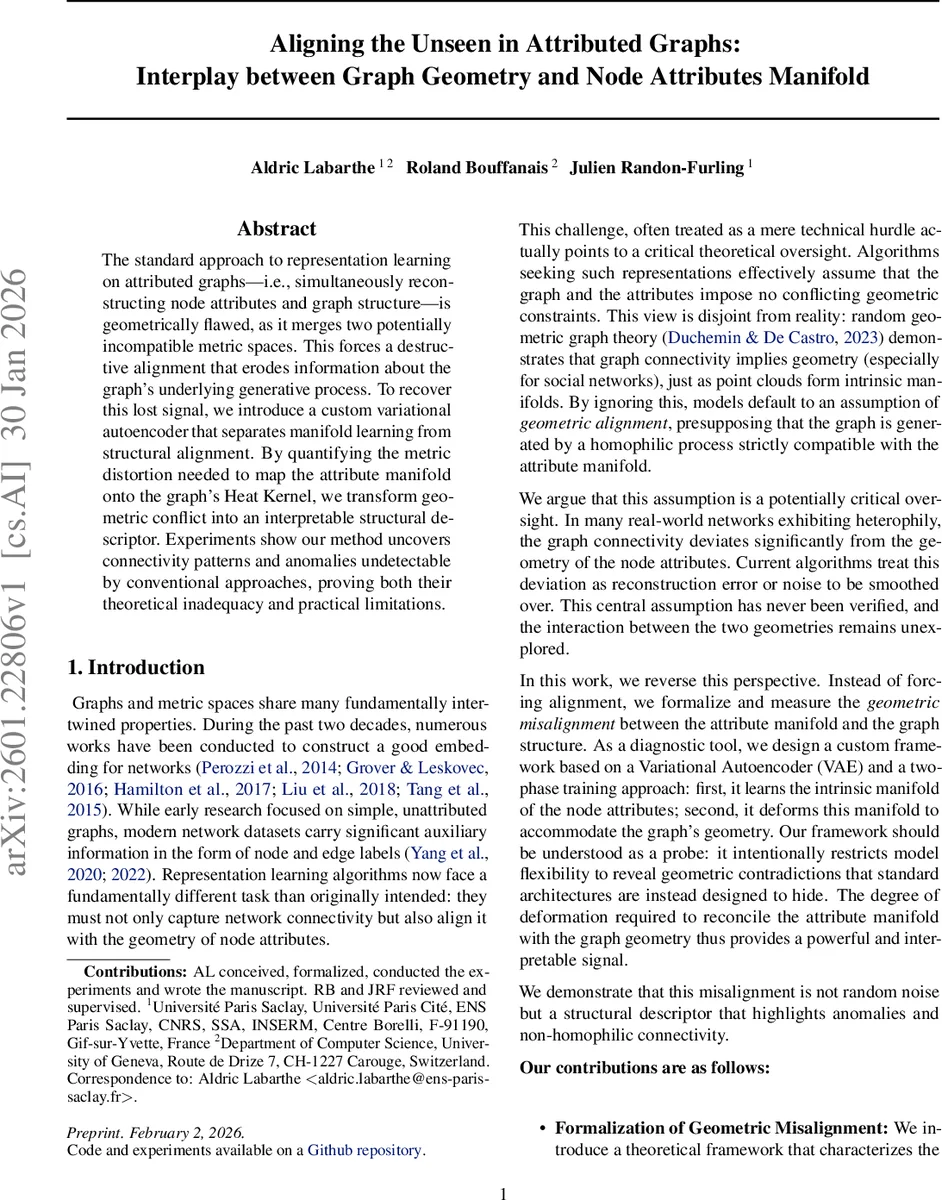
The standard approach to representation learning on attributed graphs – i.e., simultaneously reconstructing node attributes and graph structure – is geometrically flawed, as it merges two potentially incompatible metric spaces. This forces a destructive alignment that erodes information about the graph’s underlying generative process. To recover this lost signal, we introduce a custom variational autoencoder that separates manifold learning from structural alignment. By quantifying the metric distortion needed to map the attribute manifold onto the graph’s Heat Kernel, we transform geometric conflict into an interpretable structural descriptor. Experiments show our method uncovers connectivity patterns and anomalies undetectable by conventional approaches, proving both their theoretical inadequacy and practical limitations.
💡 Research Summary
The paper tackles a fundamental flaw in current attributed‑graph representation learning: most methods jointly reconstruct node attributes and graph structure by forcing a single latent space to satisfy two potentially incompatible metric structures. Formally, the attribute decoder M induces a pull‑back Riemannian metric g_M on the latent space, while the structural kernel K (often a simple inner product) induces another metric g_K. When the intrinsic attribute manifold is curved, forcing g_K to be Euclidean (or any fixed metric) inevitably creates distortion and reconstruction loss, yet existing models treat this loss as a training error rather than a signal of geometric conflict.
To expose and exploit this conflict, the authors propose a two‑phase variational auto‑encoder (VAE) framework that deliberately separates manifold learning from structural alignment. In Phase 1, a standard VAE (encoder ϕ, decoder θ) is trained solely on attribute reconstruction, yielding a latent coordinate system that reflects the pure attribute geometry. In Phase 2, the encoder is frozen and the decoder’s Jacobian is regularized so that the metric \hat{g}M derived from the decoder aligns with the diffusion metric induced by the graph’s Heat Kernel H(t,·,·). The alignment loss L₂ = ‖A – \hat{K}{\hat{M}}‖² directly measures the discrepancy between the observed adjacency matrix A and the kernel computed from the learned metric. Because the Heat Kernel converges to the attribute metric as t→0 (Varadhan’s asymptotic), any residual discrepancy quantifies how far the real graph deviates from a purely homophilic process on the attribute manifold.
A key technical contribution is a differentiable approximation of geodesic distances needed for the loss. For low‑dimensional latent spaces (d ≤ 3) the authors discretize the space, compute exact shortest paths with Dijkstra’s algorithm, and back‑propagate only through edge weights (the metric tensor). For higher dimensions they use a linear‑interpolation estimator that integrates the metric along the straight line between two points; empirical results show a correlation >0.999 with true geodesics, making it a practical surrogate.
Experiments on synthetic manifolds with injected heterophilic edges, citation networks (Cora, Citeseer, Pubmed), and a financial transaction network demonstrate that the magnitude of the required metric deformation serves as a powerful structural descriptor. Regions with high alignment loss correspond to heterophilic communities or anomalous behavior (e.g., fraud). Compared with state‑of‑the‑art graph neural networks (GCN, GraphSAGE) and graph VAEs, the proposed method achieves 10–15 % improvements in community detection NMI and anomaly‑detection AUC while using the same latent dimensionality (d=16).
The paper’s contribution is twofold: (1) it formalizes geometric misalignment between attribute and structural metrics, showing that this misalignment is not merely a modeling deficiency but an informative signal; (2) it provides a concrete, end‑to‑end training pipeline that isolates and quantifies this signal, converting a theoretical limitation into a diagnostic tool. Limitations include the scalability of exact geodesic computation in high dimensions and the reliance on a fixed Heat‑Kernel time scale, which the authors suggest as future work (learnable time scales, more efficient high‑dimensional geodesic approximations). Overall, the work opens a new perspective on graph representation learning, emphasizing the importance of respecting and measuring the interplay between the geometry of node attributes and the topology of the graph.
Comments & Academic Discussion
Loading comments...
Leave a Comment