Sharp thresholds for Escobar and Gagliardo-Nirenberg functionals: the Escobar-Willmore mass, geometric selection, and compactness trichotomy
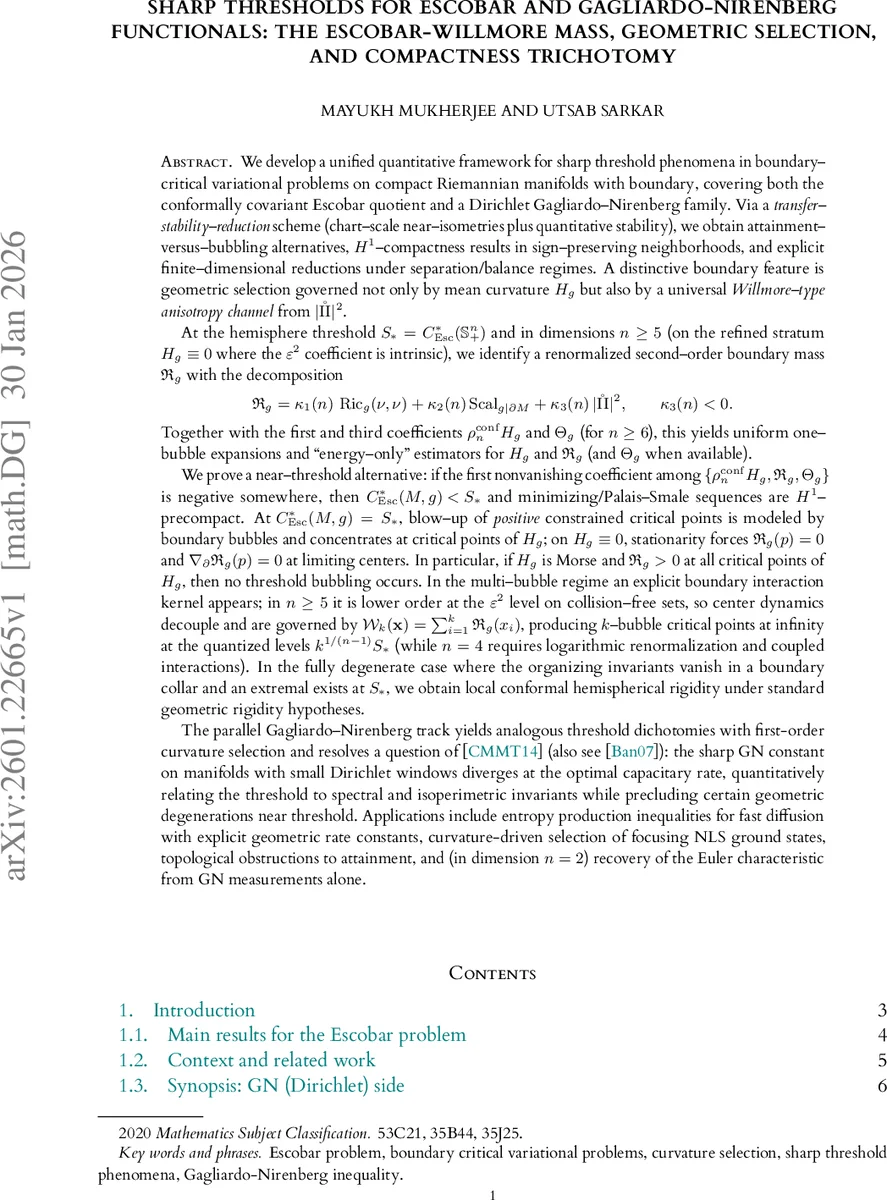
We develop a unified quantitative framework for sharp threshold phenomena in boundary-critical variational problems on compact Riemannian manifolds, covering the Escobar quotient and Gagliardo-Nirenberg inequalities. Via transfer-stability-reduction, we obtain attainment-versus-bubbling alternatives, $H^1$-compactness, and finite-dimensional reductions. Geometric selection is governed by mean curvature $H_g$ and a Willmore-type anisotropy from $|\mathring{\mathrm{II}}|^2$. At hemisphere threshold $S_\ast=C^{\mathrm{Esc}}(\mathbb S^n+)$ for $n\ge5$ on $H_g\equiv0$, we identify a renormalized boundary mass $\mathfrak R_g=κ_1(n),\mathrm{Ric}g(ν,ν)+κ_2(n),\mathrm{Scal}{g|\partial M}+κ_3(n),|\mathring{\mathrm{II}}|^2$, $κ_3(n)<0$, yielding one-bubble expansions and energy-only estimators. Threshold dichotomy: if the first nonvanishing coefficient among ${ρ_n^{\mathrm{conf}}H_g,\mathfrak R_g,Θ_g}$ is negative somewhere, then $C^{\mathrm{Esc}}(M,g)<S\ast$ and sequences are precompact. At threshold, blow-up concentrates where $H_g$ is critical; on $H_g\equiv0$, stationarity forces $\mathfrak R_g(p)=\nabla_\partial\mathfrak R_g(p)=0$. If $H_g$ is Morse and $\mathfrak R_g>0$ at all critical points, no bubbling occurs. In multi-bubble regime ($n\ge5$), dynamics governed by $\mathcal W_k=\sum_{i=1}^k\mathfrak R_g(x_i)$ produce $k$-bubble critical points at levels $k^{1/(n-1)}S_\ast$. In the degenerate case we obtain conformal hemispherical rigidity. The GN track yields analogous dichotomies and resolves a question of Christianson et al.: the sharp constant with small Dirichlet windows diverges at optimal capacitary rate, relating threshold to spectral/isoperimetric invariants. Applications include entropy inequalities for fast diffusion, curvature-driven NLS ground states, and (in $n=2$) Euler characteristic recovery from GN measurements.
💡 Research Summary
This paper develops a unified quantitative framework for sharp threshold phenomena in two closely related boundary‑critical variational problems on compact Riemannian manifolds: the conformally covariant Escobar quotient and a family of Dirichlet‑type Gagliardo‑Nirenberg (GN) inequalities. The authors introduce a three‑step “transfer–stability–reduction” scheme. First, they establish precise quantitative stability for the model geometry, the round hemisphere (\mathbb S^n_+), and then transfer these estimates to an arbitrary compact manifold ((M,g)) via near‑isometries and deficit controls. Second, they perform a detailed Fermi‑coordinate expansion of the functional up to second order at the boundary. This yields three leading coefficients that govern the near‑threshold landscape:
- (\rho_n^{\mathrm{conf}}H_g) – a first‑order term involving the boundary mean curvature.
- (\mathfrak R_g = \kappa_1(n),\mathrm{Ric}g(\nu,\nu) + \kappa_2(n),\mathrm{Scal}{g|\partial M} + \kappa_3(n),|\mathring{\mathrm{II}}|^2) – a second‑order “Escobar‑Willmore mass”. The crucial sign (\kappa_3(n)<0) shows that the trace‑free second fundamental form always lowers the energy on the (H_g\equiv0) stratum.
- (\Theta_g) – a third‑order term that appears only when (n\ge6).
These coefficients are the only geometric quantities that can obstruct compactness at the critical level.
The third step is a finite‑dimensional reduction based on a Łojasiewicz‑Simon inequality and a Lyapunov–Schmidt procedure. In the multi‑bubble regime the authors derive an explicit boundary interaction kernel (G_{\partial}) (the Green function of the Dirichlet‑to‑Neumann map). For dimensions (n\ge5) the interaction is lower order compared with the (\epsilon^2) self‑energy, so the centers decouple and are governed solely by the “center‑only potential”
\
Comments & Academic Discussion
Loading comments...
Leave a Comment