Human-Centered Explainability in AI-Enhanced UI Security Interfaces: Designing Trustworthy Copilots for Cybersecurity Analysts
Artificial intelligence (AI) copilots are increasingly integrated into enterprise cybersecurity platforms to assist analysts in threat detection, triage, and remediation. However, the effectiveness of these systems depends not only on the accuracy of underlying models but also on the degree to which users can understand and trust their outputs. Existing research on algorithmic explainability has largely focused on model internals, while little attention has been given to how explanations should be surfaced in user interfaces for high-stakes decision-making contexts [8], [5], [6]. We present a mixed-methods study of explanation design strategies in AI-driven security dashboards. Through a taxonomy of explanation styles and a controlled user study with security practitioners, we compare natural language rationales, confidence visualizations, counterfactual explanations, and hybrid approaches. Our findings show that explanation style significantly affects user trust calibration, decision accuracy, and cognitive load. We contribute (1) empirical evidence on the usability of explanation interfaces for security copilots, (2) design guidelines for integrating explainability into enterprise UIs, and (3) a framework for aligning explanation strategies with analyst needs in security operations centers (SOCs). This work advances the design of human-centered AI tools in cybersecurity and provides broader implications for explainability in other high-stakes domains.
💡 Research Summary
This paper investigates how explanation design in AI‑enhanced security dashboards influences cybersecurity analysts’ trust, performance, and cognitive load. While most explainable AI (XAI) research focuses on model‑level techniques such as saliency maps or feature attributions, the authors argue that in high‑stakes environments like Security Operations Centers (SOCs) the way explanations are presented in the user interface is equally critical.
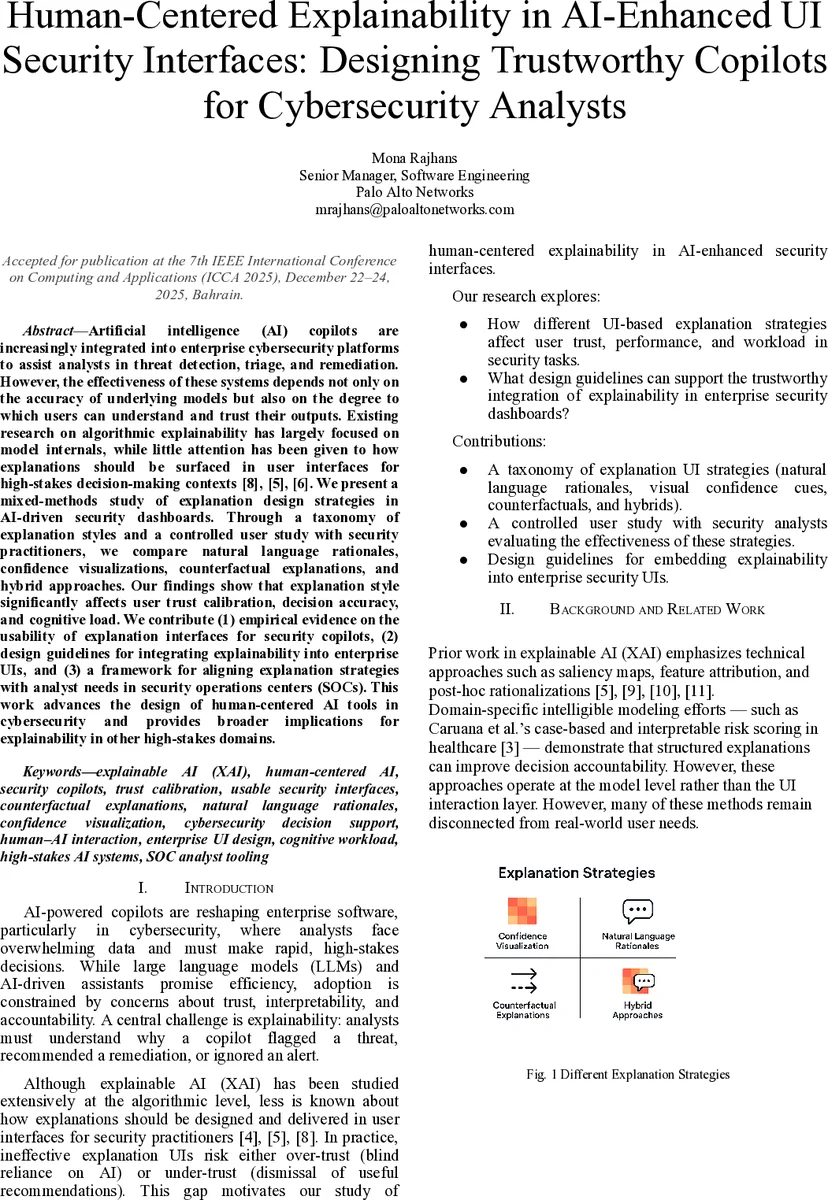
To explore this, the authors define four UI‑based explanation strategies: (1) Confidence Visualization – continuous probability bars, opacity overlays, and uncertainty markers; (2) Natural Language (NL) Rationales – short templated text generated by a GPT model; (3) Counterfactual Explanations – “What‑if” panels that let users manipulate hypothetical parameters via sliders; and (4) Hybrid – a combination of confidence bars with an optional toggle that reveals a structured rationale. Each strategy was implemented in a modular web prototype that mimics a typical SIEM workflow. All visual elements were standardized for size, typography, and hierarchy to ensure experimental control.
A within‑subjects user study was conducted with 24 participants (12 professional SOC analysts and 12 graduate students with security backgrounds). Each participant completed 16 simulated alert‑triage tasks (four per explanation type) in a counterbalanced order. Alerts contained realistic metadata (timestamps, IPs, MITRE ATT&CK tags, etc.) and were labeled as real threats, benign anomalies, or false positives by senior analysts. The AI recommendation for each alert was generated by a fixed GPT‑based rule template to keep the underlying decision logic constant across conditions.
The study measured five outcomes: (1) Decision Accuracy (correct classification), (2) Task Efficiency (time to complete a triage), (3) Cognitive Load (NASA‑TLX), (4) Trust Calibration (Schaffer & Barlow Trust‑in‑Automation scale, 0‑100), and (5) Decision Reversal Rate (percentage of participants who changed their initial judgment after viewing the explanation). Interaction logs captured clicks, hover durations, panel expansions, and toggle usage, providing behavioral evidence of engagement.
Quantitative results (Table II) show a clear effect of explanation strategy on all metrics (p < .05). Hybrid explanations achieved the highest accuracy (82 %) and the strongest trust calibration (77.9), while also yielding the highest decision reversal rate (23 %), indicating that analysts were more willing to reconsider their initial judgments when richer explanations were available. Counterfactual explanations also outperformed confidence‑only and NL‑only conditions in accuracy (78 %) and trust (71.4) but incurred the greatest cognitive load (NASA‑TLX = 58.3) and longest task times (21.2 s) due to the interactive “what‑if” panels. Natural language rationales were the fastest (16.7 s) and imposed the lowest cognitive load (42.1) but produced lower accuracy (71 %) and exhibited higher variance in trust scores, reflecting a tendency for novice users to over‑trust concise prose. Confidence‑only visualizations fell in the middle on most dimensions.
Interaction analysis corroborated these findings: Counterfactual panels attracted the longest hover times (average = 7.2 s per alert) and the most slider adjustments, suggesting deep analytical processing. Hybrid interfaces showed frequent toggle usage, supporting the progressive‑disclosure principle. Confidence‑only interfaces were often “glanced at” without further inspection, while NL rationales were read quickly but sometimes accepted without critical evaluation.
Qualitative feedback from open‑ended responses reinforced the quantitative patterns. Analysts praised Hybrid explanations as “layered, not overwhelming” and valued the ability to drill down when needed. Counterfactuals were described as “the clearest way to test whether the AI’s logic matches my mental model.” NL rationales were appreciated for speed but criticized for insufficient depth, especially among less‑experienced users. Confidence visualizations alone were deemed “helpful but insufficient” for ambiguous or high‑risk alerts. One senior analyst summed up the distinction: “Confidence tells me what, rationales tell me why, but counterfactuals tell me how much I should care.”
Based on these insights, the authors propose seven design guidelines for explainable security copilots:
- Layered Explanations via Progressive Disclosure – Show lightweight confidence cues by default; allow users to expand for rationale or counterfactual detail as needed.
- Separate “What”, “Why”, and “What‑If” – Decouple confidence, rationale, and counterfactual elements to reduce ambiguity.
- Surface Uncertainty Explicitly – Use ranges, uncertainty annotations, or textual warnings instead of binary high/low labels.
- Enable Interactive Manipulation – Provide sliders or hypothesis toggles so analysts can actively probe the model’s decision boundary.
- Match Explanation Style to Analyst Expertise and Task Criticality – Assign NL rationales to trainees, confidence + counterfactuals to senior analysts, and high‑level summaries to incident commanders.
- Log Explanation Usage for Accountability – Record which explanation components were viewed before an action, supporting audit trails and due‑diligence evidence.
- Design for Trust Calibration, Not Trust Maximization – Include model blind‑spot warnings and counter‑evidence to encourage healthy skepticism and avoid automation bias.
The paper acknowledges limitations: the study used simulated alerts, a modest sample size, and a single prototype environment. The authors call for larger field deployments across multiple SOCs to validate generalizability. They also argue that the findings extend beyond cybersecurity to other high‑stakes domains such as healthcare, finance, and law, where explanation UI design can similarly shape decision quality.
Future work directions include adaptive explanation systems that automatically adjust depth based on alert severity or real‑time analyst hesitation signals (e.g., cursor latency), multimodal explanations (visual, auditory, textual), and longitudinal studies measuring the impact of explanation logging on compliance and post‑incident investigations.
In sum, the study demonstrates that explanation style is a first‑class design variable in AI‑driven security tools. By empirically showing how different UI‑level explanations affect accuracy, trust, workload, and decision reversals, the authors provide actionable guidance for building trustworthy, human‑centered AI copilots that support analysts rather than obscure them. This work bridges the gap between algorithmic XAI research and practical UI design, emphasizing that explainability is as much about how information is presented as what information is presented.
Comments & Academic Discussion
Loading comments...
Leave a Comment