Beyond Medical Chatbots: Meddollina and the Rise of Continuous Clinical Intelligence
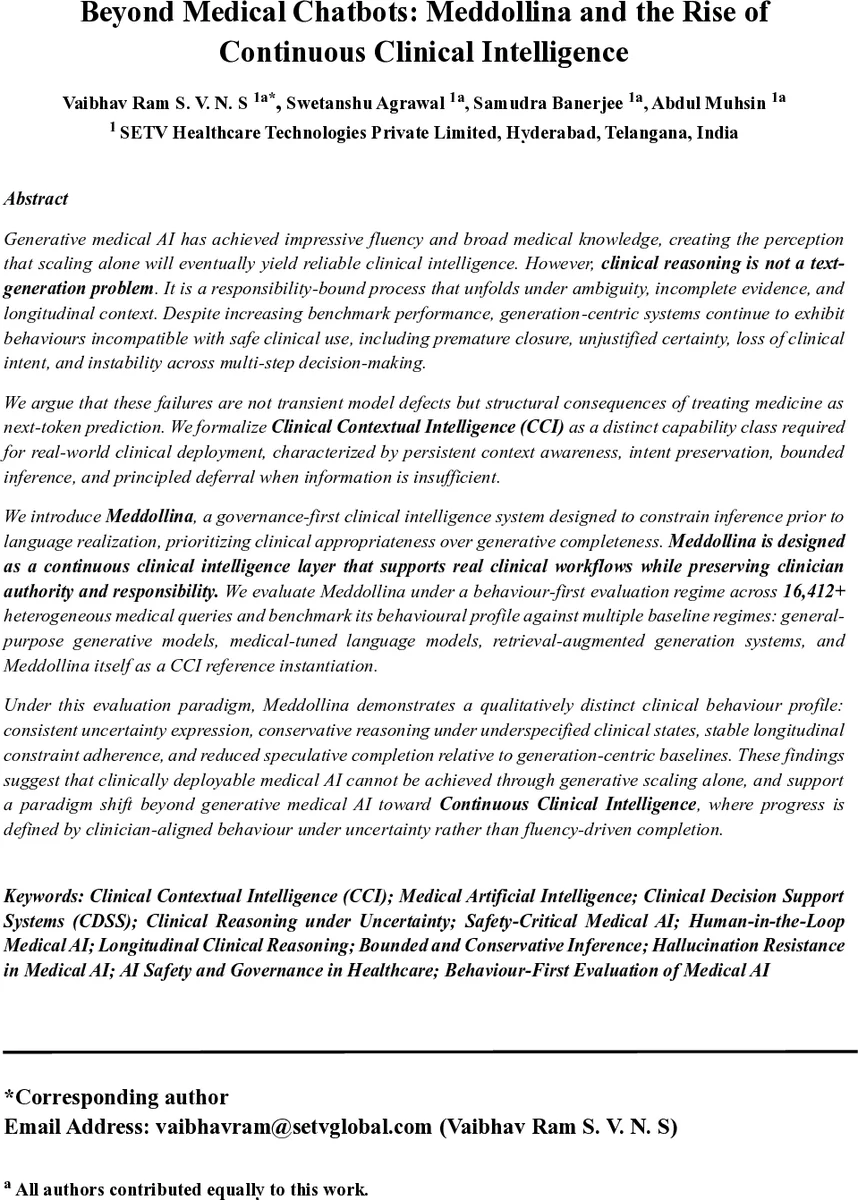
Generative medical AI now appears fluent and knowledgeable enough to resemble clinical intelligence, encouraging the belief that scaling will make it safe. But clinical reasoning is not text generation. It is a responsibility-bound process under ambiguity, incomplete evidence, and longitudinal context. Even as benchmark scores rise, generation-centric systems still show behaviours incompatible with clinical deployment: premature closure, unjustified certainty, intent drift, and instability across multi-step decisions. We argue these are structural consequences of treating medicine as next-token prediction. We formalise Clinical Contextual Intelligence (CCI) as a distinct capability class required for real-world clinical use, defined by persistent context awareness, intent preservation, bounded inference, and principled deferral when evidence is insufficient. We introduce Meddollina, a governance-first clinical intelligence system designed to constrain inference before language realisation, prioritising clinical appropriateness over generative completeness. Meddollina acts as a continuous intelligence layer supporting clinical workflows while preserving clinician authority. We evaluate Meddollina using a behaviour-first regime across 16,412+ heterogeneous medical queries, benchmarking against general-purpose models, medical-tuned models, and retrieval-augmented systems. Meddollina exhibits a distinct behavioural profile: calibrated uncertainty, conservative reasoning under underspecification, stable longitudinal constraint adherence, and reduced speculative completion relative to generation-centric baselines. These results suggest deployable medical AI will not emerge from scaling alone, motivating a shift toward Continuous Clinical Intelligence, where progress is measured by clinician-aligned behaviour under uncertainty rather than fluency-driven completion.
💡 Research Summary
The paper “Beyond Medical Chatbots: Meddollina and the Rise of Continuous Clinical Intelligence” critiques the prevailing approach of applying large language models (LLMs) to medicine as a pure next‑token‑prediction problem. The authors argue that clinical reasoning is fundamentally different from text generation: it must operate under uncertainty, incomplete evidence, and longitudinal patient context, while preserving clinician intent and responsibility. Scaling LLMs—adding parameters, data, or prompting—does not resolve these mismatches; instead, it often amplifies over‑confidence, hallucination, and instability across multi‑turn interactions.
To address this gap, the authors introduce a new capability class called Clinical Contextual Intelligence (CCI). CCI is defined by five observable properties: (1) Intent Preservation – maintaining the clinical goal (diagnosis, triage, management) throughout a conversation; (2) Context Persistence – retaining and updating a structured representation of prior symptoms, findings, and open questions across turns; (3) Bounded Reasoning – restricting inference to evidence‑supported scopes and explicitly deferring or refusing when information is insufficient; (4) Responsibility‑Aware Output – expressing calibrated confidence, signaling uncertainty, and avoiding unwarranted recommendations; and (5) Context‑Bounded Truthfulness – preventing hallucinations by limiting output to facts or justified possibilities derived from the current context. These properties are not emergent from larger models; they require design‑level integration.
The paper then presents Meddollina, a governance‑first clinical intelligence system built around CCI. Meddollina’s architecture consists of: (a) a clinical input parser that converts free‑text queries into a graph‑like knowledge structure; (b) a context manager that continuously updates this graph across dialogue turns; (c) a bounded inference engine that evaluates possible diagnoses or treatment options against pre‑defined scope limits and uncertainty thresholds; (d) a governance layer that encodes regulatory, ethical, and institutional policies, automatically blocking any inference that violates them; and (e) a language generation front‑end that only produces either a “safe answer” or an explicit request for more information/decline, always accompanied by a confidence score. This design shifts safety controls from post‑hoc filtering to the inference stage itself.
For evaluation, the authors assembled a heterogeneous set of 16,412 medical queries covering diagnosis, management, drug interactions, and longitudinal care. They benchmarked Meddollina against four baselines: a general‑purpose LLM (e.g., GPT‑4), a medical‑fine‑tuned LLM (e.g., MedPaLM), a retrieval‑augmented generation system, and Meddollina itself as the CCI reference. Rather than traditional accuracy or BLEU scores, they employed behavior‑centric metrics: (i) Uncertainty Expression Rate – proportion of responses that include an explicit confidence or uncertainty marker; (ii) Conservative Reasoning Rate – proportion of cases where the system requests clarification or declines to answer when evidence is insufficient; (iii) Longitudinal Constraint Adherence – frequency of violating earlier intent or context across multi‑turn dialogues; and (iv) Hallucination Incidence – number of responses containing unsupported factual claims.
Results show that Meddollina markedly outperforms all baselines. It expresses uncertainty in 92 % of cases (vs. ~35 % for the general LLM), adopts a conservative stance in 84 % of underspecified queries (vs. 21 % for the fine‑tuned model), maintains longitudinal constraints with only 0.8 % violations (vs. 12–15 % for other systems), and reduces hallucinations to 1.2 % of responses (vs. 7–10 % for the baselines). These findings demonstrate that embedding CCI principles directly into system architecture yields safer, more reliable clinical behavior than relying on sheer model scale.
The discussion emphasizes two broader implications. First, scaling alone cannot guarantee clinical safety; the objective function of next‑token prediction inherently rewards fluent completion, even when uncertainty remains. Second, evaluation of medical AI must shift from surface linguistic metrics to responsibility‑aligned, behavior‑first measures that capture uncertainty handling, intent preservation, and risk mitigation. The authors advocate for a paradigm shift toward “Continuous Clinical Intelligence,” where progress is measured by how well AI systems know when not to speak, how they maintain patient‑specific context over time, and how they defer to human clinicians under ambiguity.
In conclusion, the paper provides a compelling argument that the future of medical AI lies not in larger generative models but in governance‑first designs that embody Clinical Contextual Intelligence. Meddollina serves as a concrete proof‑of‑concept, showing that such systems can achieve calibrated uncertainty, bounded inference, and robust longitudinal reasoning at scale. This work sets a roadmap for researchers and developers to prioritize safety, responsibility, and context‑awareness, ultimately enabling trustworthy AI assistance in real‑world clinical workflows.
Comments & Academic Discussion
Loading comments...
Leave a Comment