Spin quantum Hall transition on random networks: exact critical exponents via quantum gravity
We solve the problem of the spin quantum Hall transition on random networks using a mapping to classical percolation that focuses on the boundary of percolating clusters. Using tools of two-dimensional quantum gravity, we compute critical exponents that characterize this transition and confirm that these are related to the exponents for the regular (square) network through the KPZ relation. Our results demonstrate the relevance of the geometric randomness of the networks and support conclusions of numerical simulations of random networks for the integer quantum Hall transition.
💡 Research Summary
In this paper the authors address the long‑standing problem of understanding the spin quantum Hall (SQH) transition on geometrically disordered, or random, networks. The conventional picture of the integer quantum Hall (IQH) transition relies on the Chalker‑Coddington (CC) network, a regular square lattice of scattering nodes. However, real disorder creates a network of saddle points that is far from regular; the “puddles” of filled states are surrounded by a variable number of saddle points. To capture this structural randomness the authors model the system as a random network (RN) and treat the randomness as a form of two‑dimensional quantum gravity (2DQG).
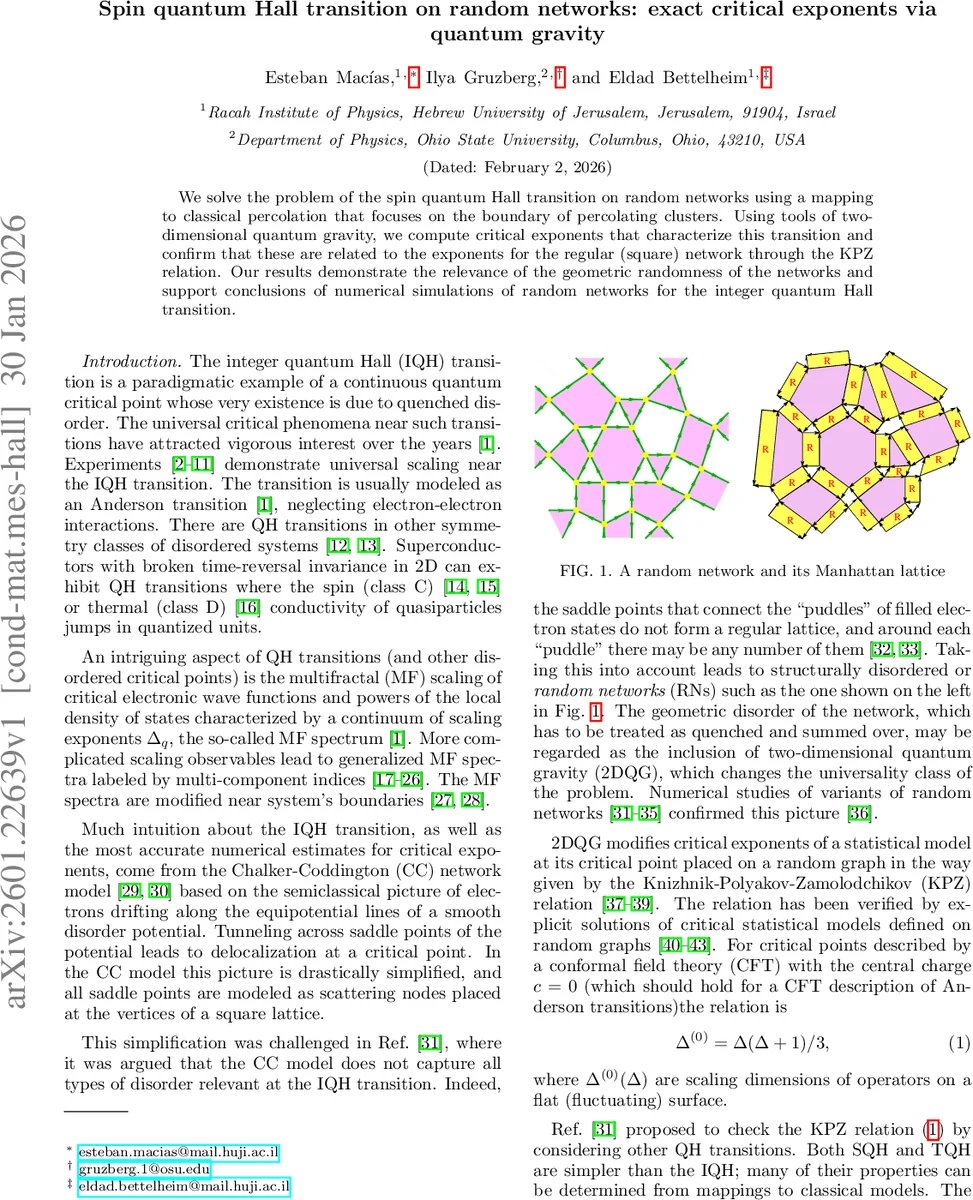
The key theoretical step is a mapping of the SQH transition onto classical bond percolation, but with a focus on the hulls (boundaries) of percolation clusters. These hulls are described by the dense phase of the O(n) loop model in the limit n→1. The loops live on the medial (Manhattan) lattice of the CC network; in the random case the medial lattice becomes a random planar graph whose faces are colored black, gray, or white. The white faces correspond to scattering nodes, while black and gray faces encode the orientation of loops. By imposing reflecting boundary conditions and defining the boundary length as the number of sides of colored faces after a maximal reduction, the authors set up a statistical ensemble of random surfaces with one boundary component.
Using the loop equations (LE) technique—originally developed for random triangulations—the authors derive exact recursion relations for the generating functions of disk partition functions (Φ) and for marked‑boundary partition functions (W). The LE are obtained by cutting a random surface along a white face adjacent to a marked boundary edge; this operation can split the surface either into two pieces of the same orientation or into two oppositely oriented pieces, leading to a bilinear functional equation (Eq. 12). Analyzing the singular behavior of this equation near the critical fugacities (x_c for area, ζ_c for boundary length) yields the string susceptibility exponent γ = −½ and the boundary‑length exponent ν_l = 2⁄3. These values are characteristic of 2DQG coupled to a c = 0 conformal field theory, which is the appropriate description of Anderson‑type transitions.
The authors then turn to multi‑leg (L‑leg) operators, which insert L mutually avoiding lines (legs) on the boundary. By recursively cutting along these legs they obtain the scaling of the two‑point functions D_L. The analysis shows that the boundary scaling dimensions in the quantum‑gravity ensemble are ˜Δ_L = L − 1, while the bulk dimensions satisfy ˜Δ_L = 2Δ_L, giving Δ_L = (L − 1)/2. Applying the KPZ relation Δ(0) = Δ(Δ + 1)/3 maps these quantum‑gravity dimensions to the known percolation dimensions in the plane: ˜Δ_L^{(0)} = L(L − 1)/3 for boundary operators and Δ_L^{(0)} = (L² − 1)/12 for bulk operators. This agreement provides a non‑trivial confirmation that the KPZ formula correctly relates critical exponents on random graphs to those on flat space for the SQH transition.
Beyond the exponents γ, ν_l, ˜Δ_L and Δ_L, the paper mentions a companion work where the thermal operator dimension Δ_t is extracted, leading to the thermodynamic exponent α and the localization‑length exponent ν for percolation clusters on random graphs. Those results give an independent verification of the KPZ mapping for the SQH transition.
In the discussion the authors stress that their exact solution demonstrates that geometric randomness does not destroy the universality class of the SQH transition but rather dresses it with 2DQG scaling, exactly as predicted by the KPZ relation. This theoretical insight supports earlier numerical studies that reported modified critical exponents for the IQH transition when the underlying network is randomized. The authors also outline a future research program: extending the 2DQG methodology to the full integer quantum Hall transition by viewing it as a limit of a sequence of solvable statistical models, as suggested in recent work (Ref.
Comments & Academic Discussion
Loading comments...
Leave a Comment