Weighted estimates for Hodge-Maxwell systems
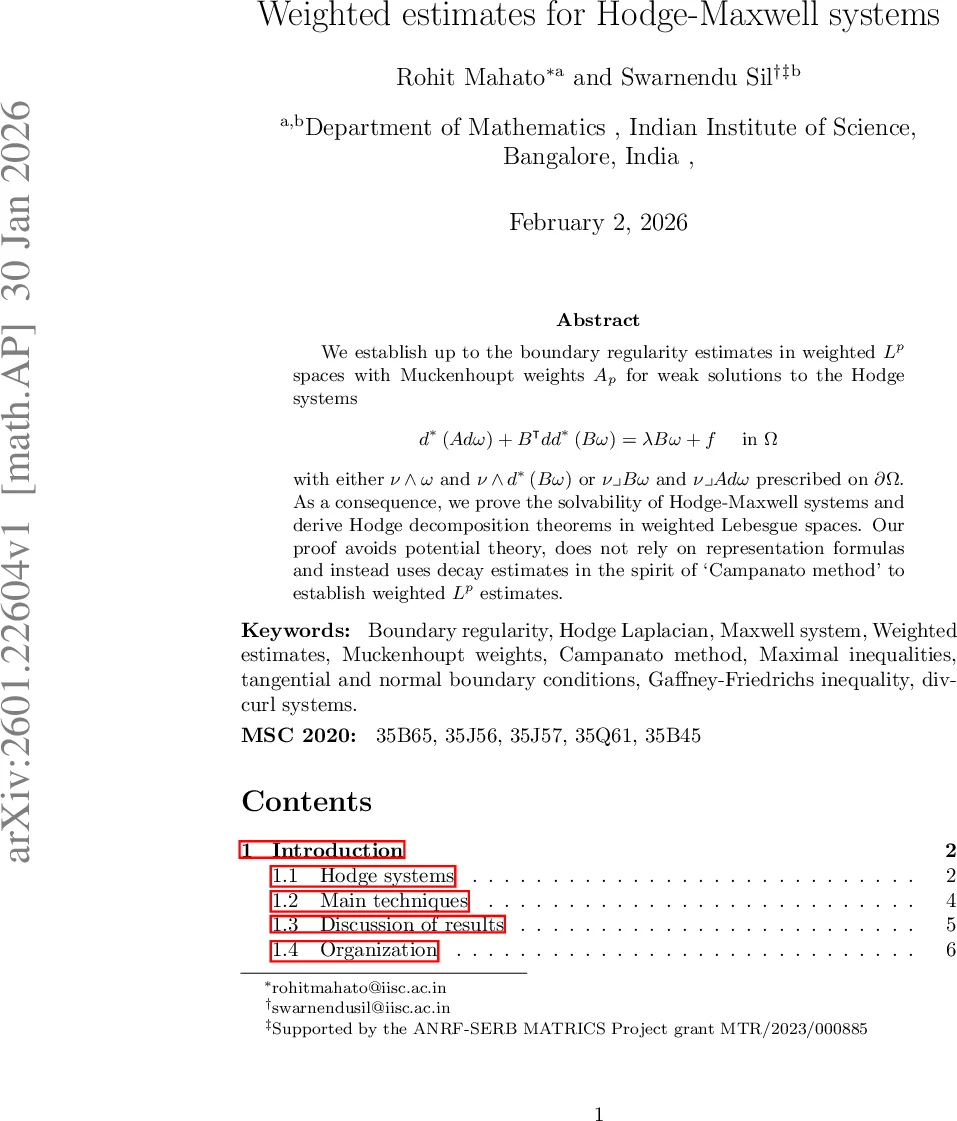
We establish up to the boundary regularity estimates in weighted $L^{p}$ spaces with Muckenhoupt weights $A_{p}$ for weak solutions to the Hodge systems \begin{align*} d^{\ast}\left(Adω\right) + B^{\intercal}dd^{\ast}\left(Bω\right) = λBω+ f \quad \text{ in } Ω \end{align*} with either $ν\wedge ω$ and $ν\wedge d^{\ast}\left(Bω\right)$ or $ν\lrcorner Bω$ and $ν\lrcorner Adω$ prescribed on $\partialΩ.$ As a consequence, we prove the solvability of Hodge-Maxwell systems and derive Hodge decomposition theorems in weighted Lebesgue spaces. Our proof avoids potential theory, does not rely on representation formulas and instead uses decay estimates in the spirit of `Campanato method’ to establish weighted $L^{p}$ estimates.
💡 Research Summary
The paper “Weighted estimates for Hodge‑Maxwell systems” by Mahato and Sil develops a comprehensive regularity theory for a broad class of linear elliptic systems that generalize the classical Hodge Laplacian. The authors consider vector‑valued differential k‑forms ω on a bounded C^{2,1} domain Ω⊂ℝ^{n} (n≥2) and study the operator
L ω := d^{}(A(x) dω) + B(x)^{\top} d d^{}(B(x) ω),
where d and d^{} are the exterior derivative and its codifferential, while A(x) and B(x) are matrix‑valued coefficient fields satisfying uniform ellipticity and sufficient smoothness. Two natural boundary conditions are imposed: (i) tangential data (ν∧ω, ν∧d^{}(Bω)) and (ii) normal data (ν⌟(Bω), ν⌟(A dω)), where ν denotes the outward unit normal. This framework includes the time‑harmonic Maxwell equations in three dimensions as a special case (with A=μ^{-1}, B=ε).
The main achievement is the derivation of global weighted L^{p} a‑priori estimates up to the boundary for weak solutions, with respect to any Muckenhoupt A_{p} weight w (1<p<∞). Concretely, for a solution ω of
L ω = λ B ω + f in Ω,
the authors prove
‖∇^{2}ω‖{L^{p}(Ω,w)} + ‖∇ω‖{L^{p}(Ω,w)} ≤ C (‖f‖{L^{p}(Ω,w)} + ‖boundary data‖{L^{p}(∂Ω,w)}),
where C depends only on n, k, N, the ellipticity constants of A, B, the A_{p} characteristic of w, and the C^{2,1} regularity of ∂Ω. This estimate is new even for constant coefficients; it extends the classical Morrey‑type L^{p} theory for the Hodge Laplacian to the weighted setting and to systems with non‑scalar coefficients.
Methodology.
The authors avoid any potential‑theoretic representation formulas, which are unavailable for the general operator L. Instead, they build on the Campanato approach introduced by Sil (2018) and later refined by Sengupta‑Sil (2021). The key steps are:
-
Local flattening and coefficient freezing. Near any boundary point the domain is flattened to a half‑space, and A, B are frozen to constant matrices. For the frozen system, sharp decay estimates for the Hessian are obtained (Lemma 32), improving the usual L^{2}–L^{2} Morrey decay to an L^{1}–L^{q} scale for any 1<q<∞.
-
Pointwise maximal function inequality. By a careful double‑localization (in the physical domain and in the flattened coordinates) the authors derive a pointwise bound for the truncated sharp maximal function of ∇^{2}ω (Lemma 34). The bound expresses this maximal function in terms of localized maximal functions of the data and of the error terms arising from coefficient variation and boundary flattening.
-
Fefferman–Stein weighted inequality. Using a weighted Fefferman–Stein theorem due to Phuc (2022), the pointwise inequality is upgraded to a global weighted L^{p} estimate. The authors control the “dangerous” terms by a delicate choice of auxiliary parameters (h, d, \bar R) that allow the smallness needed to absorb them into the left‑hand side.
-
Global a‑priori estimate and solvability. The local estimates are patched together via a covering argument, yielding the global estimate (Theorem 37). Standard functional‑analytic arguments (Lax–Milgram, density of smooth forms) then give existence and uniqueness of weak solutions in weighted Sobolev spaces (Theorem 39–40).
Consequences.
From the weighted L^{p} theory the authors derive several important corollaries:
- Weighted Hodge decomposition (Theorem 41): any L^{p}(Ω,w) form splits orthogonally into exact, co‑exact, and harmonic components, with each component belonging to the same weighted space.
- Div‑curl estimates and Gaffney inequality (Theorem 42–43): the authors obtain weighted versions of the classical Gaffney inequality, which are crucial for fluid‑mechanics and electromagnetism.
- Hodge‑Morrey decomposition (Theorem 45): a refinement that captures finer regularity in weighted Morrey spaces.
- Potential for extrapolation: the authors note that the weighted estimates serve as a starting point for Rubio de Francia extrapolation, allowing extensions to Orlicz and Musielak–Orlicz spaces.
Scope and Limitations.
The present work assumes that A and B are sufficiently smooth (essentially C^{0,α}) and does not treat discontinuous coefficients, although the authors expect their method to extend to certain classes of measurable coefficients (to be addressed in a forthcoming paper). The analysis is carried out on bounded C^{2,1} domains, but the local nature of the arguments implies that the results hold on compact Riemannian manifolds with C^{2,1} boundary as well.
Significance.
The paper provides the first systematic weighted L^{p} regularity theory for Hodge‑type systems with general matrix coefficients and mixed tangential/normal boundary conditions, without recourse to potential theory. By replacing representation formulas with decay‑plus‑maximal‑function techniques, the authors open a new pathway for treating a wide variety of linear elliptic boundary value problems where classical layer‑potential methods are either unavailable or prohibitively complex. This contribution is likely to influence future research on weighted estimates, boundary regularity, and functional‑analytic decompositions in geometric analysis and mathematical physics.
Comments & Academic Discussion
Loading comments...
Leave a Comment