Interaction induced topological magnon in electron-magnon coupled systems
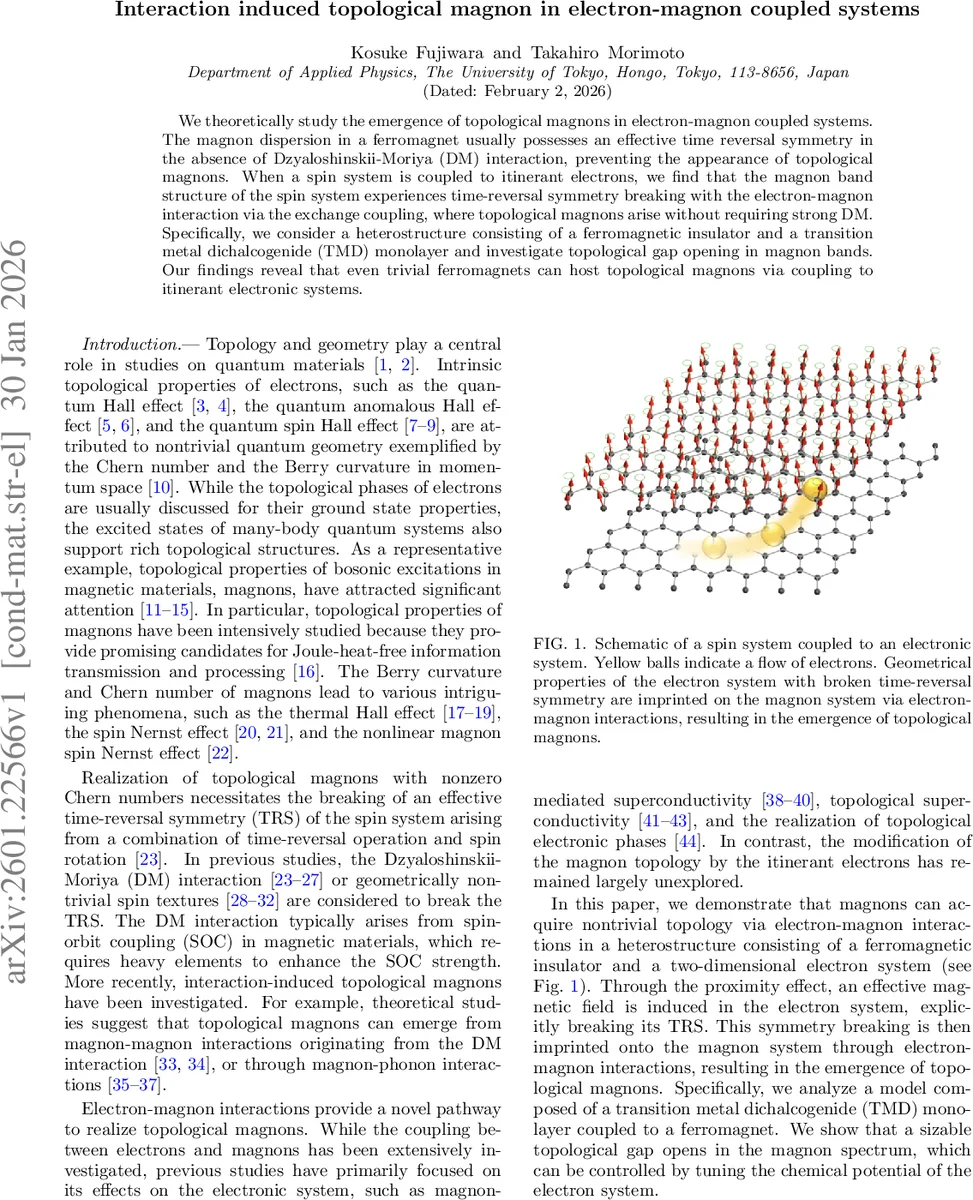
We theoretically study the emergence of topological magnons in electron-magnon coupled systems. The magnon dispersion in a ferromagnet usually possesses an effective time reversal symmetry in the absence of Dzyaloshinskii-Moriya (DM) interaction, preventing the appearance of topological magnons. When a spin system is coupled to itinerant electrons, we find that the magnon band structure of the spin system experiences time-reversal symmetry breaking with the electron-magnon interaction via the exchange coupling, where topological magnons arise without requiring strong DM. Specifically, we consider a heterostructure consisting of a ferromagnetic insulator and a transition metal dichalcogenide (TMD) monolayer and investigate topological gap opening in magnon bands. Our findings reveal that even trivial ferromagnets can host topological magnons via coupling to itinerant electronic systems.
💡 Research Summary
In this work the authors theoretically demonstrate a novel route to generate topological magnons without relying on strong Dzyaloshinskii‑Moriya (DM) interactions. They consider a heterostructure composed of a two‑dimensional ferromagnetic insulator (modeled as a Heisenberg ferromagnet on a honeycomb lattice) placed in proximity to a transition‑metal dichalcogenide (TMD) monolayer. The TMD is described by a minimal two‑band tight‑binding model that includes nearest‑neighbor hopping, spin‑dependent complex next‑nearest‑neighbor hopping (the Haldane‑type term) and a large staggered potential, which yields massive Dirac cones at the K and K′ valleys.
The key ingredient is the exchange coupling J_ex between the localized spins and the itinerant electrons. This term adds an effective Zeeman field to the electron Hamiltonian, breaking time‑reversal symmetry (TRS) for the electronic subsystem while preserving the combined spin‑rotation‑time‑reversal symmetry of the isolated spin system. When the Fermi level lies inside one of the spin‑polarized bands of the TMD, the occupied electronic bands acquire a finite integrated Berry curvature, turning the electronic subsystem into a Chern insulator.
To capture the influence of the electron‑magnon interaction on the magnon spectrum, the authors perform a Holstein‑Primakoff transformation on the spin operators and then apply a Schrieffer‑Wolff transformation to integrate out the electronic degrees of freedom to second order in J_ex. The resulting effective magnon Hamiltonian contains a self‑energy correction that depends on the electronic band structure, the Fermi distribution, and virtual particle‑hole excitations. Crucially, when the magnon energy does not overlap with the electron particle‑hole continuum (which is satisfied if the magnon bandwidth is smaller than the electronic gap or if the Fermi surface is small), the correction reduces to a momentum‑dependent complex hopping term that opens a gap at the K and K′ points of the magnon bands.
Numerical evaluation with realistic parameters for TMDs (t1≈1 eV, t2≈0.12 t1, Δ≈0.75 t1, ϕ≈0.3π) and a moderate exchange coupling (J_ex≈0.07 t1, S=1) shows that a sizable topological magnon gap of order 0.1 J can be achieved. The Berry curvature of the lowest magnon band exhibits sharp peaks of the same sign at K and K′, giving the band a Chern number C=±1. The authors map out a phase diagram as a function of the Fermi energy: when the Fermi level lies within the electronic gap the magnon Chern number is zero, whereas when it intersects a single spin‑polarized valley the magnon band becomes topological. If the Fermi level intersects both spin‑polarized valleys, the contributions to the magnon Berry curvature cancel and the Chern number returns to zero.
The mechanism is generic. The authors discuss candidate material platforms such as CrX₃ (X = I, Br, Cl) or CrXTe₃ (X = Si, Ge) coupled to MoS₂, WS₂, etc., where intrinsic DM interactions are weak. They also show in an appendix that a similar effect arises for graphene with Rashba spin‑orbit coupling, confirming that any itinerant electron system with strong spin‑orbit coupling and a gate‑tunable Fermi level can imprint its topological character onto a proximate magnon system via exchange coupling.
Experimentally, the topological magnon gap could be probed by inelastic neutron scattering, while the chiral edge modes could be detected using inelastic electron tunneling spectroscopy or Brillouin light scattering. Because the gap originates from a second‑order perturbative process, its magnitude scales as J_ex²/ε_e, where ε_e is a characteristic electronic energy (band gap or bandwidth). Therefore, materials with narrow electronic bandwidths and strong exchange coupling are most favorable.
In summary, the paper establishes that electron‑magnon exchange interactions provide a powerful and versatile pathway to engineer topological magnon bands in otherwise trivial ferromagnets. This opens new avenues for magnon‑based spintronics, low‑dissipation information transport, and the exploration of bosonic edge states without the need for heavy elements or intrinsic DM interactions. Future work should focus on experimental realization, the impact of temperature and disorder, and extending the theory to strong‑coupling regimes where magnon‑electron hybridization may lead to even richer topological phenomena.
Comments & Academic Discussion
Loading comments...
Leave a Comment