PersonaAct: Simulating Short-Video Users with Personalized Agents for Counterfactual Filter Bubble Auditing
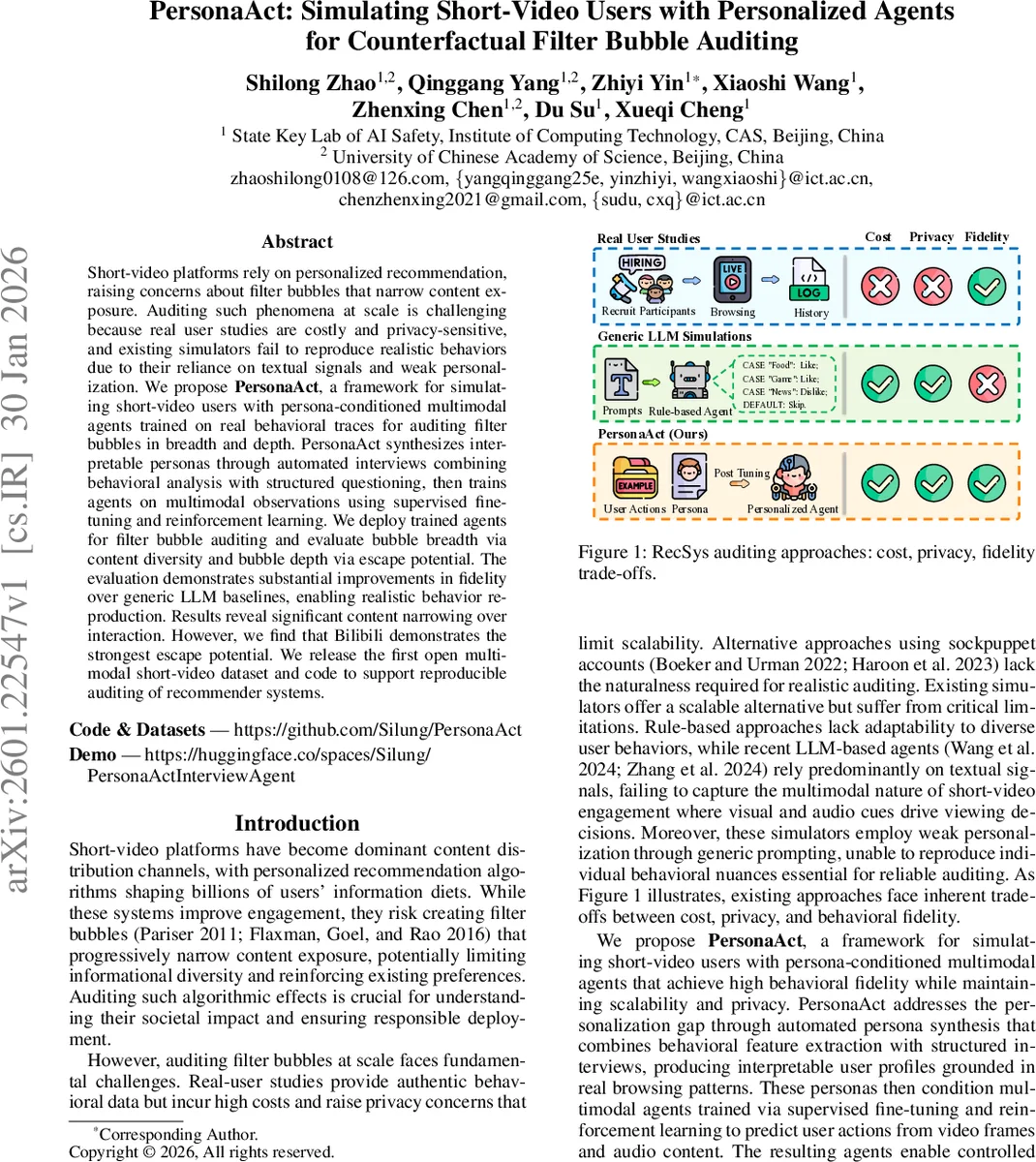
Short-video platforms rely on personalized recommendation, raising concerns about filter bubbles that narrow content exposure. Auditing such phenomena at scale is challenging because real user studies are costly and privacy-sensitive, and existing simulators fail to reproduce realistic behaviors due to their reliance on textual signals and weak personalization. We propose PersonaAct, a framework for simulating short-video users with persona-conditioned multimodal agents trained on real behavioral traces for auditing filter bubbles in breadth and depth. PersonaAct synthesizes interpretable personas through automated interviews combining behavioral analysis with structured questioning, then trains agents on multimodal observations using supervised fine-tuning and reinforcement learning. We deploy trained agents for filter bubble auditing and evaluate bubble breadth via content diversity and bubble depth via escape potential. The evaluation demonstrates substantial improvements in fidelity over generic LLM baselines, enabling realistic behavior reproduction. Results reveal significant content narrowing over interaction. However, we find that Bilibili demonstrates the strongest escape potential. We release the first open multimodal short-video dataset and code to support reproducible auditing of recommender systems.
💡 Research Summary
The paper introduces PersonaAct, a novel framework for simulating short‑video users and auditing filter bubbles at scale. Short‑video platforms such as Bilibili, Douyin (TikTok), and Kuaishou rely heavily on personalized recommendation, which can create “filter bubbles” that narrow the diversity of content a user sees. Traditional auditing methods—real‑user studies, sock‑puppet accounts, or rule‑based simulators—either lack scalability, raise privacy concerns, or fail to capture the multimodal nature of short‑video consumption. Recent large‑language‑model (LLM) based agents improve realism but still depend mainly on textual logs and weakly condition on user profiles, making them unsuitable for short‑video contexts where visual and auditory cues dominate.
PersonaAct addresses these gaps through three tightly coupled components: (1) an automated persona interview, (2) a persona‑conditioned multimodal agent, and (3) a counterfactual filter‑bubble auditing protocol. First, real user browsing traces are collected with a custom Android Debug Bridge (ADB) tool that synchronizes video frames, audio transcripts, metadata, and fine‑grained actions (watch, like, comment, share). From these logs, a behavior analyzer extracts quantitative features such as category distribution, watch‑time statistics, like/comment rates, creator preferences, and temporal habits. Using these features, a dialogue model dynamically generates interview questions that probe deeper motivations, attention mechanisms, exploration tendencies, and personality traits. The interview proceeds through a structured outline (usage context, content preferences, creator affinity, etc.) and the responses are synthesized into a rich persona profile p that combines statistical summaries with natural‑language narratives.
Second, the persona profile conditions a multimodal policy πθ(a | p, o) that predicts user actions a from observations o (video frames, audio, metadata). Training proceeds in two stages. Supervised fine‑tuning (SFT) on the collected traces establishes a baseline behavior manifold. Then Group Relative Policy Optimization (GRPO), a reinforcement‑learning algorithm, refines the policy using a composite reward: R_action (F1‑based matching of discrete actions), R_duration (a normalized error term 1 − min(1, |d − d̂|/d) for watch‑time prediction), and R_format (ensuring syntactically valid outputs). The underlying model is Qwen2.5‑VL‑7B‑Instruct, adapted with LoRA adapters for parameter‑efficient training on NVIDIA H100 GPUs.
Third, the authors propose a dual‑metric audit. Bubble breadth (content diversity) is measured by deploying agents on fresh accounts and tracking the number of distinct content categories (and entropy) within sliding windows of 50 videos. Bubble depth is quantified via a “Bubble Escape Potential” (BEP) metric: after an agent has adapted the recommender under its original persona p for 400 steps, a reversed persona p′—which inverts engagement signals (e.g., high‑watch‑time quantiles become low‑watch‑time samples)—interacts for another 400 steps. The Jensen‑Shannon divergence between the category distributions under p and p′ yields BEP ∈
Comments & Academic Discussion
Loading comments...
Leave a Comment