Searches for VLQs and LQs from the ATLAS Experiment
The Standard Model of particle physics explains many natural phenomena yet remains incomplete. Vectorlike quarks and leptoquarks lie at the heart of many extensions to the Standard Model seeking to address the hierarchy problem, or the flavour sector anomalies. These proceedings present the new results from searches with the ATLAS detector at the LHC.
💡 Research Summary
The paper presents a comprehensive overview of recent ATLAS searches for vector‑like quarks (VLQs), vector‑like leptons (VLLs), and leptoquarks (LQs) using the full Run 2 dataset at √s = 13 TeV (≈139 fb⁻¹) and, where indicated, an additional 55 fb⁻¹ of Run 3 data. The motivation is that these exotic states appear in many extensions of the Standard Model (SM) that aim to address the hierarchy problem, flavor anomalies, or grand‑unified theories.
Vector‑like quarks
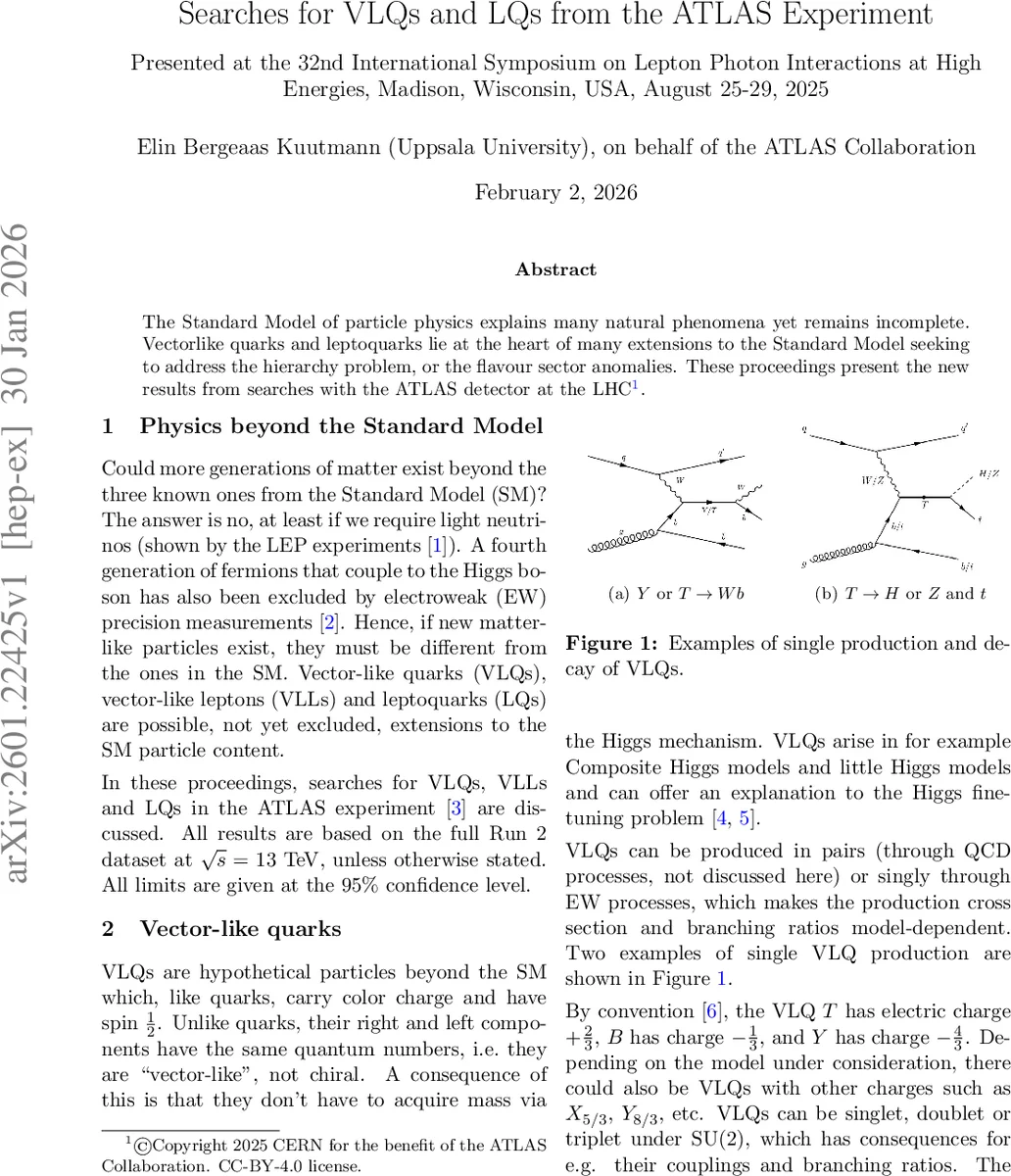
VLQs are color‑triplet spin‑½ fermions whose left‑ and right‑handed components transform identically under the electroweak group, allowing them to acquire mass independently of the Higgs mechanism. The paper discusses both pair production (QCD‑driven, not detailed) and single production via electroweak interactions, which depends on a model‑specific coupling κ that scales the production cross‑section and decay width.
-
Single T/Y → Wb in the one‑lepton channel: Events are selected with a high‑pT electron or muon, missing transverse energy (E_T^miss), a hard b‑jet, and a forward light‑quark jet. The VLQ mass is reconstructed from the lepton, E_T^miss, and the b‑jet. Limits on κ range from 0.22 to 0.52 for a singlet T (mass 1.15–2.30 TeV) and 0.14 to 0.46 for a Y from a (T,B,Y) triplet (mass 1.15–2.60 TeV). Interference with SM backgrounds is negligible for Y, as shown by overlapping exclusion curves.
-
Single T/Y → Wb in the all‑hadronic channel: A large‑R jet trigger selects events with a W‑tagged large‑R jet and an additional small‑R b‑jet. The invariant mass of the two jets gives the VLQ candidate mass. For κ = 0.5, Y masses below 2.0 TeV are excluded; for κ = 0.7, the limit rises to 2.4 TeV. Corresponding limits for T are 1.4 TeV (κ = 0.5) and 1.9 TeV (κ = 0.7). These results extend previous ATLAS exclusions.
-
Mono‑top + E_T^miss (T → Zt, Z → νν): The analysis targets a boosted top‑tagged large‑R jet plus large missing transverse momentum. An XGBoost classifier separates signal from background. Assuming κ_T = 0.5 and a branching ratio BR(T → Zt) = 25 %, VLQ masses below 1.8 TeV are excluded. Upper limits on the production cross‑section as a function of mass are provided.
-
Combined single‑T interpretation: Results from the three single‑production searches are combined, yielding exclusion contours in the plane of total decay width Γ versus branching fractions to W, Z, and H. The relative coupling ξ_W (approximately the BR(T → Wb) at high mass) is used to parametrize the limits: ξ_W = 0.5 corresponds to a singlet T, ξ_W = 0 to a doublet T. The combined analysis improves sensitivity across a broad range of Γ and ξ_W.
Leptoquarks
LQs carry both lepton and baryon numbers, electric charge, and color. They can be scalar (spin‑0) or vector (spin‑1) and decay to a lepton–quark pair. The paper focuses on single resonant production of a scalar LQ that couples to charged leptons and down‑type quarks.
- Using the full Run 2 dataset plus 55 fb⁻¹ of Run 3, limits on the Yukawa‑type coupling y and the LQ mass are set. For y = 1.0 (electron–d quark) the mass limit is 3.4 TeV; for y = 3.5 (muon–s quark) it is 4.3 TeV; for y = 3.5 (muon–b quark) the limits are 3.1 TeV and 2.8 TeV depending on the lepton flavor. These bounds extend previous pair‑production limits.
Vector‑like leptons decaying to LQs
A recent ATLAS study investigates VLLs (E, N) that decay into a vector LQ U₁, which subsequently decays to third‑generation leptons (τ or ν) and third‑generation quarks (t or b). The model is the UV‑complete “4321” framework that also addresses B‑physics anomalies. Pair‑produced VLLs are searched for via final states containing τ‑leptons, top or bottom quarks, and missing energy. The analysis excludes VLL masses between 200 GeV and 910 GeV for the cross‑section predicted by the 4321 model.
Conclusions
ATLAS has substantially expanded the excluded parameter space for VLQs, VLLs, and LQs, especially in single‑production channels that are directly sensitive to the underlying couplings (κ for VLQs, y for LQs). Mass limits now reach up to ~2.6 TeV for Y, ~2.4 TeV for T in the all‑hadronic channel, ~4.3 TeV for scalar LQs with large Yukawa couplings, and ~0.91 TeV for VLLs in the 4321 scenario. These results tighten constraints on theories that invoke heavy vector‑like fermions or leptoquarks to solve the hierarchy problem or explain flavor anomalies. Future LHC runs and the High‑Luminosity upgrade will provide larger datasets and higher energies, enabling further probing of higher mass scales and smaller couplings.
Comments & Academic Discussion
Loading comments...
Leave a Comment