Effective LoRA Adapter Routing using Task Representations
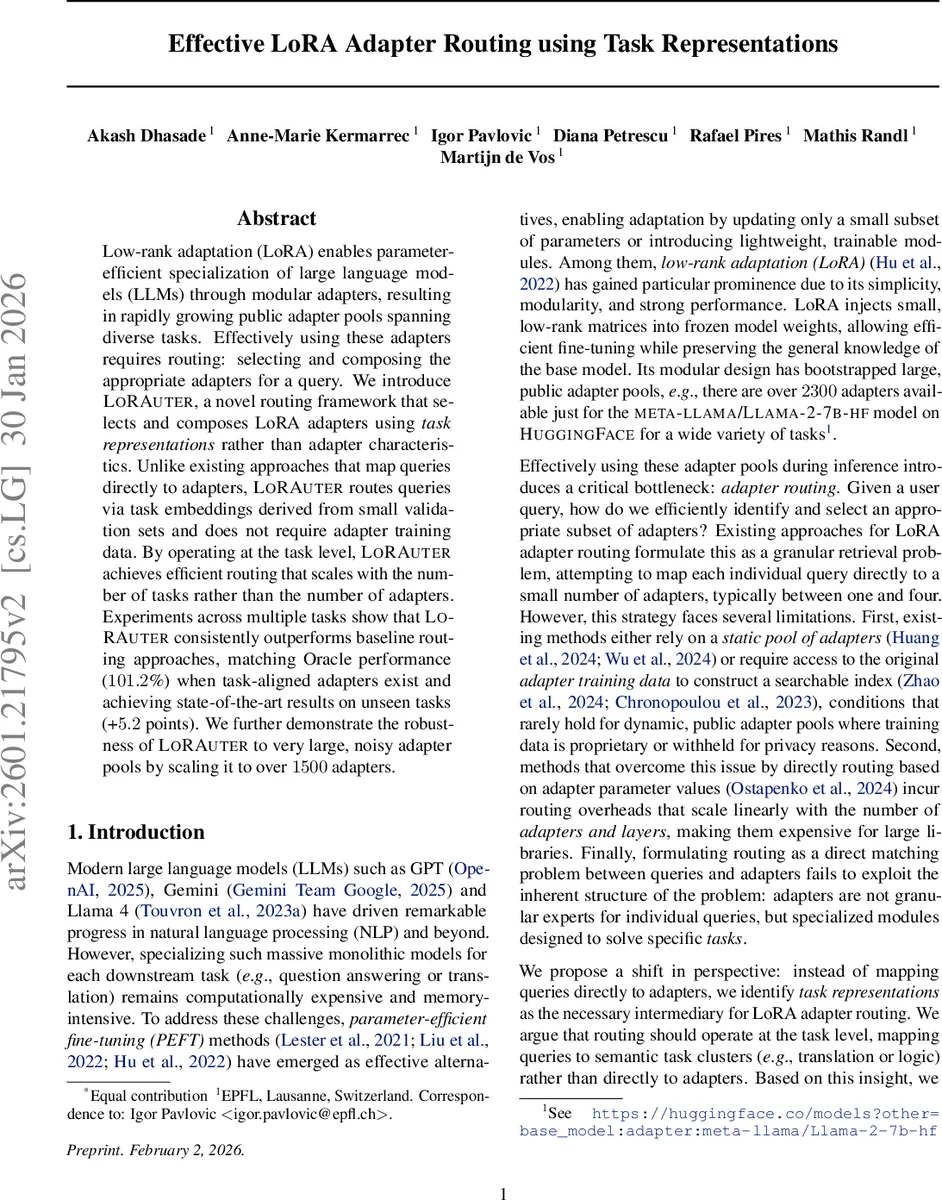
Low-rank adaptation (LoRA) enables parameter efficient specialization of large language models (LLMs) through modular adapters, resulting in rapidly growing public adapter pools spanning diverse tasks. Effectively using these adapters requires routing: selecting and composing the appropriate adapters for a query. We introduce LORAUTER, a novel routing framework that selects and composes LoRA adapters using task representations rather than adapter characteristics. Unlike existing approaches that map queries directly to adapters, LORAUTER routes queries via task embeddings derived from small validation sets and does not require adapter training data. By operating at the task level, LORAUTER achieves efficient routing that scales with the number of tasks rather than the number of adapters. Experiments across multiple tasks show that LORAUTER consistently outperforms baseline routing approaches, matching Oracle performance (101.2%) when task-aligned adapters exist and achieving state-of-the-art results on unseen tasks (+5.2 points). We further demonstrate the robustness of LORAUTER to very large, noisy adapter pools by scaling it to over 1500 adapters.
💡 Research Summary
The paper introduces LoRAuter, a training‑free routing framework for low‑rank adaptation (LoRA) adapters that operates at the level of tasks rather than individual adapters. LoRA adapters are lightweight modules that enable parameter‑efficient fine‑tuning of large language models (LLMs). Public repositories now host thousands of such adapters, but selecting the right subset for a given user query—adapter routing—remains a bottleneck. Existing routing methods either require access to the original adapter training data, involve costly per‑adapter evaluations, or rely on learned gating networks that scale linearly with the number of adapters and model layers.
LoRAuter’s key insight is to treat tasks as the primary routing entities. The system first builds a task database (T_rep) from publicly available validation sets. Each task t_i is associated with a small validation set D_i (a few labeled examples). For every task, LoRAuter identifies the most suitable adapter from the pool Φ by evaluating adapters on D_i and selecting the one with the highest task‑specific metric (e.g., ROUGE for summarization, BLEU for translation). Because exhaustive evaluation of all adapters is prohibitive when N (the number of adapters) is large, the authors employ Successive Halving (SH), a tournament‑style search that iteratively discards under‑performing adapters while allocating more resources to promising candidates. This reduces the computational cost of the task‑to‑adapter mapping by more than a factor of two and scales well across multiple GPUs.
At inference time, a user query x is embedded using a pre‑trained sentence encoder E (e.g., Sentence‑BERT). For each task, LoRAuter pre‑computes a task representation e_i by averaging embeddings of a small random subset of its validation queries, optionally prefixed with an instruction token. The query embedding e_x is then compared to all task embeddings, and the top‑K most similar tasks are retrieved. The adapters associated with these tasks are composed in the output space using a weighted sum where the weights are proportional to the query‑task similarity scores. This input‑aware composition allows the system to blend multiple adapters when a query spans several semantic domains, without requiring any additional learning.
The authors evaluate LoRAuter on a mixed‑task benchmark comprising eight NLP tasks (summarization, translation, QA, sentiment analysis, etc.) and 48 publicly released adapters built for the Llama‑2‑7B‑HF base model. In in‑domain settings—where the query’s underlying task is present in the task database—LoRAuter achieves 101.2 % of the Oracle performance, i.e., it slightly exceeds the theoretical upper bound of selecting the perfect task‑aligned adapter. In out‑of‑domain scenarios (unseen tasks), LoRAuter outperforms the strongest existing baseline, LoRA Retriever, by 5.2 percentage points. To test scalability, the authors expand the adapter pool to over 1500 adapters collected from the wild. Even with this noisy, large collection, LoRAuter’s performance remains comparable to the original 48‑adapter baseline, demonstrating robustness to both size and noise.
Key contributions are:
- Training‑free, black‑box routing – No need for adapter training data or additional router model training, enabling use of proprietary or privacy‑sensitive adapters.
- Computational efficiency – Routing complexity scales with the number of tasks (T), which is typically far smaller than the number of adapters (N). Successive Halving further reduces the cost of building the task‑to‑adapter map.
- Extensive evaluation – Experiments cover multiple model sizes, large adapter pools, and a variety of ablations, confirming the method’s generality.
Limitations include the requirement of a small validation set for each task and the initial cost of evaluating adapters during the task‑to‑adapter pairing phase. Future work could explore automated generation of validation samples, meta‑learning to further reduce pairing overhead, integration with multimodal adapters (vision, audio), and dynamic learning of composition weights for even finer‑grained adaptation.
In summary, LoRAuter presents a novel paradigm for serving LoRA adapters at scale: by routing queries through task embeddings, it achieves state‑of‑the‑art performance without any training, while remaining computationally tractable as public adapter ecosystems continue to grow. This work paves the way for more flexible, cost‑effective deployment of specialized LLM capabilities in real‑world applications.
Comments & Academic Discussion
Loading comments...
Leave a Comment