AcousTools: A 'Full-Stack', Python-Based, Acoustic Holography Library
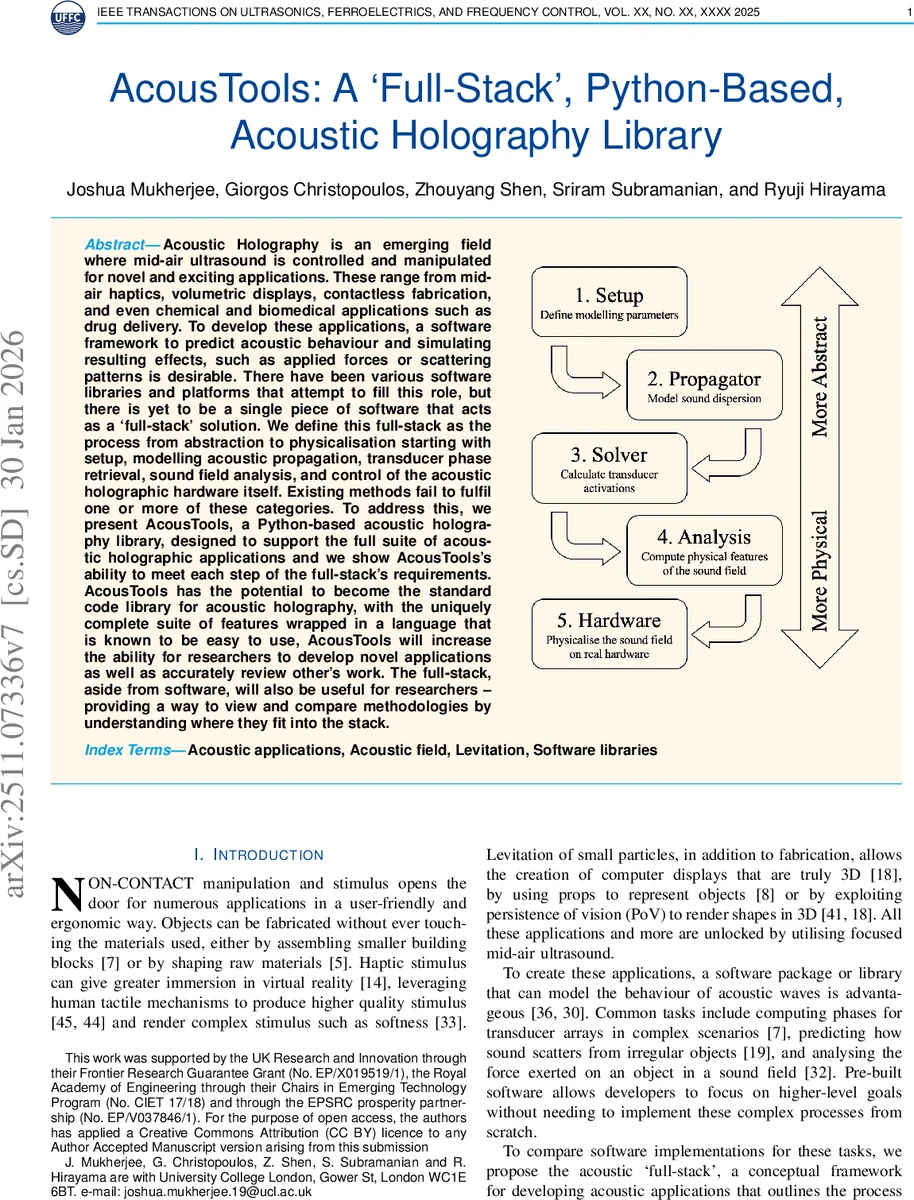
Acoustic Holography is an emerging field where mid-air ultrasound is controlled and manipulated for novel and exciting applications. These range from mid-air haptics, volumetric displays, contactless fabrication, and even chemical and biomedical applications such as drug delivery. To develop these applications, a software framework to predict acoustic behaviour and simulating resulting effects, such as applied forces or scattering patterns is desirable. There have been various software libraries and platforms that attempt to fill this role, but there is yet to be a single piece of software that acts as a ‘full-stack’ solution. We define this full-stack as the process from abstraction to physicalisation starting with setup, modelling acoustic propagation, transducer phase retrieval, sound field analysis, and control of the acoustic holographic hardware itself. Existing methods fail to fulfil one or more of these categories. To address this, we present AcousTools, a Python-based acoustic holography library, designed to support the full suite of acoustic holographic applications and we show AcousTools’s ability to meet each step of the full-stack’s requirements. AcousTools has the potential to become the standard code library for acoustic holography, with the uniquely complete suite of features wrapped in a language that is known to be easy to use, AcousTools will increase the ability for researchers to develop novel applications as well as accurately review other’s work. The full-stack, aside from software, will also be useful for researchers - providing a way to view and compare methodologies by understanding where they fit into the stack.
💡 Research Summary
The paper addresses a critical gap in the emerging field of acoustic holography: the lack of a unified software framework that can cover the entire workflow from abstract design to physical deployment. The authors introduce the concept of an “Acoustic Full‑Stack,” which decomposes the development process into five stages—Setup, Propagators, Solvers, Analysis, and Hardware. Existing tools typically support only a subset of these stages, forcing researchers to stitch together multiple packages or implement missing components from scratch, which hampers reproducibility and slows innovation.
AcousTools is presented as a Python‑based library that implements the full stack in a single, cohesive package. Built on top of PyTorch, it leverages automatic differentiation, GPU acceleration, and tensor operations to provide both flexibility and performance. In the Setup stage, users can define transducer arrays, scatterers, and target points through high‑level classes, with automatic handling of coordinate transformations and mesh generation.
For acoustic propagation, AcousTools offers two models: a conventional free‑field piston model and a Boundary Element Method (BEM) implementation that accounts for scattering from arbitrary objects. The BEM approach constructs an extended propagator matrix (E = F + G H), where (F) is the direct field, (H) maps transducers to a mesh, and (G) maps the mesh to observation points. To mitigate the large memory footprint of BEM, the library pre‑computes and caches geometry‑dependent matrices, and it provides utilities for efficient mesh handling.
Phase‑retrieval (Solvers) is handled through two families of algorithms. Gradient‑based solvers formulate the problem as (\min_x L(Ax) + C(x)), where (L) is a user‑defined objective (e.g., maximize pressure at targets) and (C) encodes hardware constraints (e.g., unit‑amplitude transducers). Automatic differentiation computes (\nabla L) without requiring explicit gradient formulas, allowing researchers to plug in custom objectives easily. Alternating‑projection solvers implement classic Gerchberg‑Saxton, Weighted‑GS, Naive, and other variants, all expressed as tensor operations for rapid iteration over thousands of target points.
The Analysis stage supplies modules to compute physically meaningful metrics such as pressure magnitude, phase, pressure gradients, Gor’kov potential, acoustic force, and stiffness. These enable quantitative evaluation of levitation forces, haptic feedback, and contact‑free manipulation.
Hardware integration abstracts communication with common controllers (Arduino, Raspberry Pi) and commercial 256‑channel ultrasound drivers via serial or UDP links. The library supports real‑time feedback loops, allowing measured acoustic fields to be fed back into the solver for adaptive control.
Experimental validation is performed on a 12 cm‑spaced planar array facing an acrylic “rabbit” reflector. Using the BEM propagator reduces pressure variance at the focal point by roughly 30 % compared with the free‑field model. Gradient‑based optimization achieves 2–3× better pressure uniformity than Weighted‑GS while maintaining comparable computation times. With GPU acceleration, the entire pipeline (propagation, solving, analysis, transmission) executes in under 10 ms, demonstrating feasibility for real‑time applications.
The authors acknowledge limitations: BEM meshes can become memory‑intensive for high‑resolution geometries, and dynamic scattering objects require frequent recomputation of geometry‑dependent matrices, which may challenge real‑time performance. Moreover, current hardware drivers are limited to a few commercial arrays, so broader compatibility will require additional adapters.
In summary, AcousTools delivers the first comprehensive, Python‑native library that spans the full acoustic holography stack. By unifying setup, propagation, phase retrieval, analysis, and hardware control, it promises to improve reproducibility, lower the barrier to entry for new researchers, and accelerate the development of novel applications such as mid‑air haptics, volumetric displays, and contact‑free manufacturing. Future community contributions—e.g., plug‑in solvers, extended hardware interfaces, and standardized data formats—could further solidify AcousTools as the de‑facto platform for acoustic holography research.
Comments & Academic Discussion
Loading comments...
Leave a Comment