Abstract Integration in Net Convergence Structures
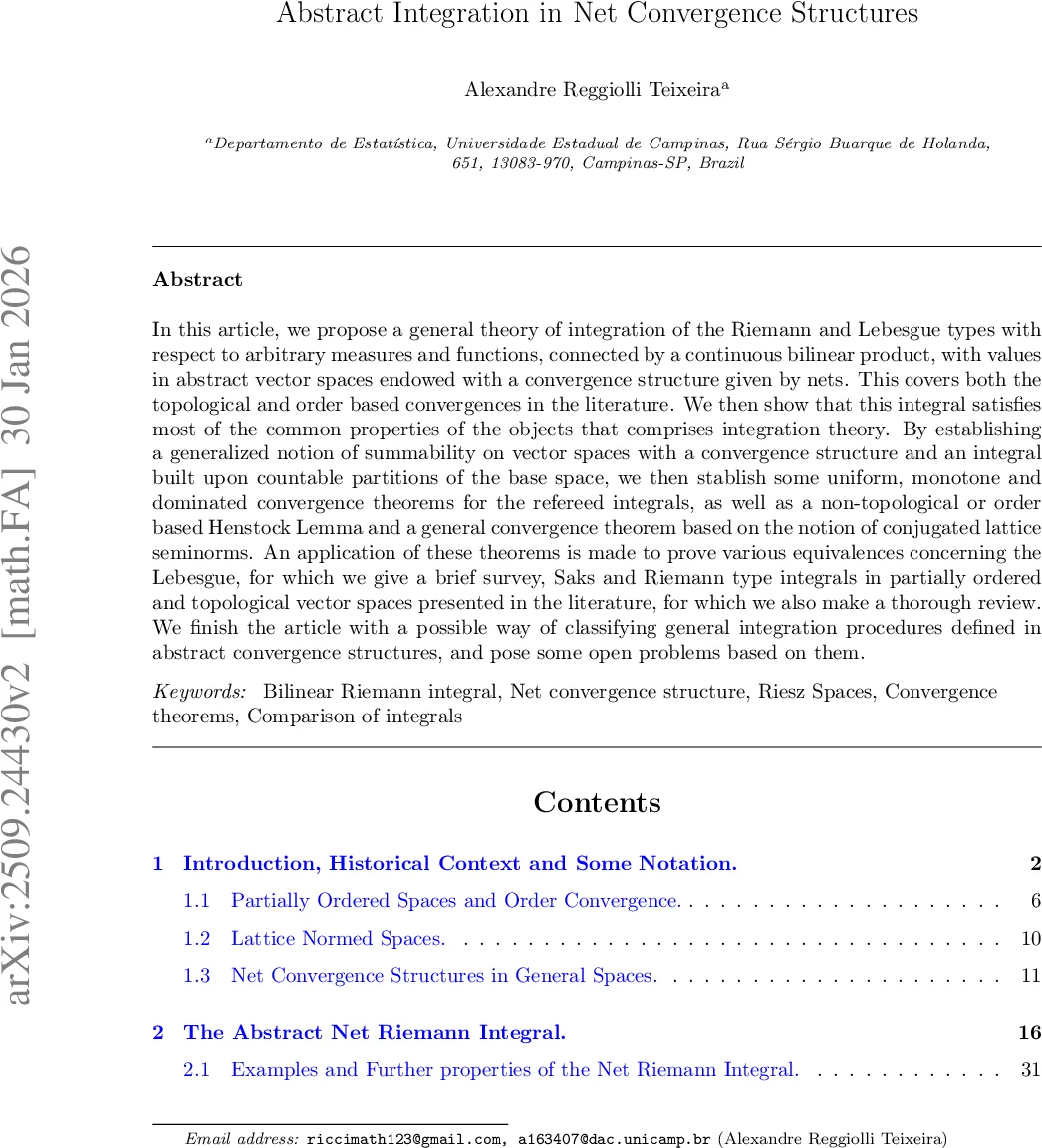
In this article, we propose a general theory of integration of the Riemann and Lebesgue types with respect to arbitrary measures and functions, connected by a continuous bilinear product, with values in abstract vector spaces endowed with a convergence structure given by nets. This covers both the topological and order based convergences in the literature. We then show that this integral satisfies most of the common properties of the objects that comprises integration theory. By establishing a generalized notion of summability on Riesz spaces and an integral built upon countable partitions of the base space, we then stablish some uniform, monotone and dominated convergence theorems for the refereed integrals, as well as a non-topological or order based Henstock Lemma and a general convergence theorem based on the notion of conjugated lattice seminorms. An application of these theorems is made to prove various equivalences concerning the Lebesgue, for which we give a brief survey, Saks and Riemann type integrals in partially ordered and topological vector spaces presented in the literature, for which we also make a thorough review. We finish the article with a possible way of classifying general integration procedures defined in abstract convergence structures, and pose some open problems based on them.
💡 Research Summary
The paper introduces a highly abstract framework for integration that unifies Riemann‑type and Lebesgue‑type integrals using “net convergence structures.” Instead of relying on a specific topology or order, the authors consider a vector space equipped with a continuous bilinear product ⟨·,·⟩ and an arbitrary measure taking values in another vector space. On this space they define a convergence operation for nets (directed families of elements) that satisfies a small set of natural axioms; this notion, originally studied by Dolecki and Mynard, generalizes both order‑convergence (p₀q‑convergence) and topological convergence.
The central construction is the abstract net Riemann integral. For a function f : Ω → X and a set‑function μ : ℱ → Y, one builds countable partitions of Ω (called S‑partitions) and forms Riemann sums Σ⟨f(ξ_j), μ(A_j)⟩. The integral is defined as the net limit of these sums when the partition becomes finer. Because the limit is taken in the abstract net sense, the definition does not require any underlying topology or order on X, Y, or Z. The authors prove that this integral enjoys the usual algebraic properties—additivity, isotonicity, and compatibility with subsets—using only the net‑limit axioms (Theorem 2.3, 2.4).
To handle infinite series, the paper develops a summability theory on Riesz spaces (vector lattices). By extending the classical notions of unconditional and conditional convergence to the net‑convergence setting, they define the S‑integral, which is essentially the net limit of infinite Riemann sums. The S‑integral contains the net Riemann integral as a special case and provides a bridge to many existing integration concepts.
A substantial part of the work is devoted to convergence theorems. The authors separate results into order‑based and topology‑based families:
Order‑based: They introduce a notion of null sets for non‑negative set‑functions valued in Riesz spaces and prove a uniform convergence theorem (Theorem 4.1) that generalizes the Montero‑Fernandez result. Monotone and dominated convergence theorems (Theorems 4.5, 4.6) are obtained solely from order‑convergence, without any topological assumptions. A non‑topological Henstock Lemma (Theorem 4.6) and a very general convergence theorem based on conjugated lattice seminorms (Theorem 4.14) are also established.
Topology‑based: By assuming a Hausdorff topology on the underlying spaces, the authors derive a quasi‑uniform (Egorov‑type) convergence theorem for the net Riemann integral (Theorem 4.10) and show that many classical results (e.g., Sion’s 1973 theorems) are special cases of their framework.
The paper then compares the new integrals with a wide spectrum of classical constructions:
- In Riesz spaces, the Lebesgue integral (Section 5.1) is shown to be a special case of the S‑integral, and consequently of the net Riemann integral.
- In topological vector spaces, the Bartle‑Dunford‑Schwartz (BDS) integral (Section 5.2.1) and the Haluska‑Rodriguez‑Salazar integrals for bornological locally convex spaces (Section 5.2.2) are recovered.
- The submeasure integral of Massé (Section 5.2.3) is partially identified with the S‑integral under suitable control measures.
- The authors resolve several open comparison problems from the literature: they answer Lipecki’s question about Sion vs. Turpin, clarify the relationship between Lebesgue and Riemann constructions on partially ordered spaces (Pa‑vla‑kos, Popescu), and show that Sion’s truncation integral is encompassed by the S‑integral.
A new Saks‑type integration procedure is introduced (Section 6). Defined again via net convergence, it subsumes the net Riemann integral and also captures non‑additive integrals such as those studied by Boccuto and Riečan. This demonstrates the flexibility of the net‑convergence approach for handling both additive and non‑additive measures.
In the concluding section, the authors propose a classification scheme for integration procedures based on the underlying convergence structure (order, topological, or mixed) and list several open problems, including deeper connections with stochastic integration, extensions to non‑Archimedean settings, and the development of a categorical framework for net‑based integration.
Overall, the paper provides a unifying, highly abstract theory of integration that eliminates the need for specific topological or order structures, replaces them with a minimal net‑convergence axiom system, and shows that virtually all known integration methods in analysis can be derived as special cases. This opens new avenues for research in measure theory, functional analysis, and applications where traditional topological assumptions are either unavailable or undesirable.
Comments & Academic Discussion
Loading comments...
Leave a Comment