Direct Bias-Correction Term Estimation for Average Treatment Effect Estimation
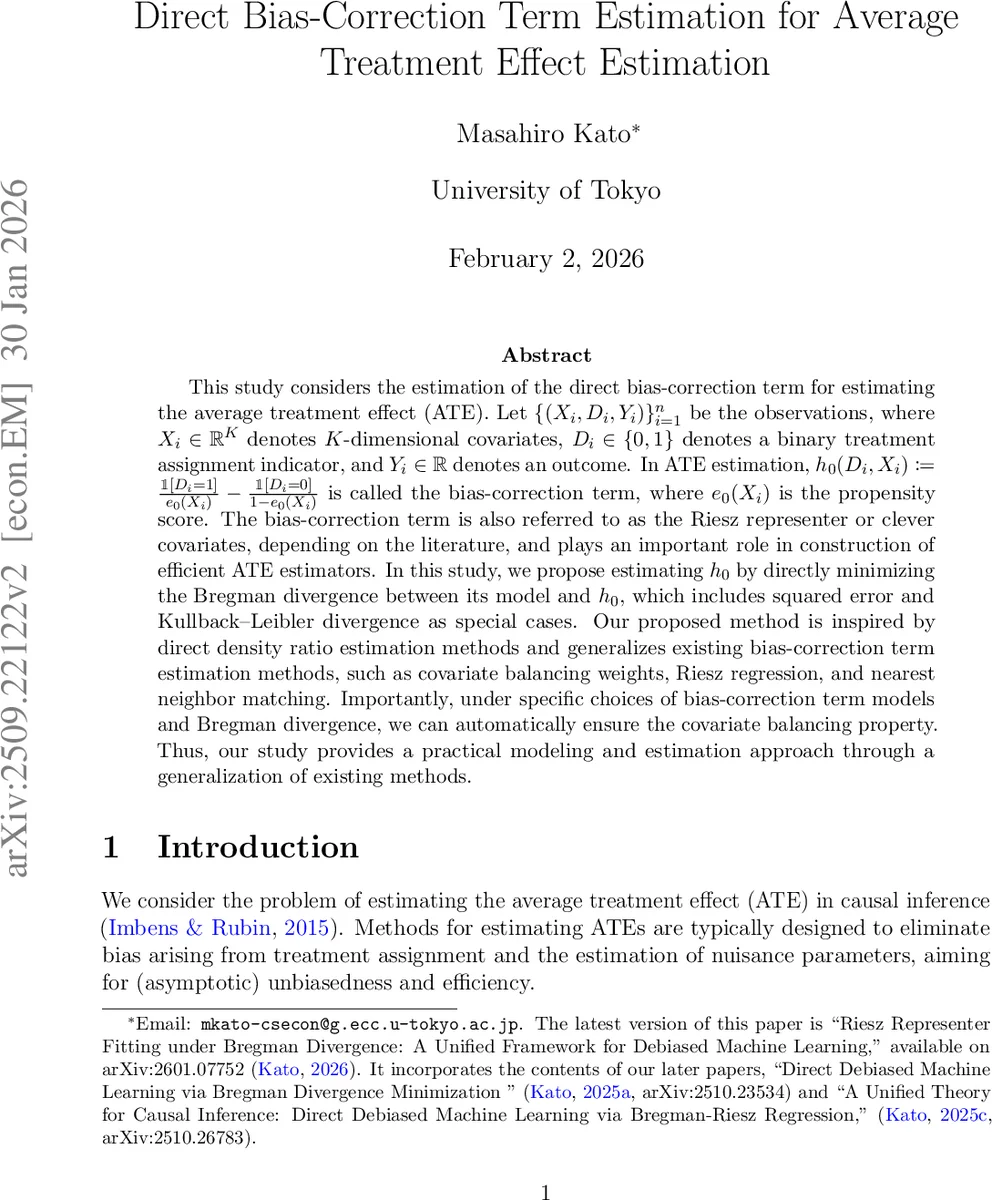
This study considers the estimation of the direct bias-correction term for estimating the average treatment effect (ATE). Let ${(X_i, D_i, Y_i)}_{i=1}^{n}$ be the observations, where $X_i$ denotes $K$-dimensional covariates, $D_i \in {0, 1}$ denotes a binary treatment assignment indicator, and $Y_i$ denotes an outcome. In ATE estimation, $h_0(D_i, X_i) = \frac{1[D_i = 1]}{e_0(X_i)} - \frac{1[D_i = 0]}{1 - e_0(X_i)}$ is called the bias-correction term, where $e_0(X_i)$ is the propensity score. The bias-correction term is also referred to as the Riesz representer or clever covariates, depending on the literature, and plays an important role in construction of efficient ATE estimators. In this study, we propose estimating $h_0$ by directly minimizing the Bregman divergence between its model and $h_0$, which includes squared error and Kullback–Leibler divergence as special cases. Our proposed method is inspired by direct density ratio estimation methods and generalizes existing bias-correction term estimation methods, such as covariate balancing weights, Riesz regression, and nearest neighbor matching. Importantly, under specific choices of bias-correction term models and Bregman divergence, we can automatically ensure the covariate balancing property. Thus, our study provides a practical modeling and estimation approach through a generalization of existing methods.
💡 Research Summary
The paper addresses a central component of average treatment effect (ATE) estimation: the bias‑correction term
(h_{0}(D,X)=\frac{\mathbf 1{D=1}}{e_{0}(X)}-\frac{\mathbf 1{D=0}}{1-e_{0}(X)}),
where (e_{0}(X)=P(D=1\mid X)) is the propensity score. Traditional approaches first estimate the propensity score (often by logistic regression) and then plug the estimate into (h_{0}). The authors argue that this two‑step procedure introduces unnecessary intermediate error and propose to estimate (h_{0}) directly by minimizing a Bregman divergence between a candidate model (h) and the unknown true function (h_{0}).
A Bregman divergence is defined by a strictly convex, differentiable function (g:\mathbb R\to\mathbb R): \
Comments & Academic Discussion
Loading comments...
Leave a Comment