Trigonal warping enables linear optical spectroscopy in single-valley superconductors
In superconductors with multiple pairing channels, Bardasis-Schrieffer modes and clapping modes arise as fluctuations in channels whose angular momenta differ from that of the pair condensate. Crystal symmetries often impose selection rules which keep these modes optically dark. We show that if pairing occurs around a single Fermi surface, trigonal warping renders both of these modes, as well as the quasiparticle excitation gap, visible in the longitudinal and Hall optical responses. Our results suggest that rhombohedral graphene multilayers, which are believed to host the required ingredients, might offer an ideal setting for the study of exotic superconducting collective modes.
💡 Research Summary
The paper investigates how collective excitations in multichannel superconductors—specifically Bardasis‑Schrieffer (Ba‑Sch) modes and clapping modes—can become visible in linear optical experiments despite being symmetry‑forbidden in most crystals. The authors identify trigonal warping of a single Fermi surface as a mechanism that breaks the inversion symmetry of the electronic velocity in a way that couples these modes to light at zero momentum (q → 0).
Starting from a spinless electron model with two pairing channels (ℓ = 1, 2) and attractive couplings g₁ ≥ g₂, they introduce a mean‑field gap Δ(k)=Δ_mf χ₁(k) and parametrize fluctuations as Higgs (h), Anderson‑Bogoliubov–Goldstone (θ), and two real fields a and b that represent Ba‑Sch or clapping fluctuations depending on the symmetry of χ₁ and χ₂. Minimal coupling to the electromagnetic vector potential A is performed, and a gauge transformation removes the overall phase θ. The resulting effective action contains three‑point vertices linking A and the collective fields Φ = (h,a,b) and a paramagnetic vertex proportional to the electronic velocity v(k).
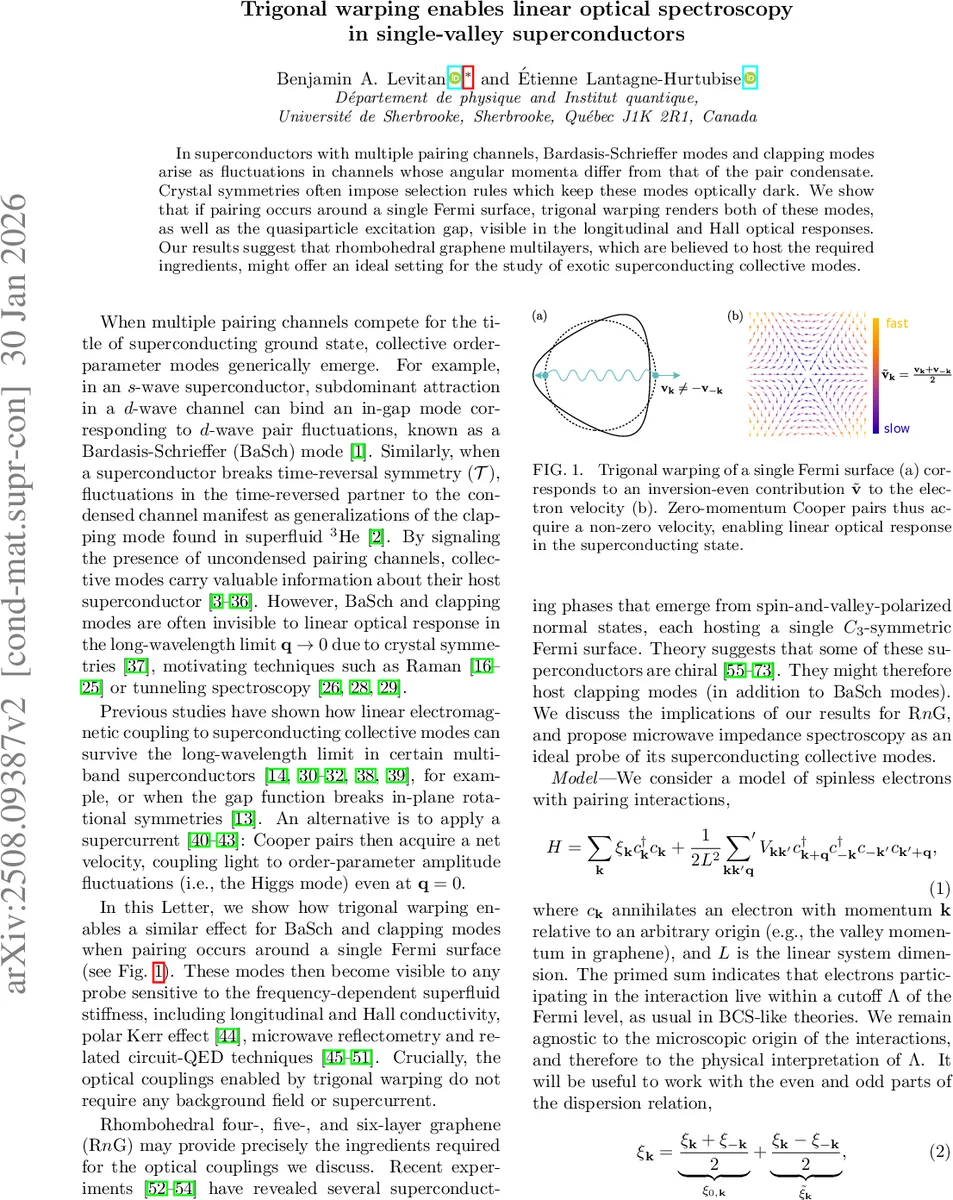
Crucially, the dispersion is split into an even part ξ₀(k) (isotropic) and an odd part ˜ξ(k) that embodies trigonal warping: ˜ξ(k)=η(kₓ³−3kₓk_y²). Its gradient yields an odd velocity component ˜v(k)=ηk²(cos 2φ, −sin 2φ). This component is even under inversion and therefore survives in the q → 0 limit, playing the role of a background supercurrent but with a direction that depends on the angle φ. Because the product of the two pairing form factors χ₁(k)χ₂(k) carries a phase e^{−2iφ}, the angular dependence of ˜v(k) exactly cancels that of the form‑factor product, allowing a non‑zero coupling Π_j(q=0,Ω) between the electromagnetic field and the a/b collective modes. The Higgs mode remains dark because the angular average of ˜v(k) vanishes.
The authors evaluate the coupling functions Π_j analytically for a concrete “toy” model with p + ip pairing (χ₁=χ₂=e^{iφ}) and obtain closed‑form expressions (Eqs. 18a‑b). The resulting longitudinal conductivity σ_xx(Ω) displays a δ‑function at zero frequency, another δ‑peak at the collective mode frequency Ω_c, and a broad continuum above the quasiparticle gap 2Δ_mf. The Hall conductivity σ_xy(Ω) also shows distinct features at Ω_c and 2Δ_mf, reflecting the broken inversion symmetry. The collective mode frequency is derived as Ω_c≈√(2Δ_mf)
Comments & Academic Discussion
Loading comments...
Leave a Comment