Spin Current Generation Controlled by the Néel State in a Compensated Ferrimagnet
Compensated ferrimagnets, which break sublattice and time-reversal symmetries in the ground state, exhibit an isotropic ferromagnet-like spin splitting despite a vanishing net magnetization, in contrast to altermagnets with momentum-dependent spin splitting. We investigate how isotropic spin splitting manifests in spin transport by analyzing the spin Seebeck effect and spin pumping in a junction between a compensated ferrimagnet and a normal metal. We show that compensated ferrimagnets generate a sizable spin Seebeck signal, with a sign that can be reversed by switching between the two Néel states. Furthermore, we demonstrate that spin pumping exhibits a Néel-state-dependent resonance splitting, which is absent in conventional antiferromagnets. These results identify spin pumping as a natural readout mechanism for compensated ferrimagnets and establish them as promising magnetization-free building blocks for spintronic memory devices.
💡 Research Summary
The authors introduce compensated ferrimagnets (CFs) as a new class of antiferromagnetic materials that combine zero net magnetization with an isotropic, ferromagnet‑like spin splitting. Unlike conventional antiferromagnets, whose magnon modes are degenerate and therefore difficult to read electrically, or altermagnets, whose momentum‑dependent spin splitting imposes strict geometric constraints, CFs possess a uniform s‑wave spin splitting that arises from sub‑lattice inequivalence (different easy‑axis anisotropies K_A and K_B).
A two‑dimensional square‑lattice model with two sub‑lattices is analyzed using Holstein‑Primakoff bosons and a Bogoliubov transformation. The resulting magnon spectrum contains two branches ω⁺_k and ω⁻_k whose energy separation is 2|ΔK|S₀, where ΔK = K_A – K_B. The two possible Néel configurations are labeled by m = ±1; flipping m interchanges the roles of the sub‑lattices and swaps the energies of the two branches.
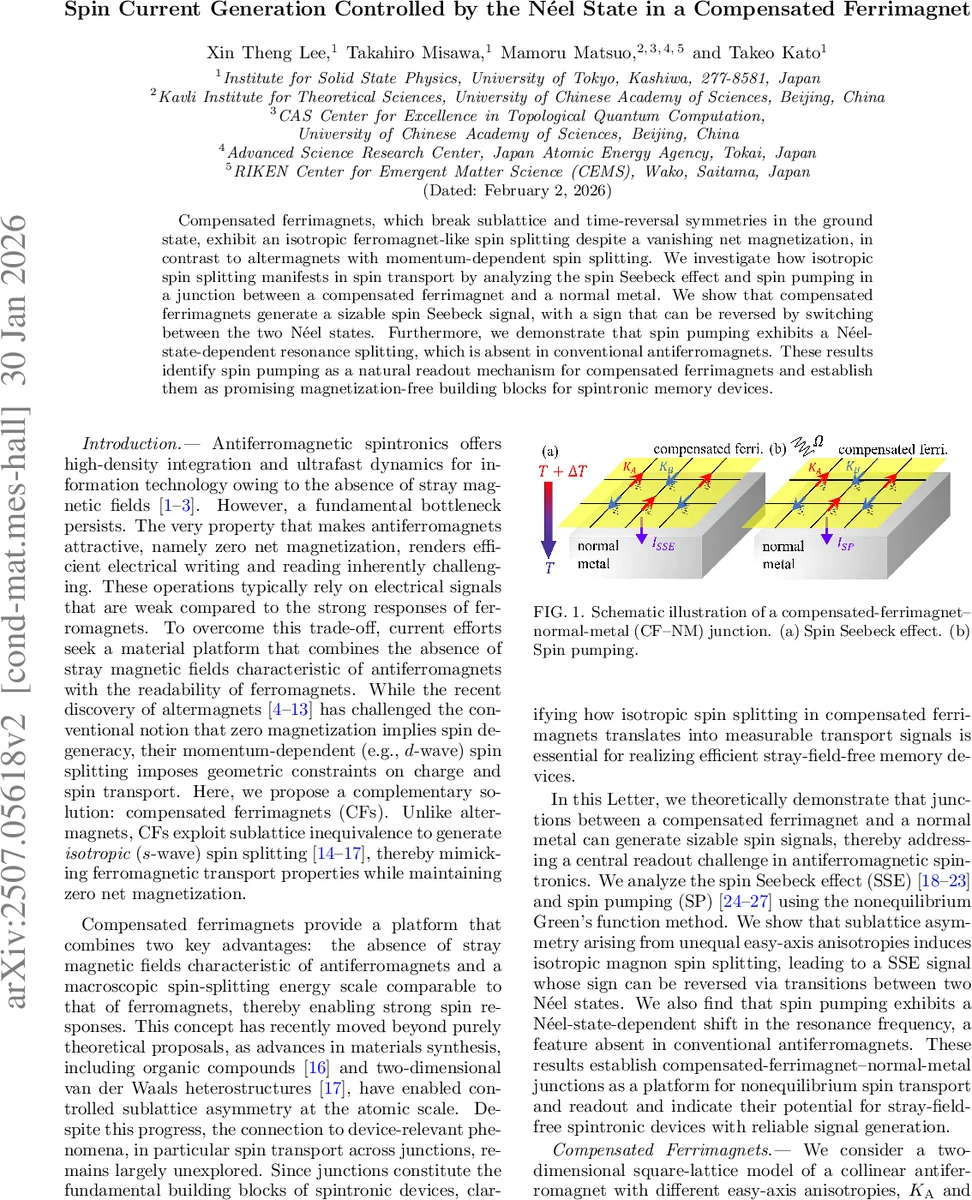
The spin Seebeck effect (SSE) across a CF–normal‑metal (NM) interface is calculated with the Keldysh nonequilibrium Green’s function formalism, treating the interfacial exchange coupling J_CF to second order. The spin current is proportional to the difference in thermal populations of the two magnon branches. When K_A = K_B the branches are symmetric and the SSE vanishes, reproducing the known result for ordinary antiferromagnets. For ΔK ≠ 0, however, the thermal imbalance generates a sizable spin current that scales roughly linearly with ΔK and varies monotonically with temperature. Crucially, the sign of the current reverses when the Néel vector is switched (m → –m), because the higher‑energy (+) mode and lower‑energy (–) mode exchange places. This provides a direct, sign‑based electrical readout of the Néel state.
Spin pumping (SP) is then examined by applying a microwave field that drives ferromagnetic resonance in the CF. The authors add a time‑dependent Zeeman term V(t) to the Hamiltonian and compute the induced nonequilibrium magnon occupation. For a circularly polarized microwave (Ω > 0) the spin current exhibits a single resonance peak at Ω = ω⁺₀, whereas for a linearly polarized field the response is the sum of the Ω and –Ω contributions, yielding two peaks at ω⁺₀ and ω⁻₀ with opposite signs. Because the two magnon modes are non‑degenerate when K_A ≠ K_B, each Néel configuration produces a distinct resonance frequency: the m = +1 state resonates at ω⁺₀, while the m = –1 state resonates at |ω⁻₀|. This Néel‑state‑dependent frequency splitting is absent in conventional antiferromagnets, where the two modes remain degenerate and cancel each other for linear polarization. Consequently, spin pumping offers a frequency‑domain, noise‑robust method to read the magnetic state without electrical contacts.
Quantitatively, the CF‑NM SSE current is about two orders of magnitude smaller than that of a ferromagnetic‑insulator–NM junction, yet its sign controllability makes it valuable for logic. The SP current reaches a maximum set by the interfacial coupling and damping (α_G ≈ 10⁻³), with peak amplitudes on the order of 10⁻⁴–10⁻³ A m⁻².
The discussion emphasizes several practical advantages. The isotropic s‑wave spin splitting removes the directional constraints that limit altermagnets, allowing polycrystalline films and complex device geometries. The ability to read the Néel vector via resonance frequency rather than amplitude reduces susceptibility to electrical noise, addressing a long‑standing bottleneck in antiferromagnetic spintronics. Potential material platforms that naturally exhibit sub‑lattice anisotropy include Heusler alloys with inequivalent magnetic sites, two‑dimensional van‑der‑Waals magnets lacking out‑of‑plane mirror symmetry, and chemically tunable organic antiferromagnets.
In summary, the paper provides a comprehensive theoretical framework showing that compensated ferrimagnets can generate robust spin currents despite zero net magnetization and can be read electrically through spin Seebeck measurements or magnetically via spin‑pumping‑induced resonance splitting. These findings position CFs as promising, magnetization‑free building blocks for future spintronic memory and logic devices.
Comments & Academic Discussion
Loading comments...
Leave a Comment